Universal science, local delivery
A companion to Chapter 18 of the book, Global Perspectives on Personalised Learning. The same ideas in several forms: film, conversation, 2 infographics, a mind map and 6 activities. Start with whichever suits you.
Chapter 18 in two minutes
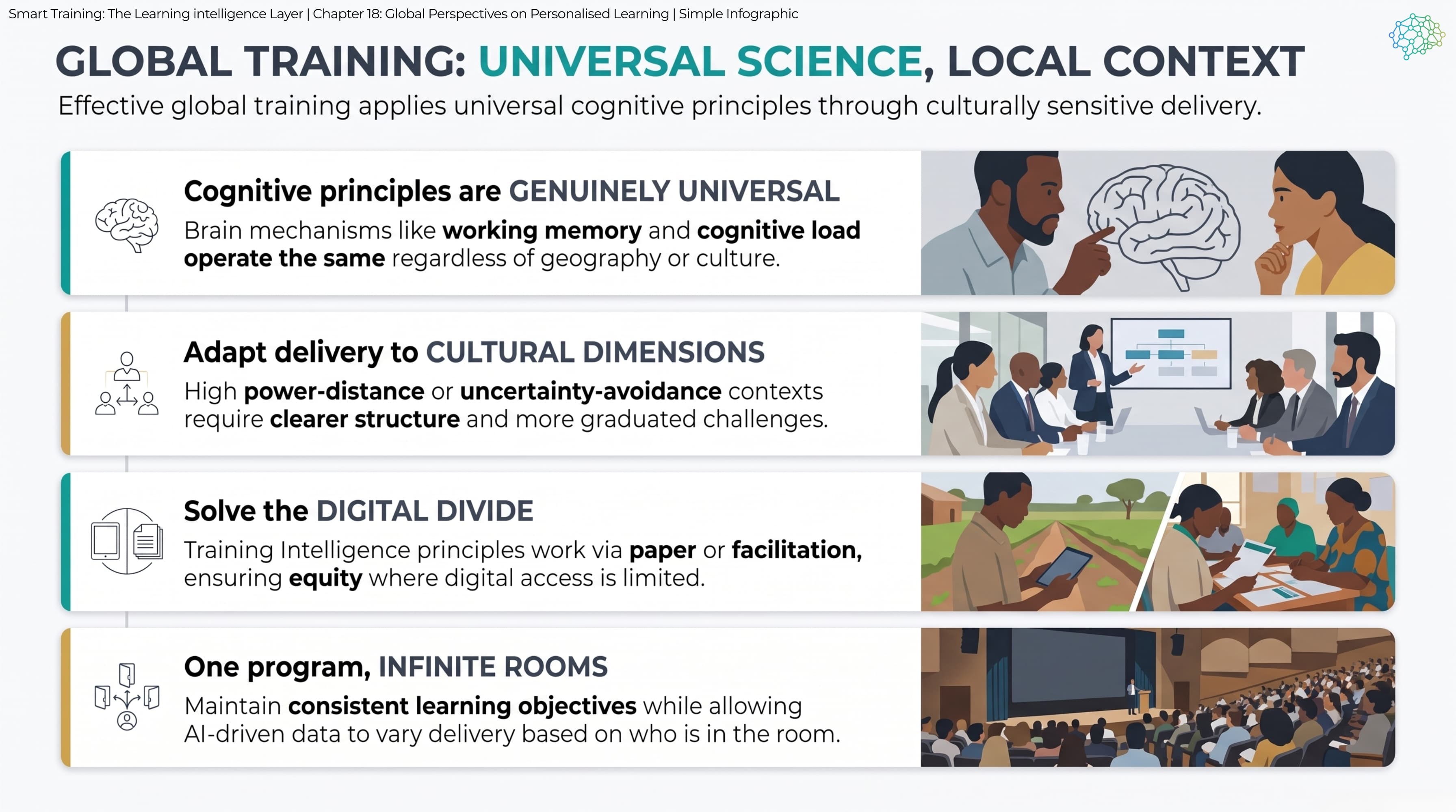
Chapter 18 starts from what holds everywhere. Working memory, cognitive load and prior knowledge work the same way regardless of nationality or geography, so learning objectives and capability standards can travel across regions unchanged.
What cannot travel unchanged is delivery. Cultural expectations, language, pace, structure, examples and facilitation style all need adapting. Drawing on Hofstede's cultural dimensions, the chapter suggests that groups with high power distance or high uncertainty avoidance often respond better to clearer structure and more graduated challenge.
The chapter also treats equity as a design question. Digital access is uneven, so the principles have to work on paper or through structured facilitation as well as on screen. For multinational programmes, the aim is localisation without fragmentation: one set of objectives, with delivery varied for the people in each room.
While the what remains fixed, the how must shift to match local needs.
Watch or listen
Prefer to take it in by eye or by ear? Both cover the core ideas of Chapter 18 in a few minutes.
Film, 2 min
How global training should adapt to culture
Why the same programme can keep its objectives across countries while changing how it is delivered in each one. Captions are built in.
Conversation, 6 min
Adapting global training for local cultures
A conversation about what stays universal in learning, what culture changes, and how to run one programme in many places without it splintering.
Chapter 18 at a glance
A quick overview, then the full argument with the evidence. Select either one to see it full size.
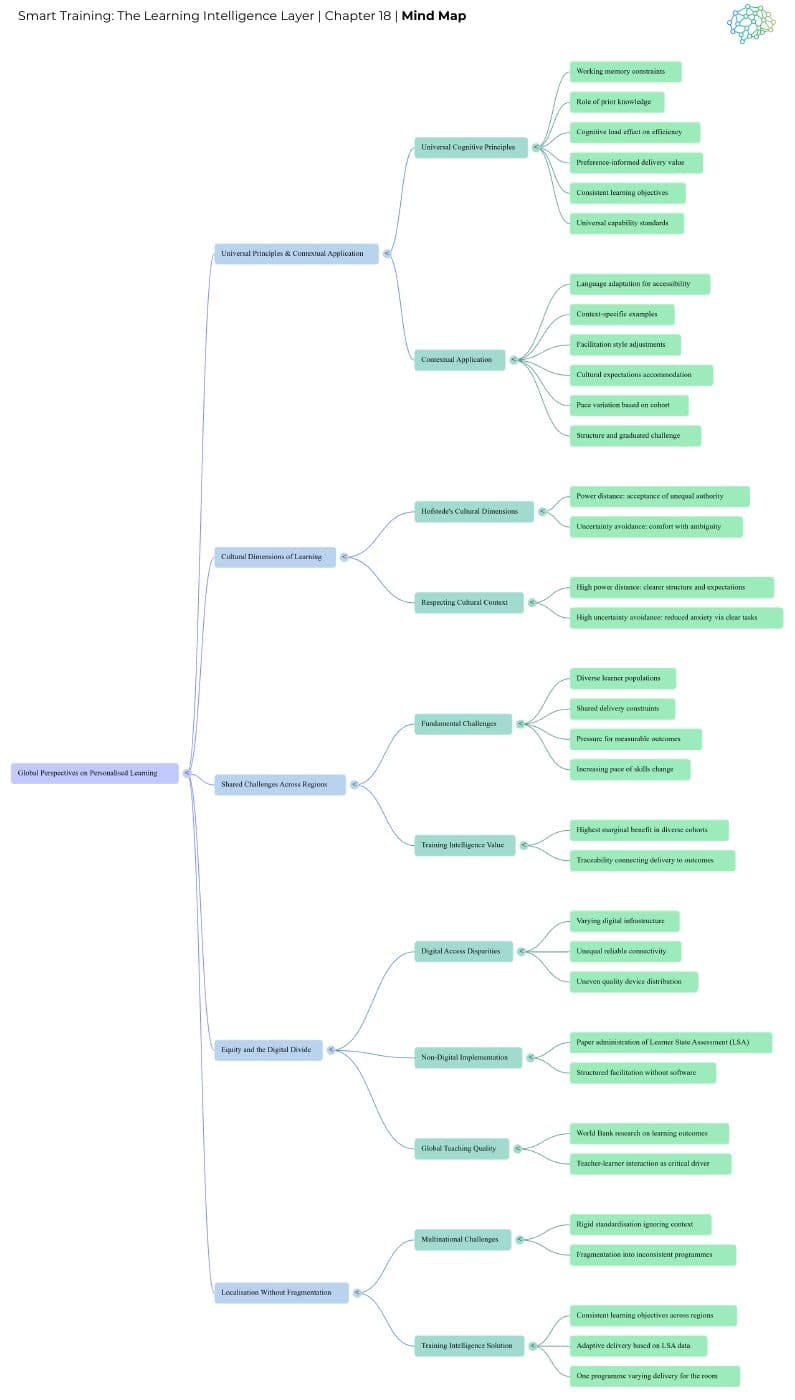
How the ideas connect
Every idea in Chapter 18 on one page. Look at it before you read to see the shape of the argument, or afterwards as a recap.
Put it into practice
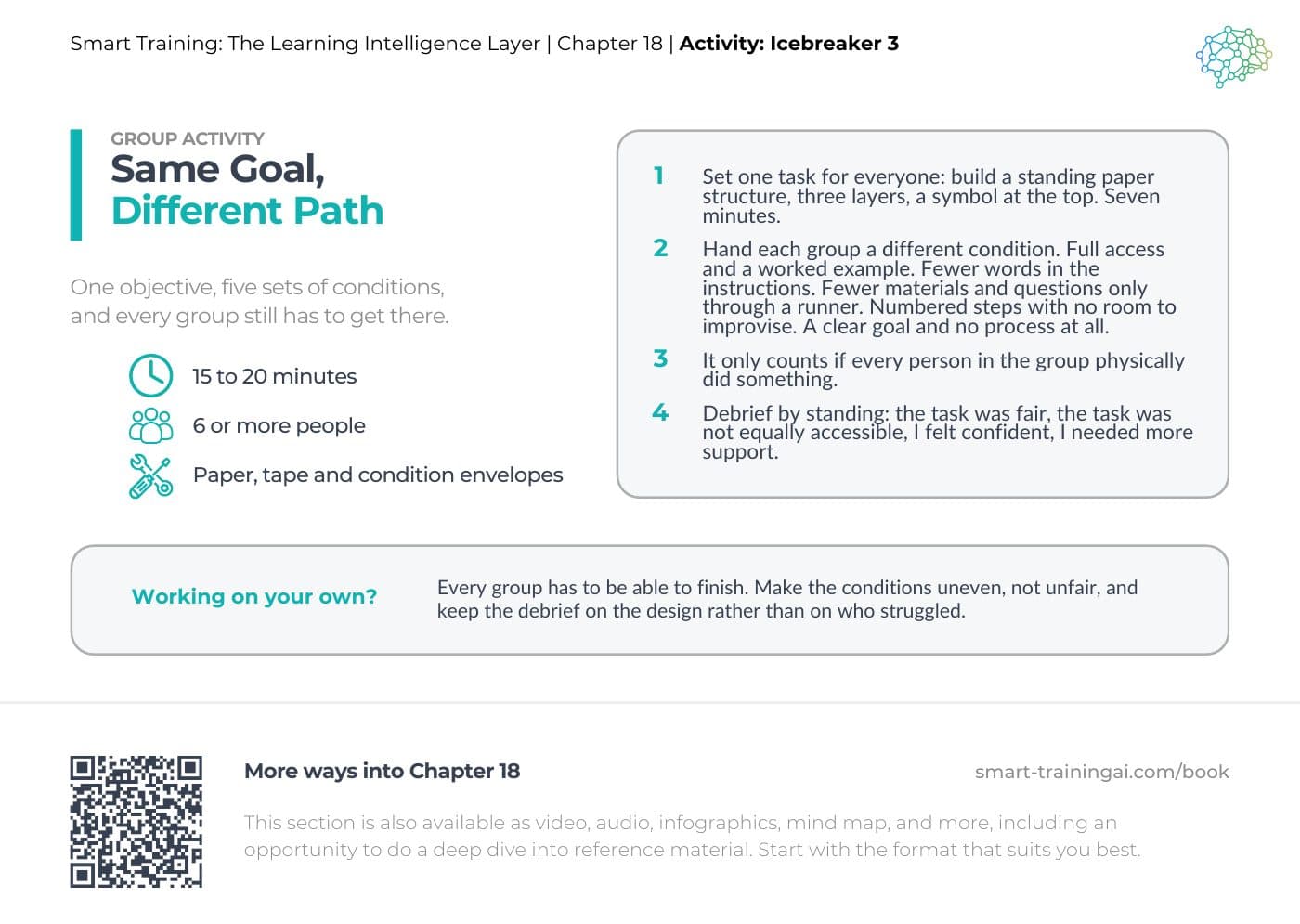
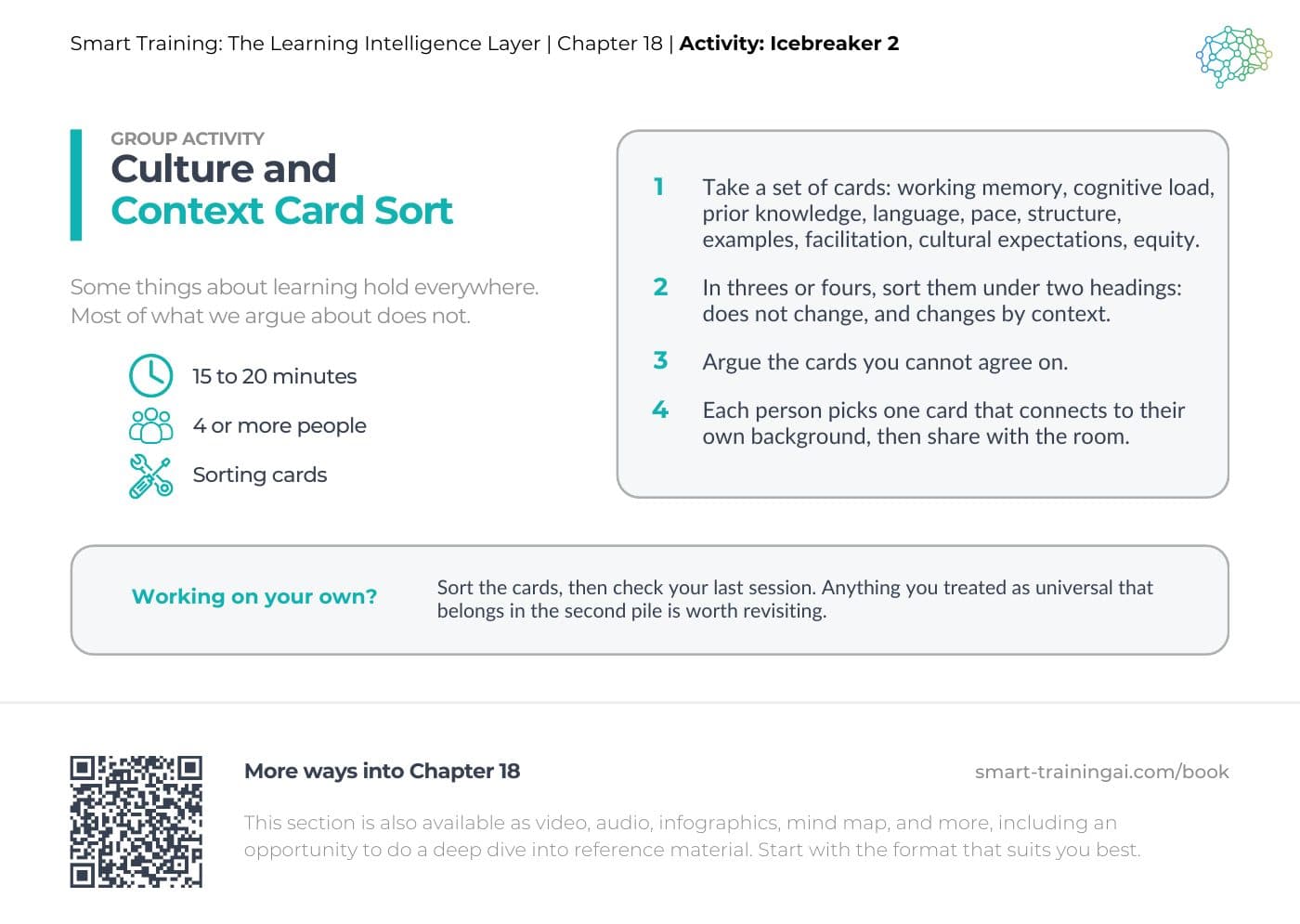
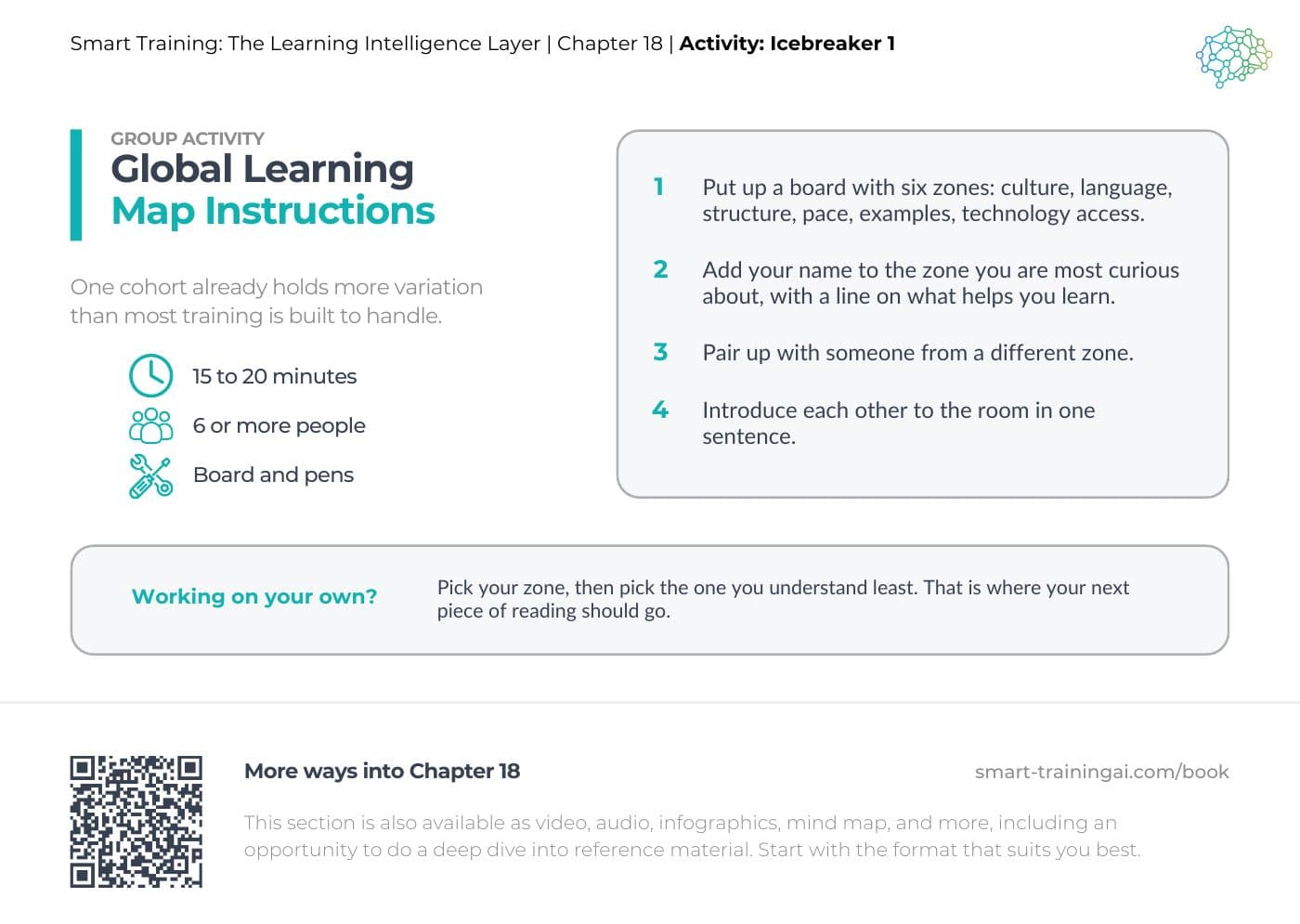
Short activities to run with a group or work through on your own. Each one has a printable card.
With a group (3)
On your own (3)
Go deeper
The research and writing behind Chapter 18.
- Hofstede, Hofstede and Minkov, McGraw-Hill (Google Books)Cultures and Organizations: Software of the MindThe source of the cultural dimensions, including power distance and uncertainty avoidance, that the chapter uses to think about delivery.
- OECDGetting Skills Right: Future-Ready Adult Learning SystemsHow adult learning systems compare across countries, and who gets left out of them.
- World BankWorld Development Report 2018: Learning to Realize Education's PromiseThe evidence on learning outcomes worldwide, and why the interaction between teacher and learner matters so much.