Glossary

A mind map and 6 activities for this section of the book, to use with a group or on your own.
How the ideas connect

Every idea in the Glossary on one page. Look at it before you read to see the shape of the argument, or afterwards as a recap.
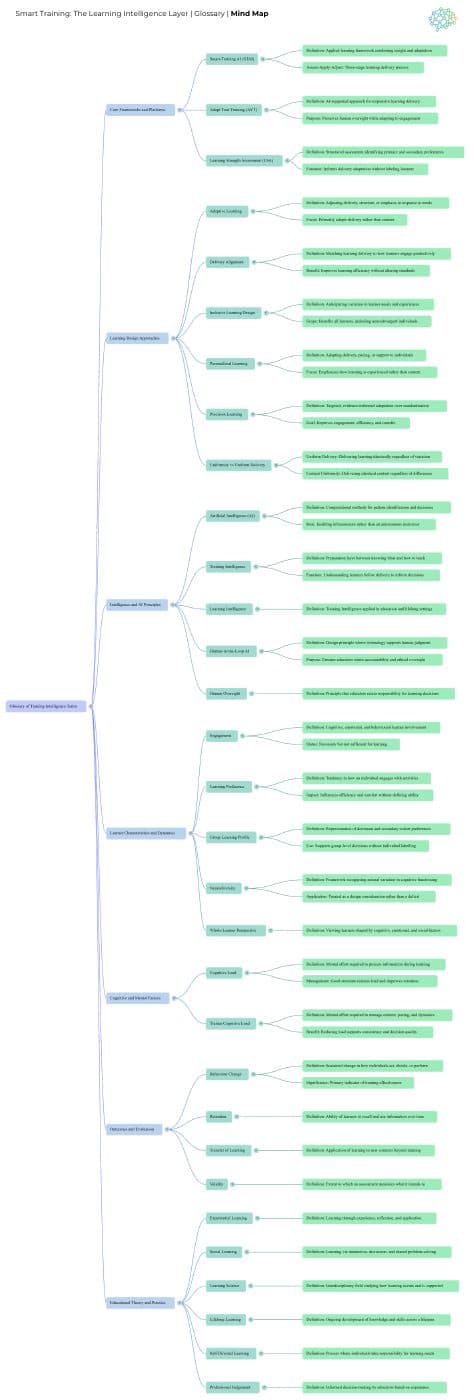
Mind map of the Glossary.

Put it into practice

Short activities to run with a group or work through on your own. Each one has a printable card.

With a group (3)

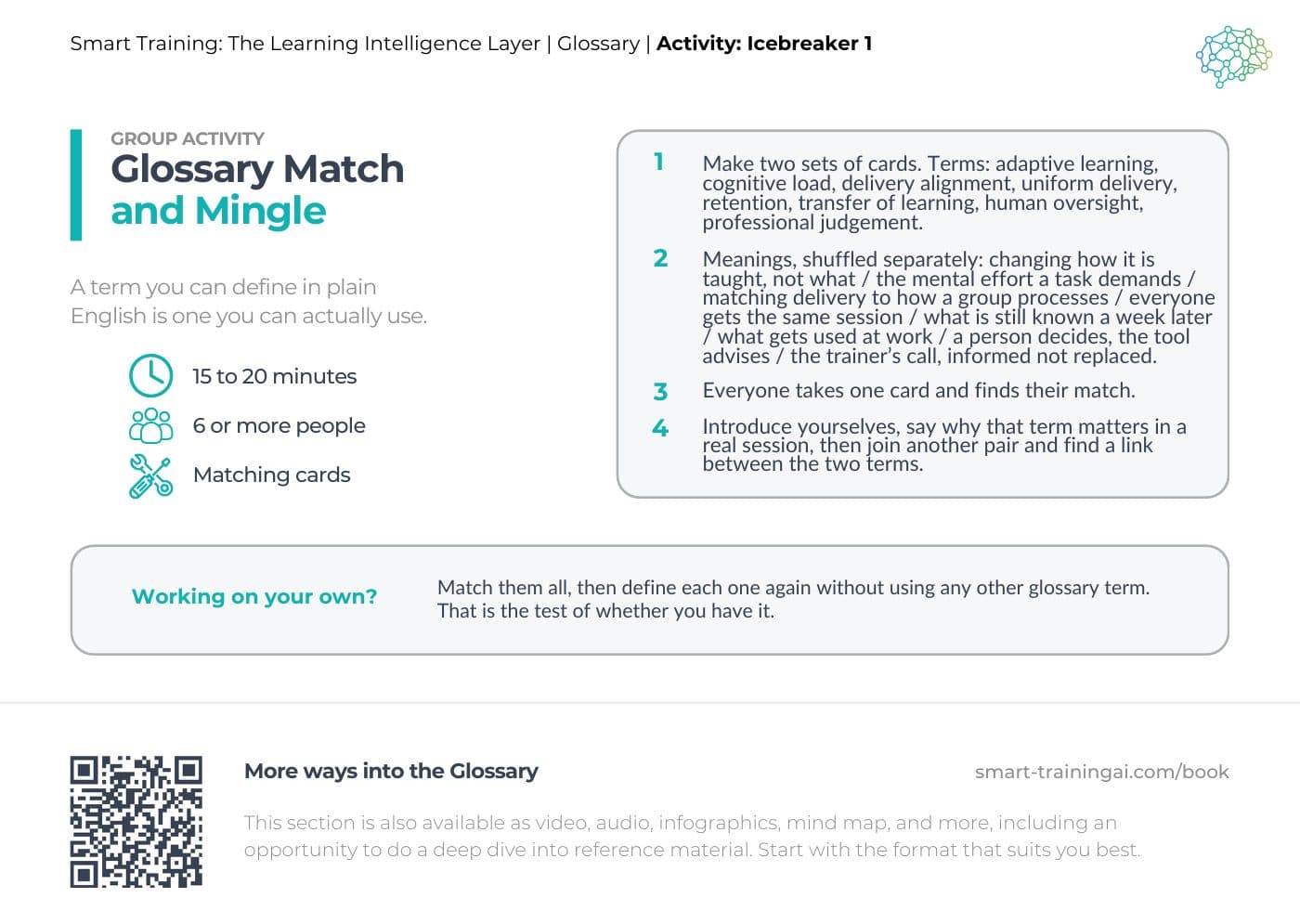
  • Printable card for Glossary Match and Mingle
    Time
    15 to 20 minutes
    Who
    6 or more people
    You will need
    Matching cards

    Icebreaker

    Glossary Match and Mingle

    A term you can define in plain English is one you can actually use.

    1. Make two sets of cards. Terms: adaptive learning, cognitive load, delivery alignment, uniform delivery, retention, transfer of learning, human oversight, professional judgement.
    2. Meanings, shuffled separately: changing how it is taught, not what / the mental effort a task demands / matching delivery to how a group processes / everyone gets the same session / what is still known a week later / what gets used at work / a person decides, the tool advises / the trainer’s call, informed not replaced.
    3. Everyone takes one card and finds their match.
    4. Introduce yourselves, say why that term matters in a real session, then join another pair and find a link between the two terms.

    Working on your own? Match them all, then define each one again without using any other glossary term. That is the test of whether you have it.

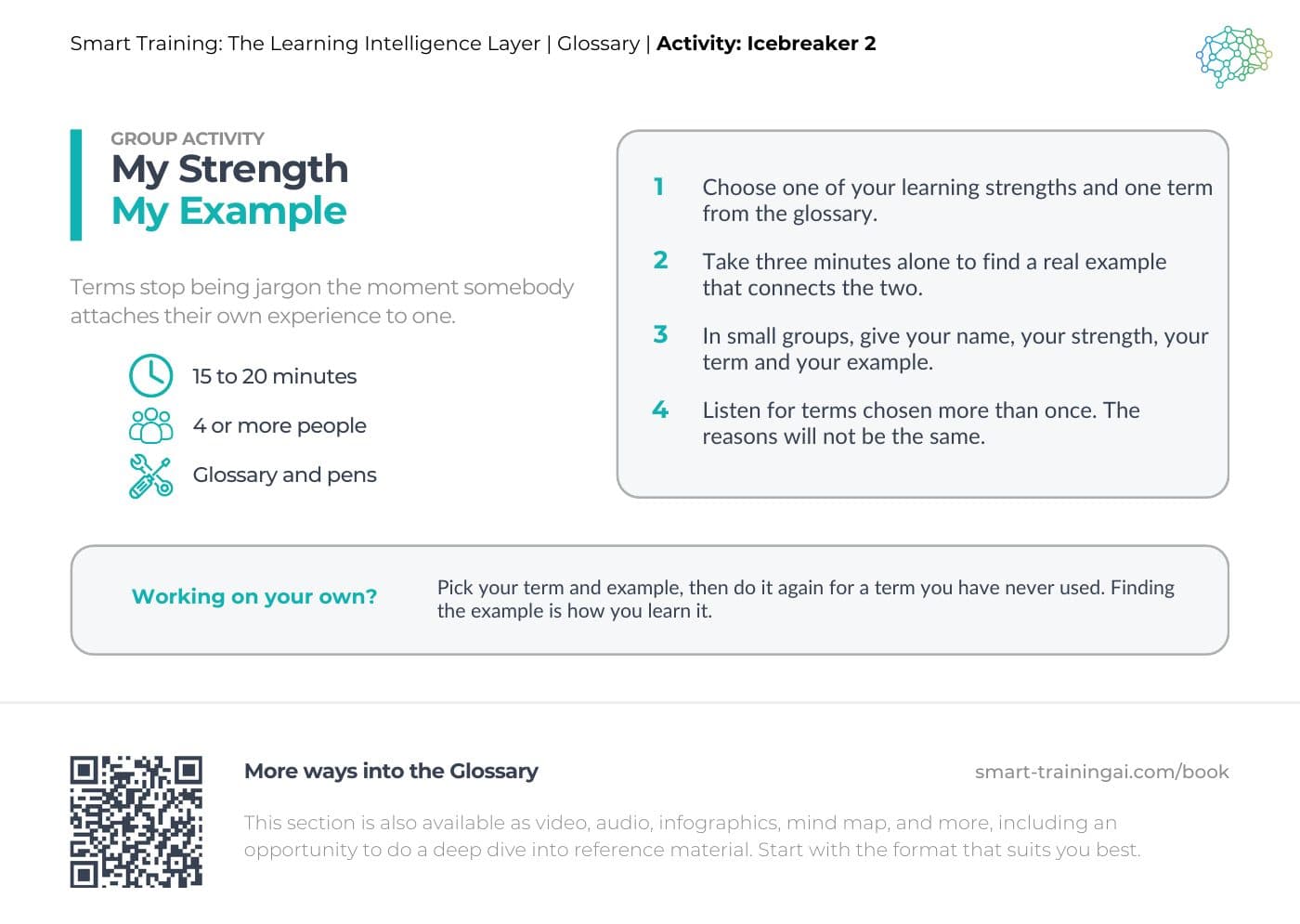
  • Printable card for My Strength My Example
    Time
    15 to 20 minutes
    Who
    4 or more people
    You will need
    Glossary and pens

    Icebreaker

    My Strength My Example

    Terms stop being jargon the moment somebody attaches their own experience to one.

    1. Choose one of your learning strengths and one term from the glossary.
    2. Take three minutes alone to find a real example that connects the two.
    3. In small groups, give your name, your strength, your term and your example.
    4. Listen for terms chosen more than once. The reasons will not be the same.

    Working on your own? Pick your term and example, then do it again for a term you have never used. Finding the example is how you learn it.

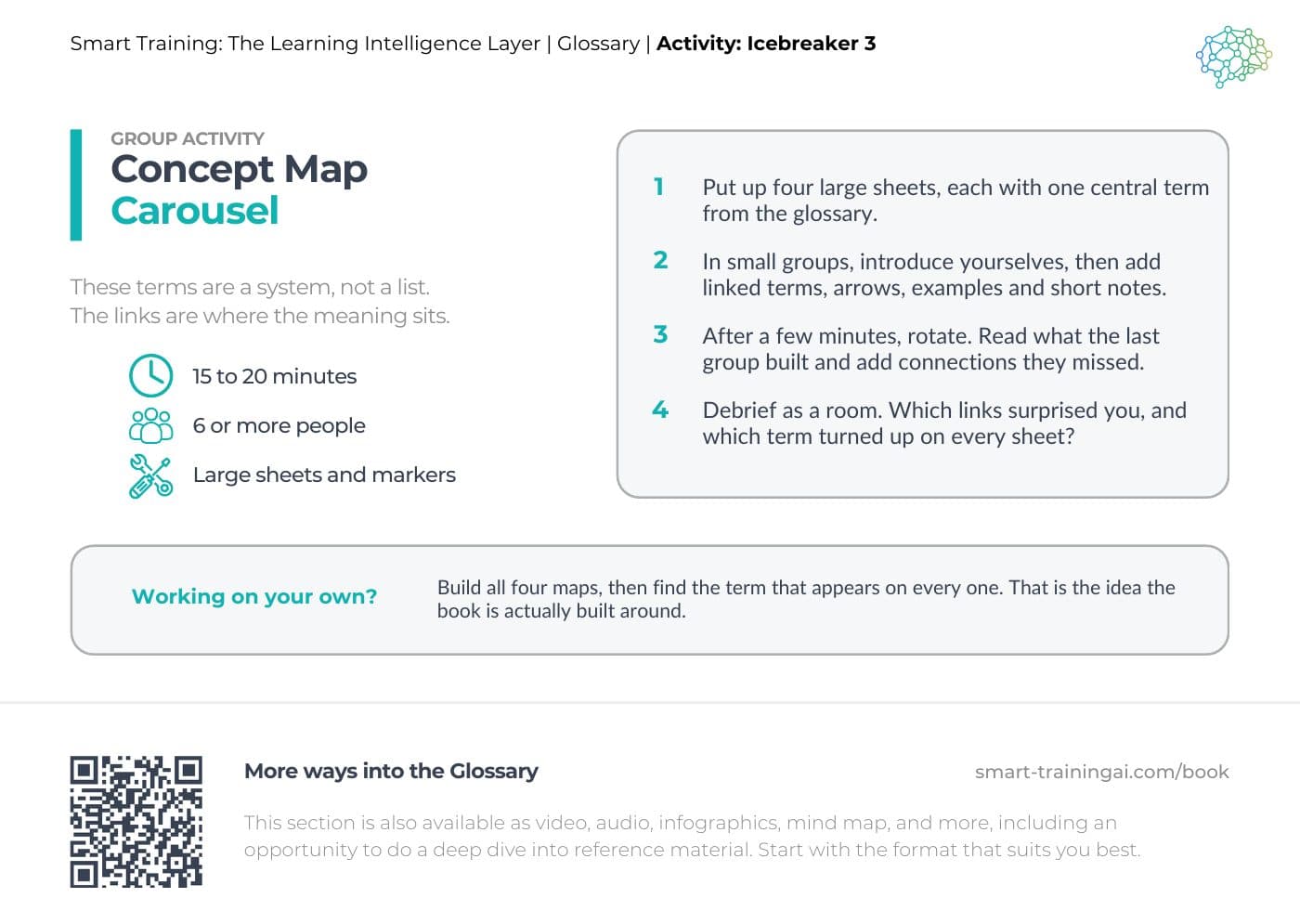
  • Printable card for Concept Map Carousel
    Time
    15 to 20 minutes
    Who
    6 or more people
    You will need
    Large sheets and markers

    Icebreaker

    Concept Map Carousel

    These terms are a system, not a list. The links are where the meaning sits.

    1. Put up four large sheets, each with one central term from the glossary.
    2. In small groups, introduce yourselves, then add linked terms, arrows, examples and short notes.
    3. After a few minutes, rotate. Read what the last group built and add connections they missed.
    4. Debrief as a room. Which links surprised you, and which term turned up on every sheet?

    Working on your own? Build all four maps, then find the term that appears on every one. That is the idea the book is actually built around.

On your own (3)

  • Printable card for Define, Distinguish Apply
    Time
    20 to 30 minutes
    Who
    On your own
    You will need
    Notebook or journal and pen

    Journaling

    Define, Distinguish Apply

    You only own a term once you can separate it from the one next to it.

    1. Pick six terms. For each, write your own definition and one line on why it matters.
    2. Separate the close pairs: adaptive and personalised, engagement and retention, retention and transfer.
    3. Name the two you thought meant the same thing, and the distinction you see now.
    4. Finish: if I were designing a session using this glossary, I would adapt the delivery by.dle that.

    Working with a group? Write first, then compare definitions for one term only. Six versions of the same word in plain English is the fastest way to fix it.

  • Printable card for Name the Problem, Then Fix it
    Time
    25 to 35 minutes
    Who
    On your own
    You will need
    Paper and pen

    Problem solving

    Name the Problem, Then Fix it

    Same deck every time, fast and full, and the AI suggestions followed without question.

    1. Put the right term to each fault: the sameness, the overload, the weak recall, the lack of use afterwards.
    2. Say how delivery alignment could improve without touching the content.
    3. Explain what human oversight should look like when a tool is making suggestions.
    4. Pick the three terms that matter most here, and name one practical action for each.

    Working with a group? Compare your three priority terms. Which fault people name first says a lot about what they notice in their own sessions.

  • Printable card for Terms That Get Confused
    Time
    30 to 40 minutes
    Who
    On your own
    You will need
    Paper and pen

    Worksheet

    Terms That Get Confused

    Two words that sound alike will send a trainer in two different directions.

    1. Read Approach A. Uniform delivery, content uniformity, engagement, completion. These are the easy terms. They describe what a session looked like and whether people turned up and seemed interested, which is why they get used as proof that it worked.
    2. Read Approach B. Delivery alignment, retention, transfer of learning, professional judgement, human oversight. These describe what changed afterwards and who decided. Harder to observe, slower to collect, and much closer to whether anything was actually learned.
    3. Compare them: what each set measures, and when; how easily each is observed in the room; what each one would have a trainer do next; which set survives being asked for evidence.
    4. Critique both. Why are these terms so widely used? Which decision do they quietly justify? What do they reveal that the first set cannot? What makes them hard to put into practice?
    5. Make a judgement. Rewrite these so they match the glossary: giving everyone the same delivery is fair; learners looked interested so it worked; if AI recommends a change, follow it. Finish the sentence: The distinction in this glossary that matters most is…
Smart Training AI logo

Empowering trainers to boost engagement and results through targeted, adaptive learning

© 2025 Smart Training AI™ All rights reserved.