Learning science meets practice

A companion to the About the Authors section of the book. The same ideas in several forms: film, 2 infographics, a mind map and 6 activities. Start with whichever suits you.

The About the Authors section in two minutes

The book brings together two perspectives. Tim Dingle has more than 46 years across education, leadership, training and applied AI, including time as Head of Biology and deputy head at Mill Hill School and as Headmaster of the Royal Grammar School High Wycombe from 1999 to 2006.

Tony Walmsley is a senior leadership practitioner and learning specialist. He works with professional services firms, financial institutions and multinational organisations, translating learning concepts into practical behaviours for experienced, senior groups, with a focus on adaptability, behavioural change and sustained performance.

From different starting points they reached the same view: there is a gap between what is delivered and what is received, and treating learners as a uniform group carries a real cost. Their shared conviction is that learning should be designed around the learner's cognitive reality, not the other way round.

Learning improves when designed for the learner's cognitive reality, rather than forcing learners to adapt to rigid systems.

Watch or listen

Prefer to take it in by eye or by ear? Both cover the core ideas of the About the Authors section in a few minutes.

Film, 1 min

Why traditional training fails the learner

The experience behind the book, and why both authors came to see training failures as a problem of design. Captions are built in.

The About the Authors section at a glance

A quick overview, then the full argument with the evidence. Select either one to see it full size.

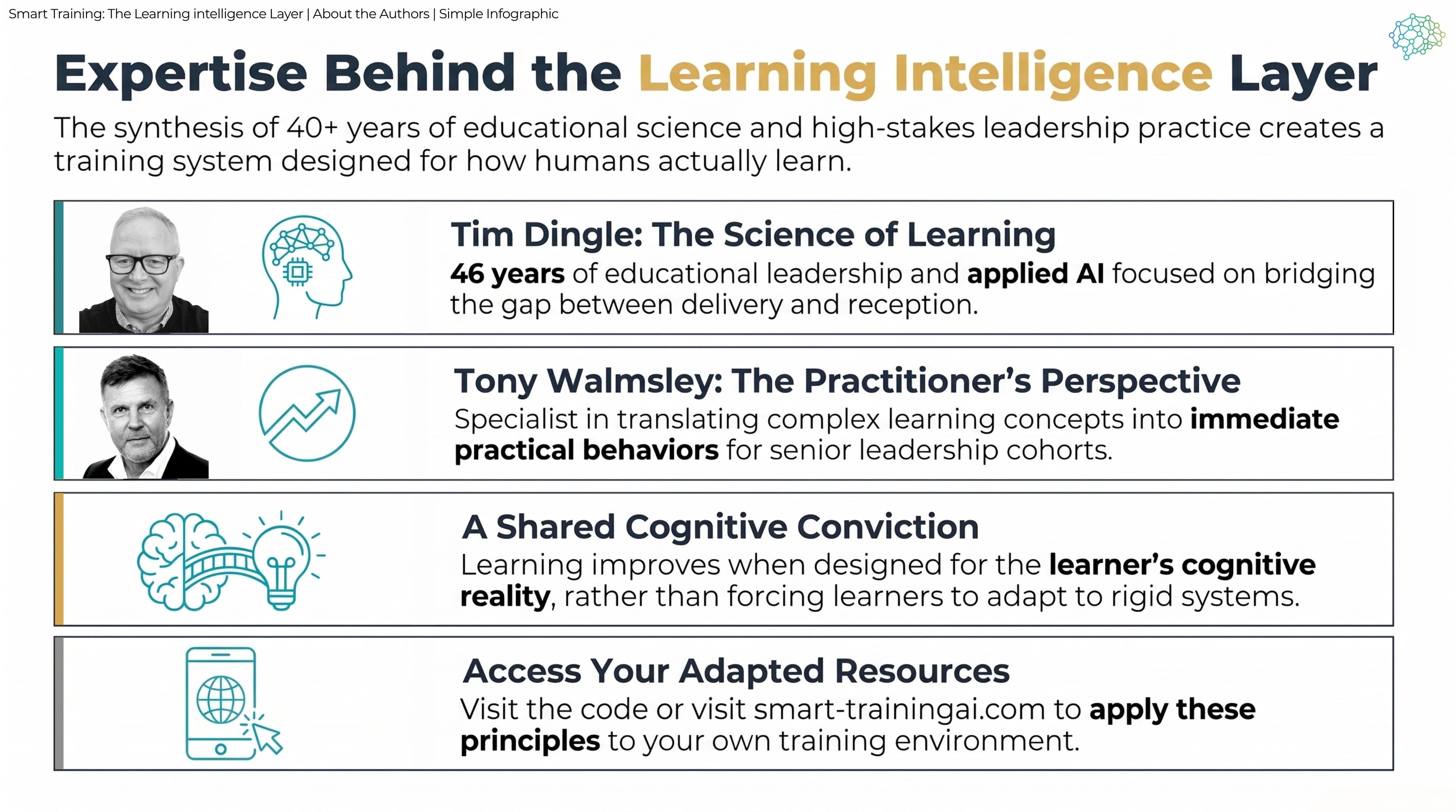
Expertise Behind the Learning Intelligence Layer
Four-panel infographic: Tim Dingle and the science of learning, with 46 years of educational leadership and applied AI; Tony Walmsley and the practitioner's perspective, translating learning concepts into practical behaviours for senior leadership groups; a shared conviction that learning should be designed for the learner's cognitive reality; and a pointer to adapted resources at smart-trainingai.com.
Bridging the Gap: The Experts Behind Smart-Training
Detailed infographic: portraits of Tim Dingle, the science of learning, and Tony Walmsley, the practice of performance; merging theory with real-world organisational complexity; designing for the learner's cognitive reality; and prioritising relevance and engagement over content volume.

How the ideas connect

Every idea in the About the Authors section on one page. Look at it before you read to see the shape of the argument, or afterwards as a recap.
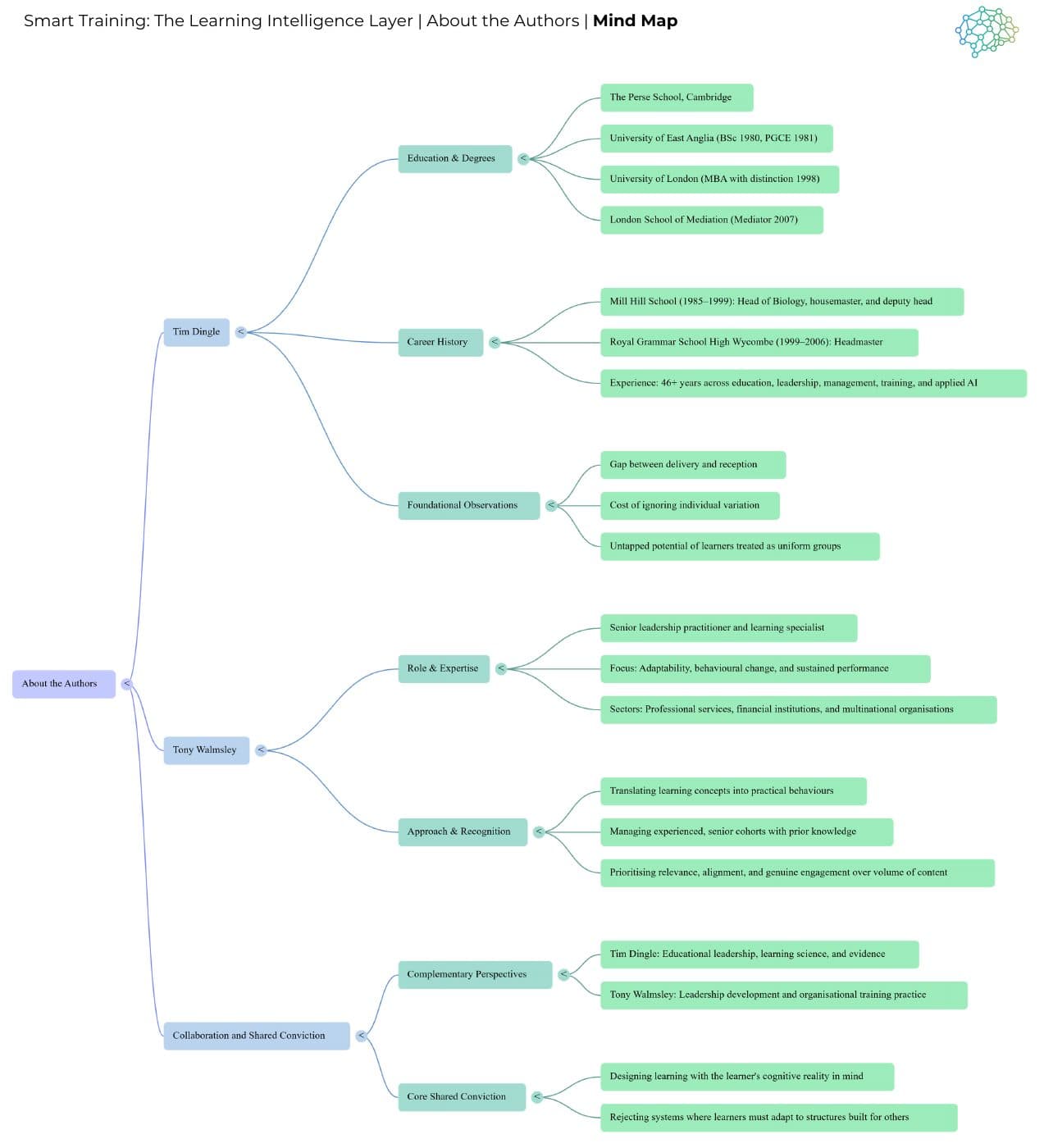
Mind map of the About the Authors section.

Put it into practice

Short activities to run with a group or work through on your own. Each one has a printable card.

With a group (3)

  • Printable card for The Human Learning Gallery
    Time
    10 to 15 minutes
    Who
    6 or more people
    You will need
    Flipchart paper and markers

    Icebreaker

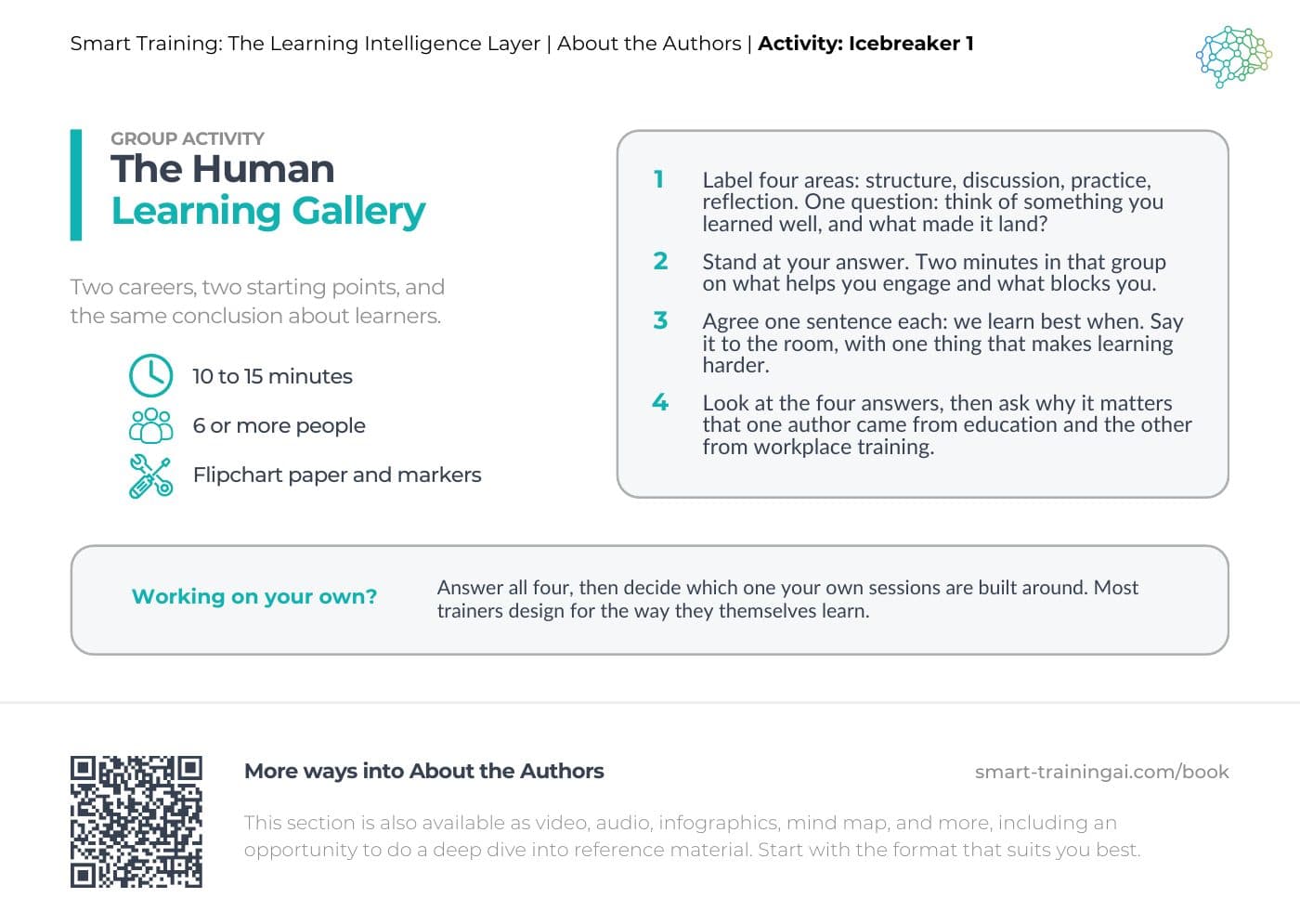
    The Human Learning Gallery

    Two careers, two starting points, and the same conclusion about learners.

    1. Label four areas: structure, discussion, practice, reflection. One question: think of something you learned well, and what made it land?
    2. Stand at your answer. Two minutes in that group on what helps you engage and what blocks you.
    3. Agree one sentence each: we learn best when. Say it to the room, with one thing that makes learning harder.
    4. Look at the four answers, then ask why it matters that one author came from education and the other from workplace training.

    Working on your own? Answer all four, then decide which one your own sessions are built around. Most trainers design for the way they themselves learn.

  • Printable card for Evidence Before Identity
    Time
    10 to 15 minutes
    Who
    4 or more people
    You will need
    Clue cards and pens

    Icebreaker

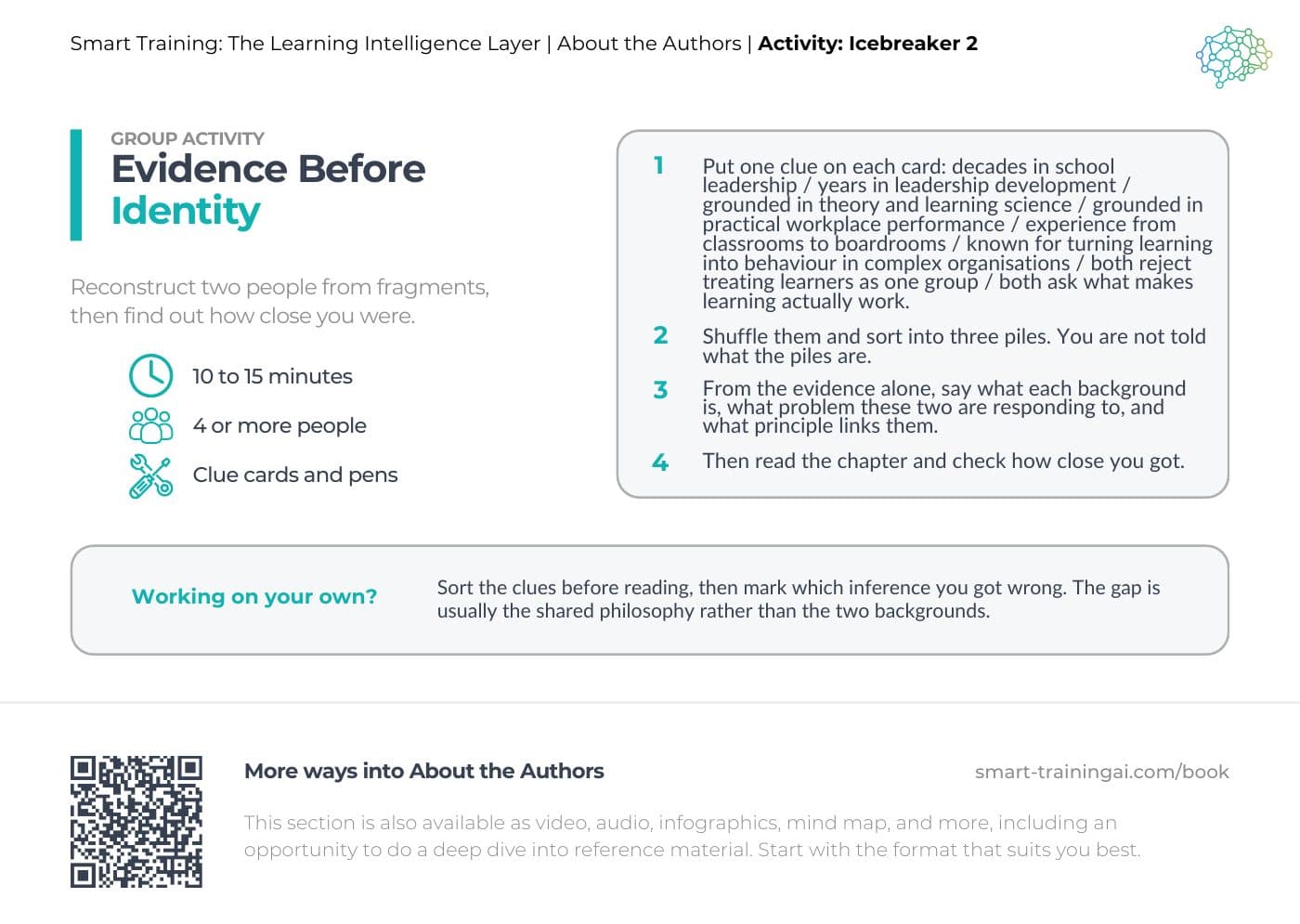
    Evidence Before Identity

    Reconstruct two people from fragments, then find out how close you were.

    1. Put one clue on each card: decades in school leadership / years in leadership development / grounded in theory and learning science / grounded in practical workplace performance / experience from classrooms to boardrooms / known for turning learning into behaviour in complex organisations / both reject treating learners as one group / both ask what makes learning actually work.
    2. Shuffle them and sort into three piles. You are not told what the piles are.
    3. From the evidence alone, say what each background is, what problem these two are responding to, and what principle links them.
    4. Then read the chapter and check how close you got.

    Working on your own? Sort the clues before reading, then mark which inference you got wrong. The gap is usually the shared philosophy rather than the two backgrounds.

  • Printable card for Fix the Failed Session
    Time
    10 to 15 minutes
    Who
    4 or more people
    You will need
    Paper and pens

    Icebreaker

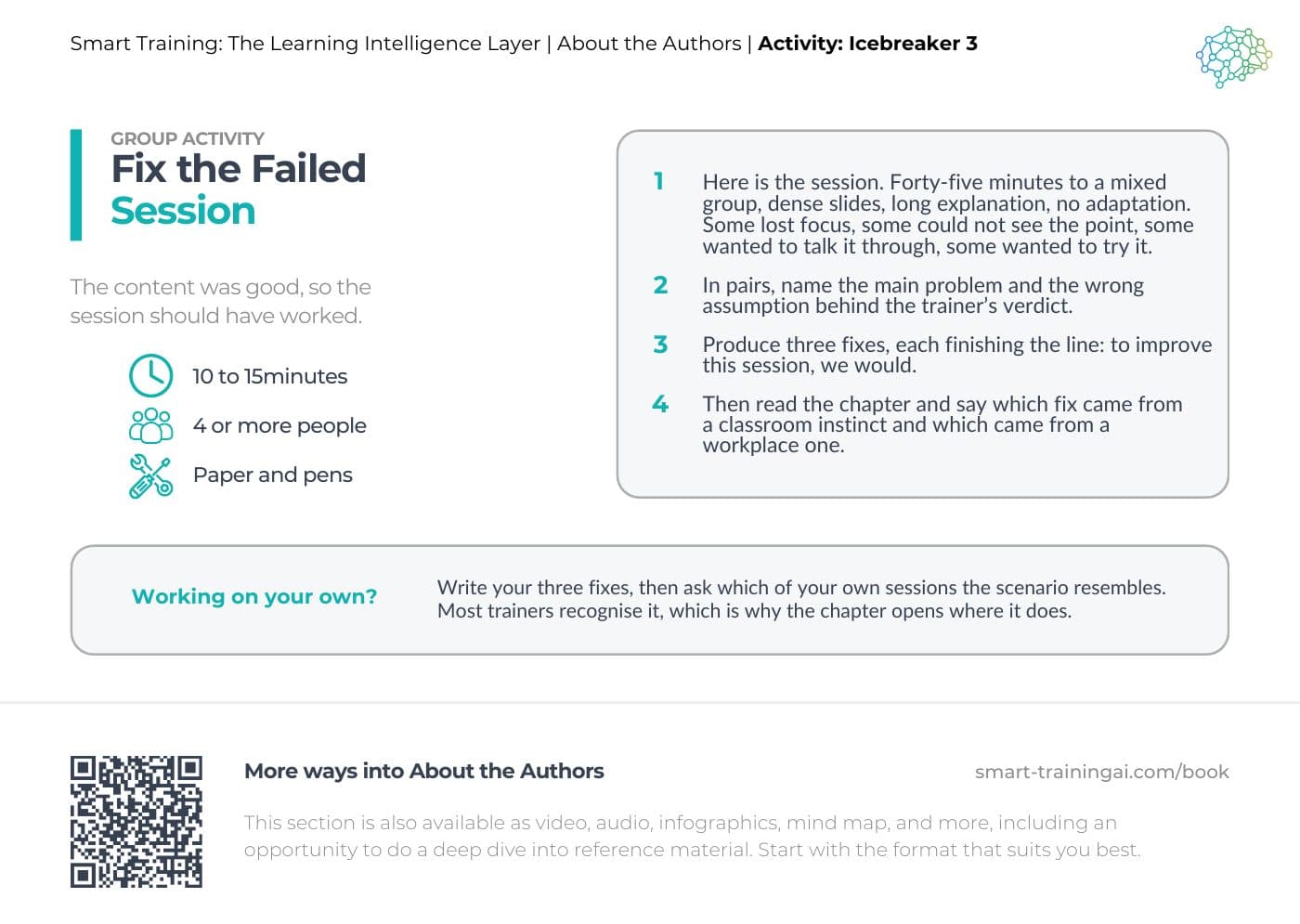
    Fix the Failed Session

    The content was good, so the session should have worked.

    1. Here is the session. Forty-five minutes to a mixed group, dense slides, long explanation, no adaptation. Some lost focus, some could not see the point, some wanted to talk it through, some wanted to try it.
    2. In pairs, name the main problem and the wrong assumption behind the trainer’s verdict.
    3. Produce three fixes, each finishing the line: to improve this session, we would.
    4. Then read the chapter and say which fix came from a classroom instinct and which came from a workplace one.

    Working on your own? Write your three fixes, then ask which of your own sessions the scenario resembles. Most trainers recognise it, which is why the chapter opens where it does.

On your own (3)

  • Printable card for Why These Authors, Why This Book
    Time
    15 to 20 minutes
    Who
    On your own
    You will need
    Notebook or journal and pen

    Journaling

    Why These Authors, Why This Book

    A biography placed before the argument is doing work. Find out what.

    1. Write what each author contributes that the other cannot, using details from the chapter rather than impressions.
    2. Name the shared conviction underneath both careers, in one sentence.
    3. Answer the real question: why open a book like this with who the authors are, instead of with the argument itself?
    4. Finish on the belief they share. What does designing for the learner’s cognitive reality mean to you, as someone who has been taught badly at least once?

    Working with a group? Compare only the one-sentence version of the shared conviction. Twelve attempts at it will expose whether the chapter actually makes its case.

  • Printable card for Why These Two Authors
    Time
    20 to 30 minutes
    Who
    On your own
    You will need
    Paper and pen

    Problem solving

    Why These Two Authors

    A publisher asks why readers should trust this book. Answer from the chapter.

    1. List what each author brings: the settings they worked in, what they would have seen go wrong, and the kind of authority that gives them.
    2. Say what would have been strong but incomplete if either had written it alone.
    3. Take a trainer who says the material was clear, so disengagement is the learners’ problem. Why would both authors reject that, and for different reasons?
    4. Write the recommendation. Why does this section strengthen the book before the argument starts?

    Working with a group? Split the room in two, one author each, and have both sides answer the trainer’s claim. The two rejections should not sound the same.

  • Printable card for Credibility or Evidence
    Time
    30 to 40 minutes
    Who
    On your own
    You will need
    Paper and pen

    Worksheet

    Credibility or Evidence

    Experience makes a case worth hearing. It does not make it correct.

    1. Read Approach A. Tim Dingle brings education, school leadership and learning science, and decades of watching learning succeed and fail in formal settings. The authority is long observation and research. It establishes why something should work and under what conditions it does not.
    2. Read Approach B. Tony Walmsley brings leadership development and organisational training, where learning has to turn into behaviour against real deadlines and competing priorities. The authority is applied. It establishes what survives contact with an actual workplace.
    3. Compare them: what each one is in a position to claim; what kind of credibility each brings; where their experience genuinely overlaps; what each would notice first in a failing session.
    4. Critique both. What does research-grounded authority settle? Where does long observation stop being proof? What does applied experience demonstrate that research cannot? When is practice just a longer habit?
    5. Make a judgement. A strong author biography does not prove a training philosophy is correct. Say how far that holds, what this section does prove, and what it only implies. Finish the sentence: After reading this, what I would still want evidence for is…
Smart Training AI logo

Empowering trainers to boost engagement and results through targeted, adaptive learning

© 2025 Smart Training AI™ All rights reserved.