Four theories, one room
A companion to Chapter 10 of the book, Bridging Historical Learning Theories. The same ideas in several forms: film, conversation, 2 infographics, a mind map and 6 activities. Start with whichever suits you.


Chapter 10 in two minutes
Behaviourism, cognitive theory, constructivism and experiential learning each grew up correcting the one before. In practice they were split up: corporate trainers leaned on behaviourism, university lecturers on constructivism. Chapter 10 argues that treating them as rivals leaves learning incomplete, because no single framework captures the whole learner.
The theories describe parts of the same process. Practice and reinforcement build habits and skills. Attention to memory and load structures understanding. Meaning is made with others, and action followed by reflection turns experience into learning. The problem is not a shortage of theory but knowing which one to draw on, and when.
Doing that live, for every person in the room, is an impossible load for a trainer. The chapter proposes learner preferences as the bridge: knowing before the session how a group prefers to engage, so delivery can move between practice, structured explanation, collaborative tasks and reflection as the group needs.
The gap is not a shortage of theory. It is knowing which one, and when.
Watch or listen
Prefer to take it in by eye or by ear? Both cover the core ideas of Chapter 10 in a few minutes.
Film, 1 min
How learning preference bridges training
How knowing a group's preferences lets a trainer draw on the right theory at the right moment, rather than committing to one. Captions are built in.
Conversation, 6 min
How to combine four learning theories
A conversation about why the major learning theories were treated as competitors, what they share, and how one session can use all four.
Chapter 10 at a glance
A quick overview, then the full argument with the evidence. Select either one to see it full size.
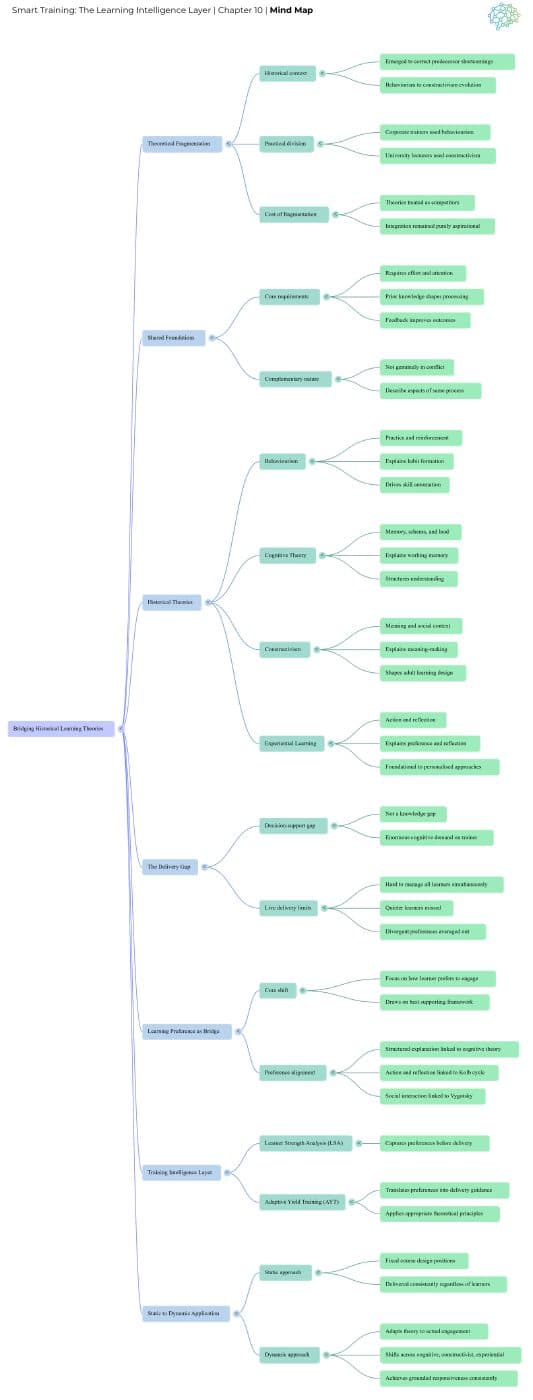
How the ideas connect
Every idea in Chapter 10 on one page. Look at it before you read to see the shape of the argument, or afterwards as a recap.
Put it into practice
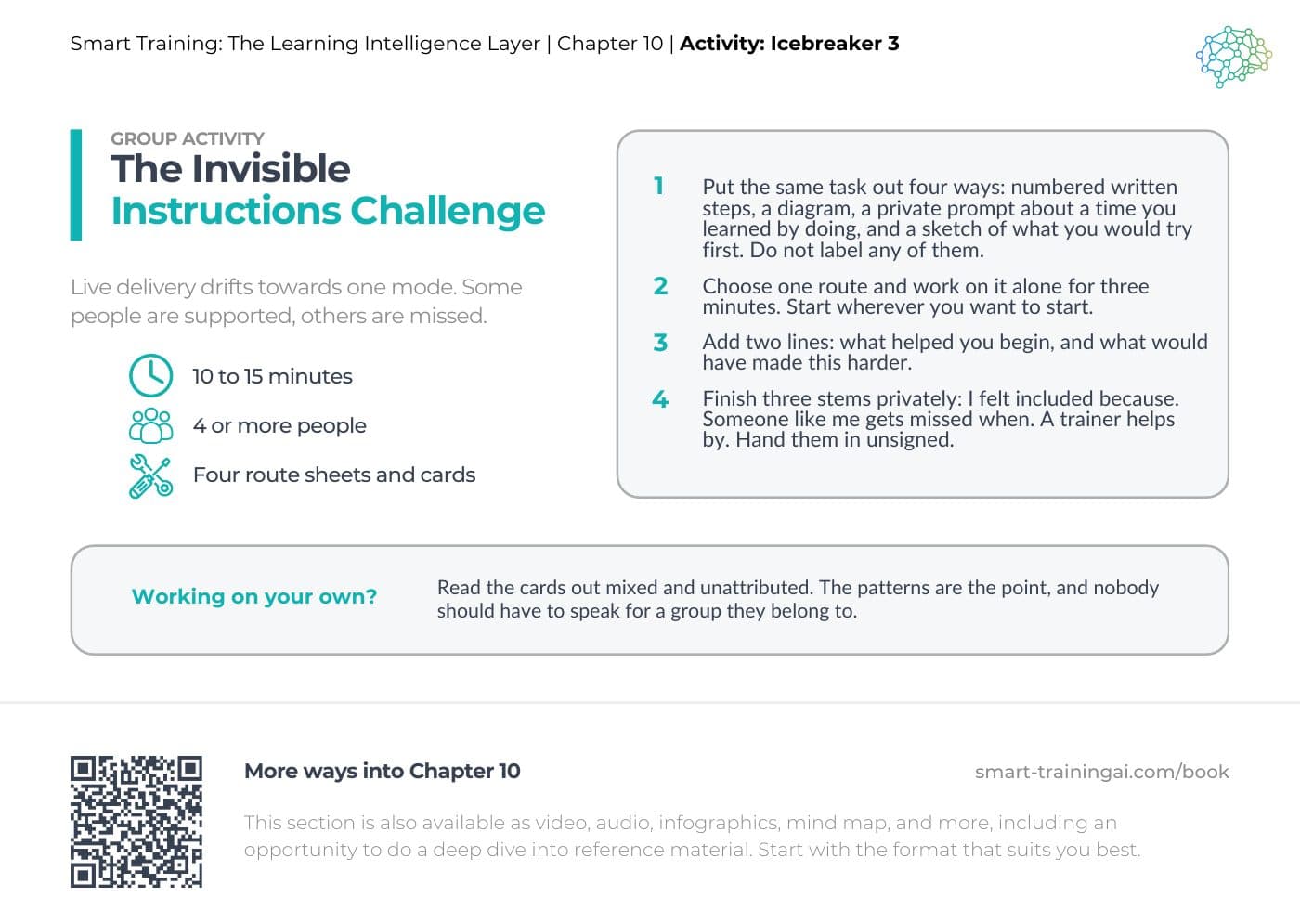
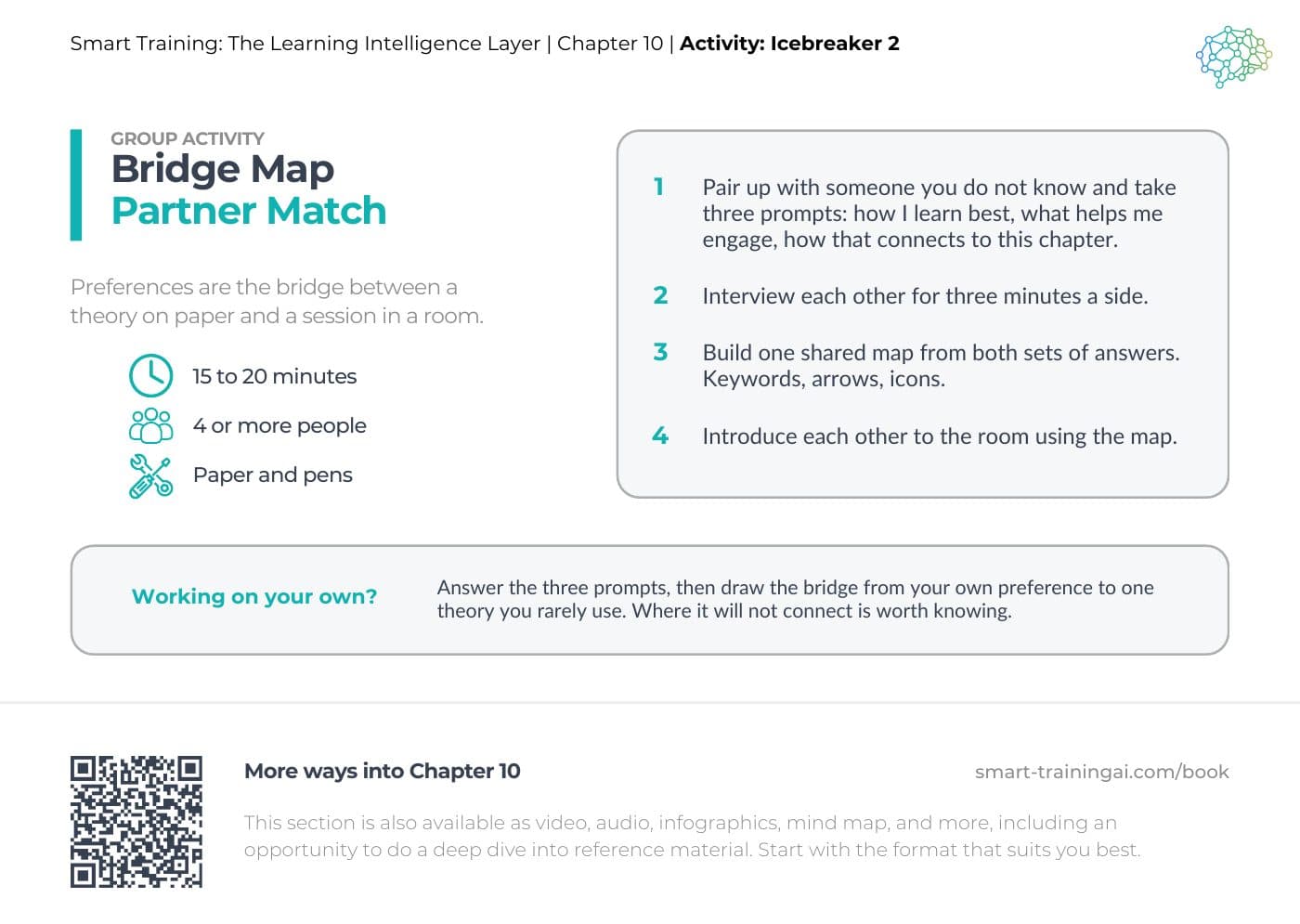
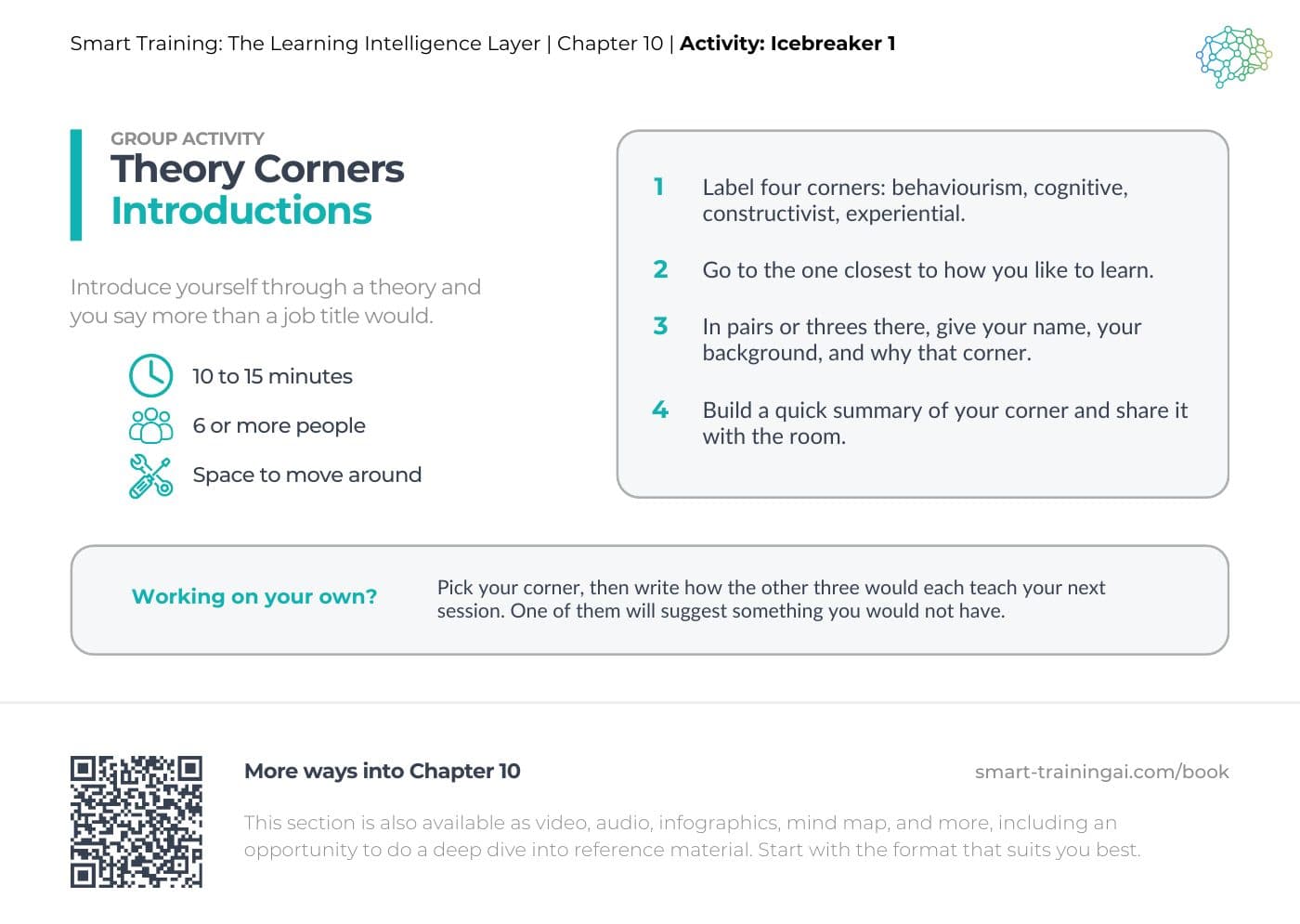
Short activities to run with a group or work through on your own. Each one has a printable card.
With a group (3)
On your own (3)
Go deeper
The research and writing behind Chapter 10.
- B. F. Skinner, B. F. Skinner FoundationScience and Human BehaviorThe behaviourist case for practice and reinforcement, the first of the chapter's four theories.
- Sweller, Ayres and Kalyuga, SpringerCognitive Load TheoryThe cognitive account of memory and load, and why structure helps people take in new ideas.
- Lev Vygotsky, Harvard University PressMind in SocietyThe social side of learning, behind the chapter's case for discussion and group work.
- David Kolb, ResearchGateExperiential LearningThe cycle of action and reflection that completes the chapter's set of four theories.