Context changes the design

A companion to Chapter 11 of the book, Sector-Specific Training. The same ideas in several forms: film, conversation, 2 infographics, a mind map and 6 activities. Start with whichever suits you.

Chapter 11 in two minutes

Some things hold in every industry. Working memory is finite, prior knowledge shapes what people take in, and attention has to be directed. Chapter 11 argues that generic training models go wrong by assuming that because the principles are universal, one design will transfer anywhere.

The chapter filters the science through five dimensions of context: the regulatory environment, the risk profile, the pace of change, the workforce and how success is measured. It works through seven settings, from schools and corporate training to leadership development, safety-critical work, healthcare, professional services and the public sector.

Corporate training tends to prize time to competence, while safety-critical sectors need mastery with little room for error. Across all of them, the chapter calls for measuring retention, application and performance change rather than attendance and satisfaction, and for professional judgement informed by insight into the group.

Measure what matters, not what's easy.

Watch or listen

Prefer to take it in by eye or by ear? Both cover the core ideas of Chapter 11 in a few minutes.

Film, 1 min

How context shapes training design

Why the same learning principles lead to different training designs once a sector's rules, risks and people are taken into account. Captions are built in.

Conversation, 6 min

Why generic corporate training fails

A conversation about the five dimensions of sector context, what seven different sectors demand, and how to measure outcomes instead of activity.

0:000:00

Chapter 11 at a glance

A quick overview, then the full argument with the evidence. Select either one to see it full size.

Framework for Effective Learning Design
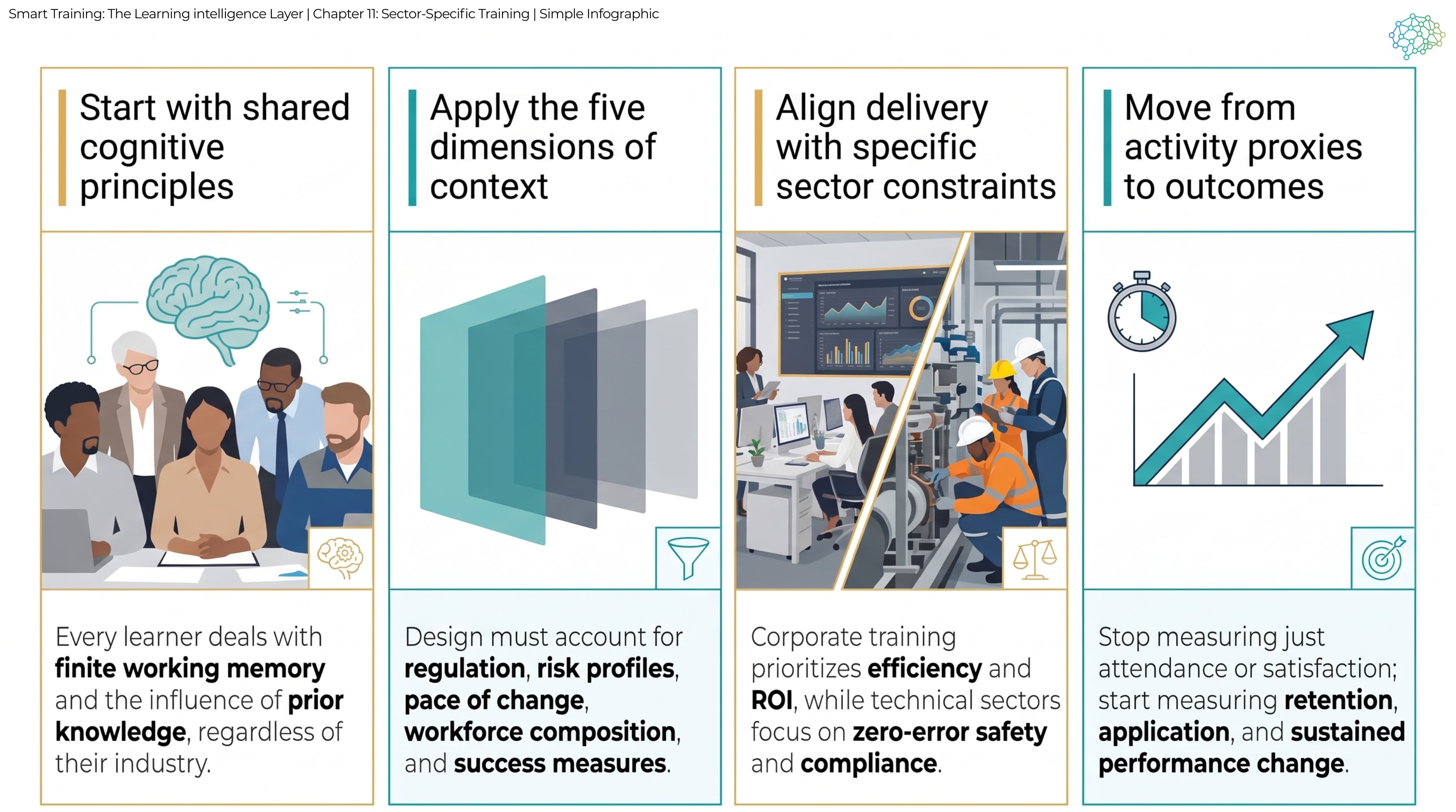
Infographic in four steps: start with shared cognitive principles such as finite working memory and prior knowledge; apply the five dimensions of context, regulation, risk, pace of change, workforce and success measures; align delivery with sector constraints, efficiency and return on investment in corporate settings, zero-error safety and compliance in technical ones; and move from activity proxies to outcomes such as retention, application and sustained performance change.
Training Intelligence: Why Context Changes Everything
Detailed infographic: universal learning science, including finite working memory and attention, filtered through a five-dimension sector filter of regulatory environment, risk profile, pace of change, workforce and success measures; corporate efficiency set against technical rigour; a shift from activity proxies like attendance to evidence of performance change; and a closing line on coaching as an effective intervention.

How the ideas connect

Every idea in Chapter 11 on one page. Look at it before you read to see the shape of the argument, or afterwards as a recap.
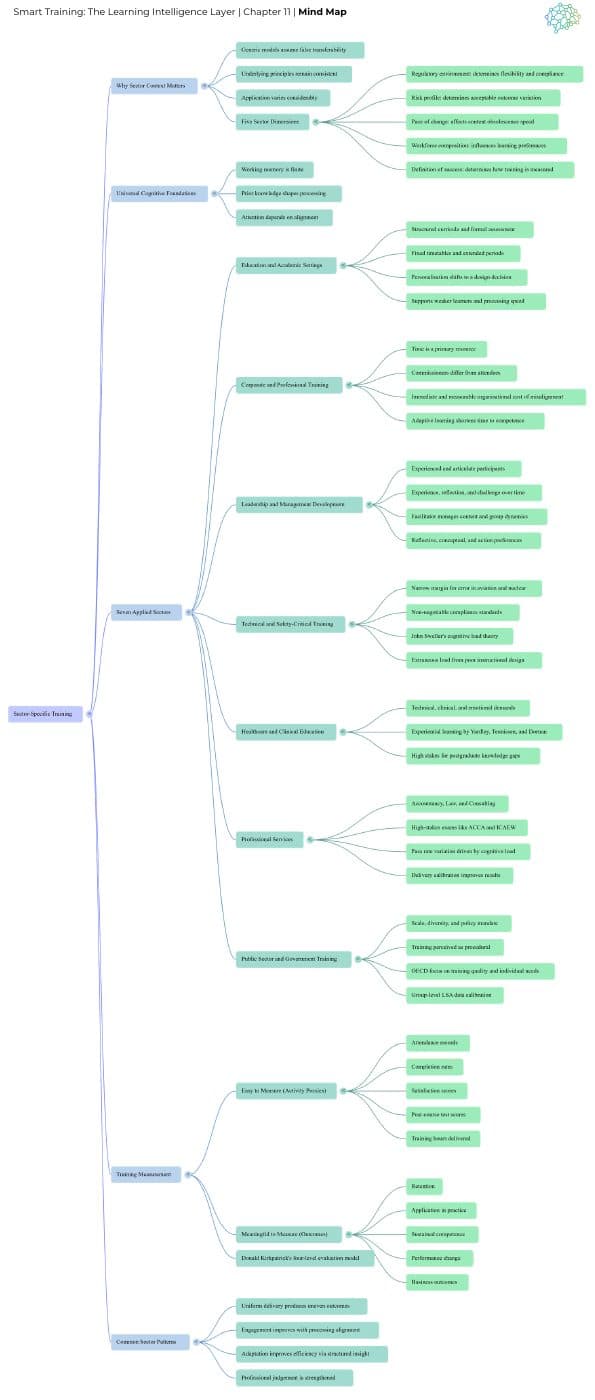
Mind map of Chapter 11.

Put it into practice

Short activities to run with a group or work through on your own. Each one has a printable card.

With a group (3)

  • Printable card for Sector Match Carousel
    Time
    20 to 25 minutes
    Who
    6 or more people
    You will need
    Station cards, sticky notes and pens

    Icebreaker

    Sector Match Carousel

    The same principles meet very different constraints once a sector is named.

    1. Set up stations for the sectors in the chapter, each with a short scenario and one question.
    2. Move round in pairs or threes, a few minutes at each.
    3. Decide what matters most there: regulation, risk, pace of change, workforce, or how success is measured. Leave a sticky note.
    4. At every stop, meet someone new and name a sector you know something about.

    Working on your own? Work round the sectors yourself, then rank them by how far each is from the one you know best. The furthest is where your assumptions will fail.

  • Printable card for The Training Design Fault Line
    Time
    15 to 20 minutes
    Who
    4 or more people
    You will need
    Scenario sheets and pens

    Icebreaker

    The Training Design Fault Line

    One procedure to teach, four sectors to teach it in, one set of slides for all of them.

    1. Take one topic: a new workplace procedure. Then four settings: a college, a corporate office, a clinical setting, a safety-critical environment.
    2. Four minutes alone. What stays the same everywhere, what has to change, and how would success be judged differently?
    3. Mark each sector low, moderate or high risk if the training stays generic, with a written reason for each.
    4. In pairs, make the case for your highest risk sector. Your partner asks two questions only: what are you assuming, and what supports it?

    Working on your own? Run the four sectors, then add your own. Where it falls on your risk scale usually explains which constraints you treat as normal.

  • Printable card for Build the Ideal Training Team
    Time
    15 to 20 minutes
    Who
    6 or more people
    You will need
    Sticky notes and pens

    Icebreaker

    Build the Ideal Training Team

    Who you would need on the team says what the sector really demands.

    1. Take one sector each as a small group, with markers, sticky notes or cards.
    2. Build the ideal training team for it. Compliance lead, coach, subject expert, assessor, mentor, or whatever that sector actually needs.
    3. Each person takes one role, introduces themselves through it, and says why it is on the model.
    4. Present to another group rather than the whole room.

    Working on your own? Build the team for your own sector, then mark the roles that exist in reality. The missing ones are usually where training quietly fails.

On your own (3)

  • Printable card for Context Changes the Design
    Time
    30 to 40 minutes
    Who
    On your own
    You will need
    Notebook or journal and pen

    Journaling

    Context Changes the Design

    The learning science holds everywhere. What a sector will allow does not.

    1. Write why a generic training model fails once a sector is named.
    2. Take the five dimensions and say in a line each why they shape design: regulation, risk, pace of change, workforce, and how success is defined.
    3. Compare two sectors. What pressures shape each, and where would personalisation need care?
    4. Finish on measurement. Why are attendance and satisfaction not enough, and what would you track instead?

    Working with a group? Give people different sector pairings, then read the comparisons aloud. The constraints one person takes for granted surprise everybody else.

  • Printable card for Redesign for Sector Fit
    Time
    25 to 35 minutes
    Who
    On your own
    You will need
    Paper and pen

    Problem solving

    Redesign for Sector Fit

    One deck, two teams. Too rigid for one, too loose for the other, useless to both.

    1. Say why one identical delivery fails here, and which sector factors are being ignored.
    2. Redesign it for the professional services team: relevance, efficiency, and getting it into practice.
    3. Redesign it for the safety-critical team: less load to carry, more structured practice, rigour intact.
    4. Replace attendance and satisfaction with three measures that would actually show whether it worked.

    Working with a group? Split the two redesigns across the room, then swap. Reading someone else’s sector is the fastest way to see your own assumptions.

  • Printable card for Generic Design or Sector Fit
    Time
    30 to 40 minutes
    Who
    On your own
    You will need
    Paper and pen

    Worksheet

    Generic Design or Sector Fit

    The principles are the same everywhere. What a sector permits is not.

    1. Read Approach A. One training model is built once and used across sectors. It travels well, costs less and keeps delivery consistent. Regulation, risk and pace of change are treated as background rather than design input. Success is judged by attendance, completion and satisfaction.
    2. Read Approach B. The learning principles hold, but delivery is shaped by the sector: what is regulated, what the risk is, how fast things change, who the workforce is. Success is judged by retention, application and sustained competence, which is harder to collect.
    3. Compare them: what each one treats as a design constraint; where personalisation can go, and where it must not; what gets measured, and how easily; what is still true in practice six months on.
    4. Critique both. When is uniform delivery still necessary? What do proxy measures hide? What does designing to context make possible? Are meaningful measures always collectable?
    5. Make a judgement. In high-risk sectors, adaptation should touch delivery and never assessment or standards. Argue for or against, drawing on two sectors from the chapter. Finish the sentence: The claim in this chapter most open to challenge is…
Smart Training AI logo

Empowering trainers to boost engagement and results through targeted, adaptive learning

© 2025 Smart Training AI™ All rights reserved.