Assessment that changes delivery

A companion to Chapter 15 of the book, Assessing and Adapting Learning Strengths. The same ideas in several forms: film, conversation, 2 infographics, a mind map and 6 activities. Start with whichever suits you.

Chapter 15 in two minutes

Without insight, trainers adapt by instinct and guesswork, and often reach only part of the room. Chapter 15 sets out how the Learning Strength Assessment gives a clearer starting point. It treats preferences as tendencies that shape efficiency, comfort and engagement, not as fixed labels or a measure of potential or intelligence.

The assessment shows patterns across several dimensions rather than one restrictive category, and it does not rank learners or predict performance. Its value is at group level: a cohort profile showing the mix of preferences in the room, so overlooked learners are served by design rather than by luck.

The chapter describes three steps. Assess the cohort, including any gap between the trainer's preferences and the group's. Apply the insight to sequencing, grouping and activities. Adjust with quick wins now and plans for later. Assessment exists to improve delivery, never for performance or employment decisions, and learners who understand their own preferences become more independent.

Assessment exists to improve delivery, not to categorise.

Watch or listen

Prefer to take it in by eye or by ear? Both cover the core ideas of Chapter 15 in a few minutes.

Film, 2 min

How learning strength assessments reach the whole room

How a group's profile helps a trainer plan several ways into the same material, so more of the room can take part. Captions are built in.

Conversation, 5 min

Why fixed learner labels fail

A conversation about why sorting people into fixed types does not hold up, and how preferences can inform a session without limiting anyone.

0:000:00

Chapter 15 at a glance

A quick overview, then the full argument with the evidence. Select either one to see it full size.

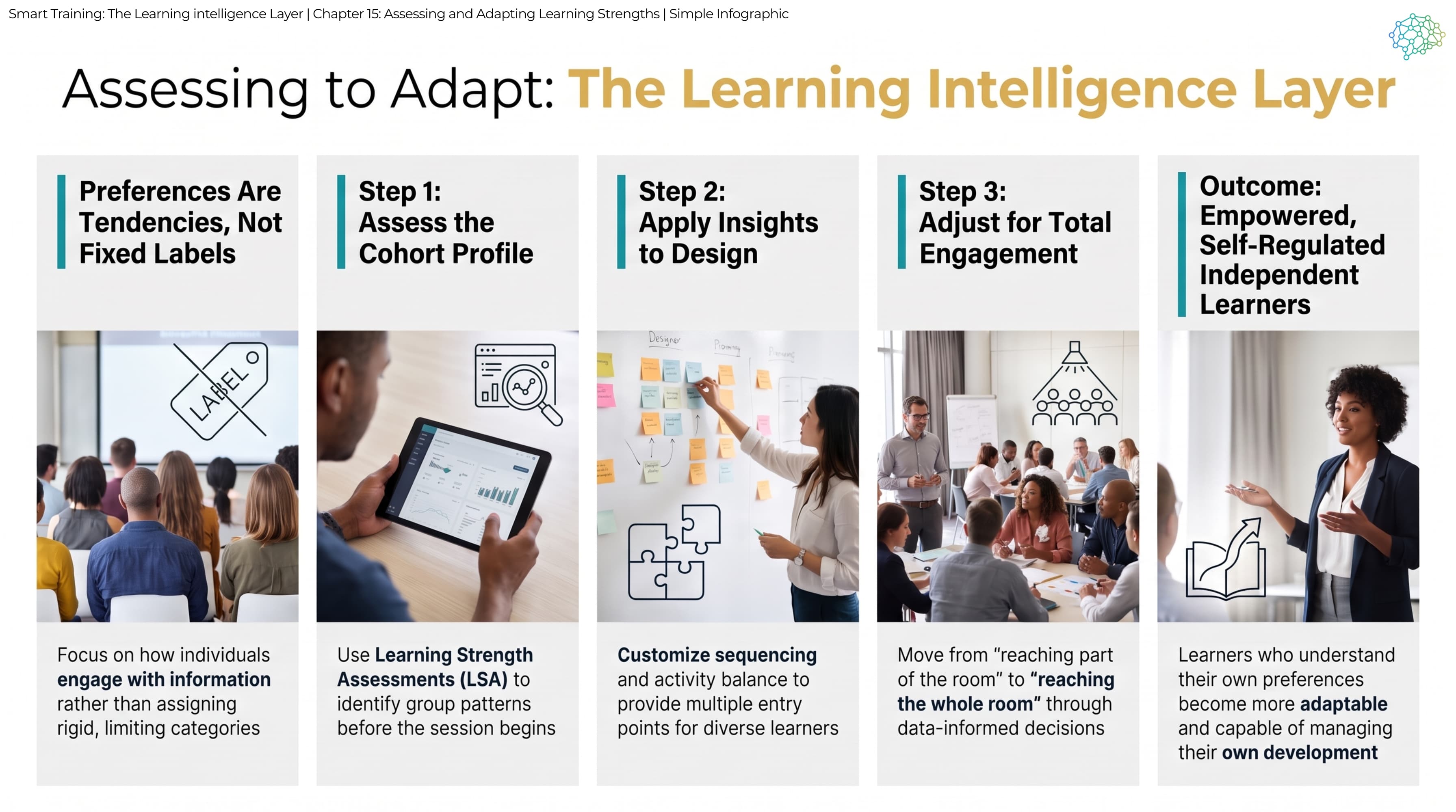
Assessing to Adapt: The Learning Intelligence Layer
Infographic: preferences are tendencies, not fixed labels; step 1, assess the cohort profile before the session; step 2, apply insights to sequencing and activity balance; step 3, adjust to reach the whole room; outcome, empowered, self-regulated, independent learners.
Beyond Guesswork: The Power of Training Intelligence
Detailed infographic: conventional preparation relies on instinct and reaches only part of the room; preferences shape efficiency, comfort and engagement, not potential or intelligence, and are shown as a profile rather than a single category; a three-step journey to assess the cohort, apply the insight and adjust for results; and data-led preparation that reaches the whole room.

How the ideas connect

Every idea in Chapter 15 on one page. Look at it before you read to see the shape of the argument, or afterwards as a recap.
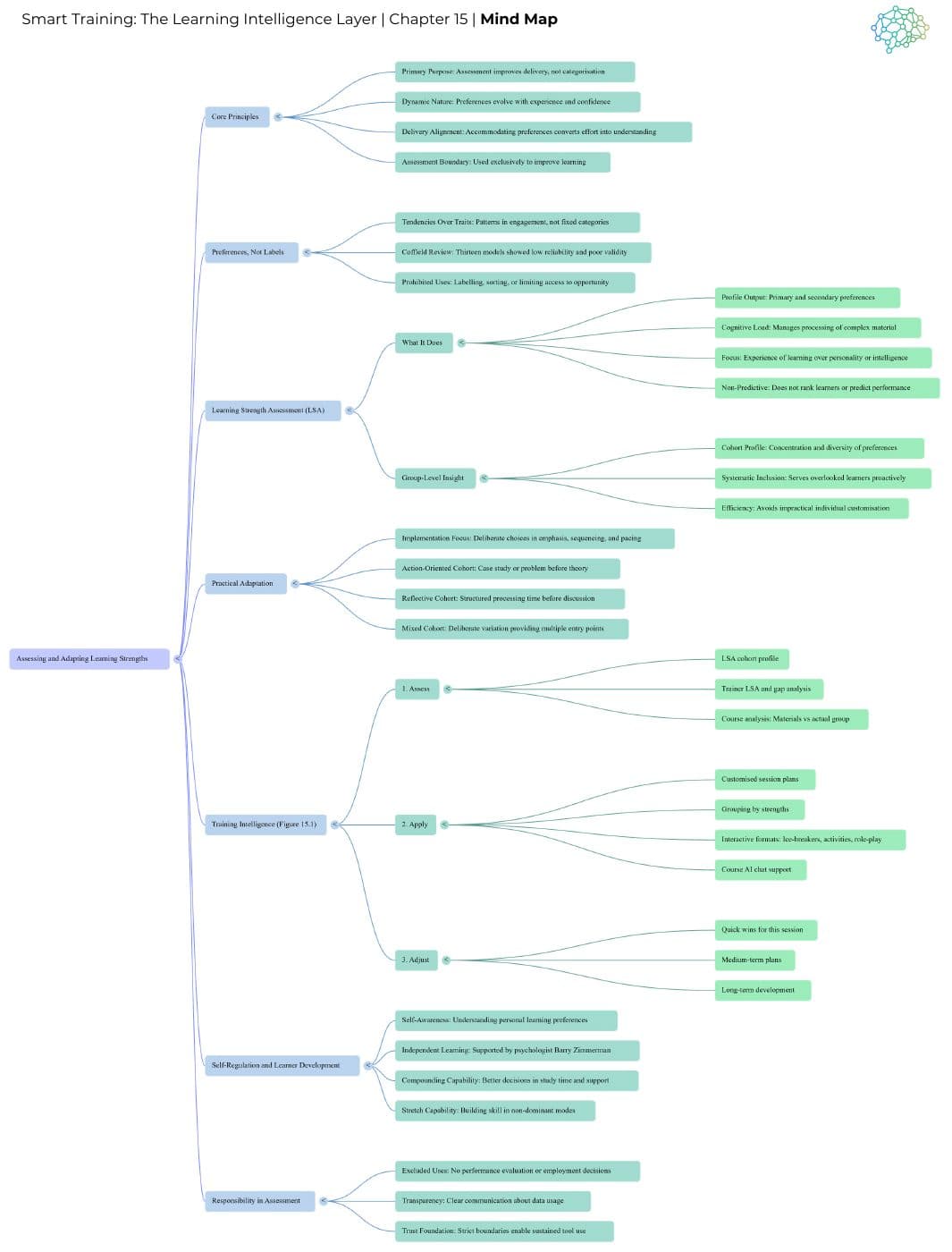
Mind map of Chapter 15.

Put it into practice

Short activities to run with a group or work through on your own. Each one has a printable card.

With a group (3)

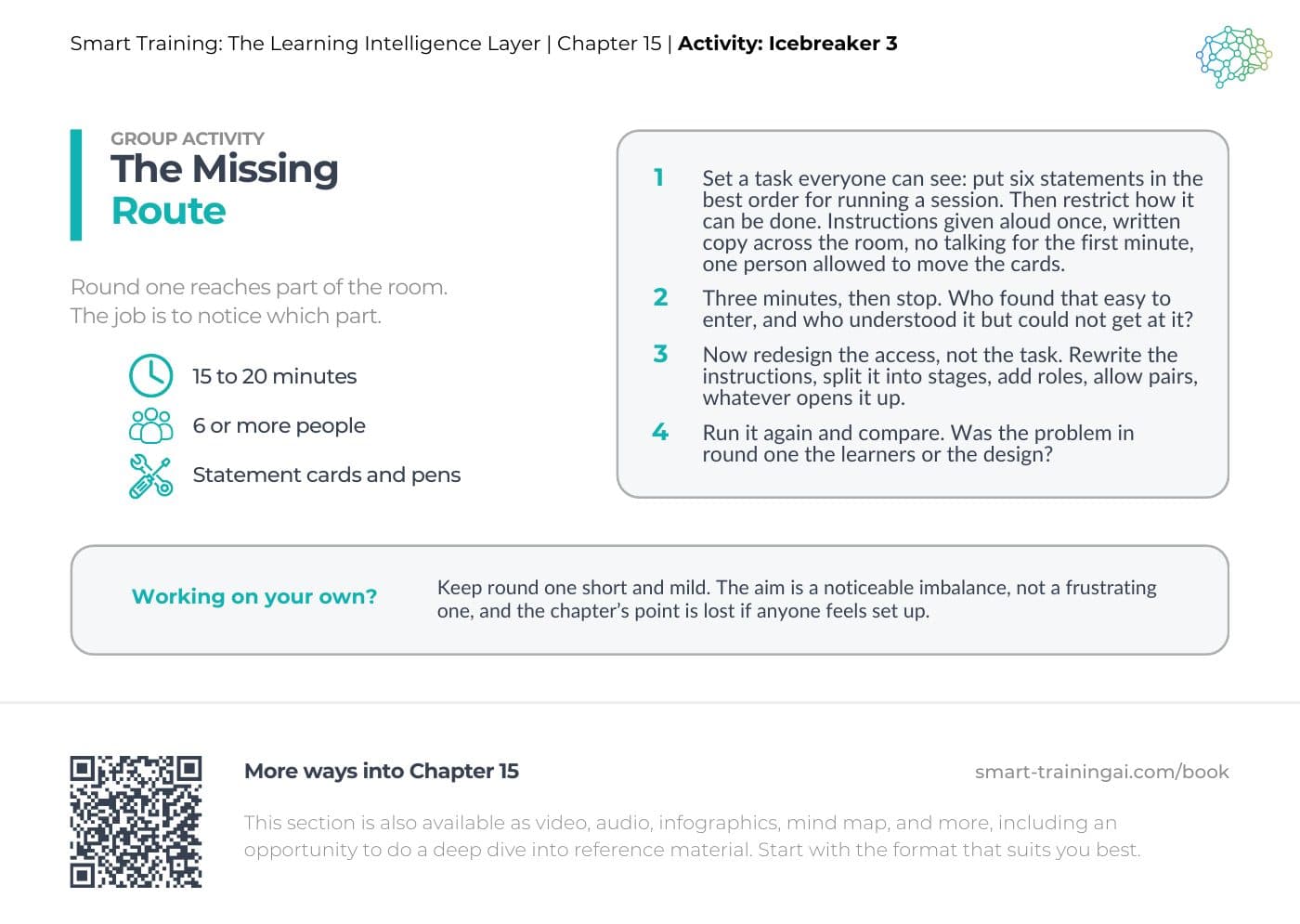
  • Printable card for The Better Way In
    Time
    15 to 20 minutes
    Who
    6 or more people
    You will need
    Station materials and pens

    Icebreaker

    The Better Way In

    Different starting points, not different abilities. The distinction is the chapter.

    1. Set up four stations carrying the same idea four ways: read it, see it, hear it, try it.
    2. Choose the one you think gets you into it fastest. Three minutes there.
    3. Write down why you chose it, what helped, and what would have helped more.
    4. Regroup and count the four. Then ask what a trainer should do with that information, and what they should not.

    Working on your own? Work through all four stations and time each one. Faster is not better, but knowing which is slower for you is worth having.

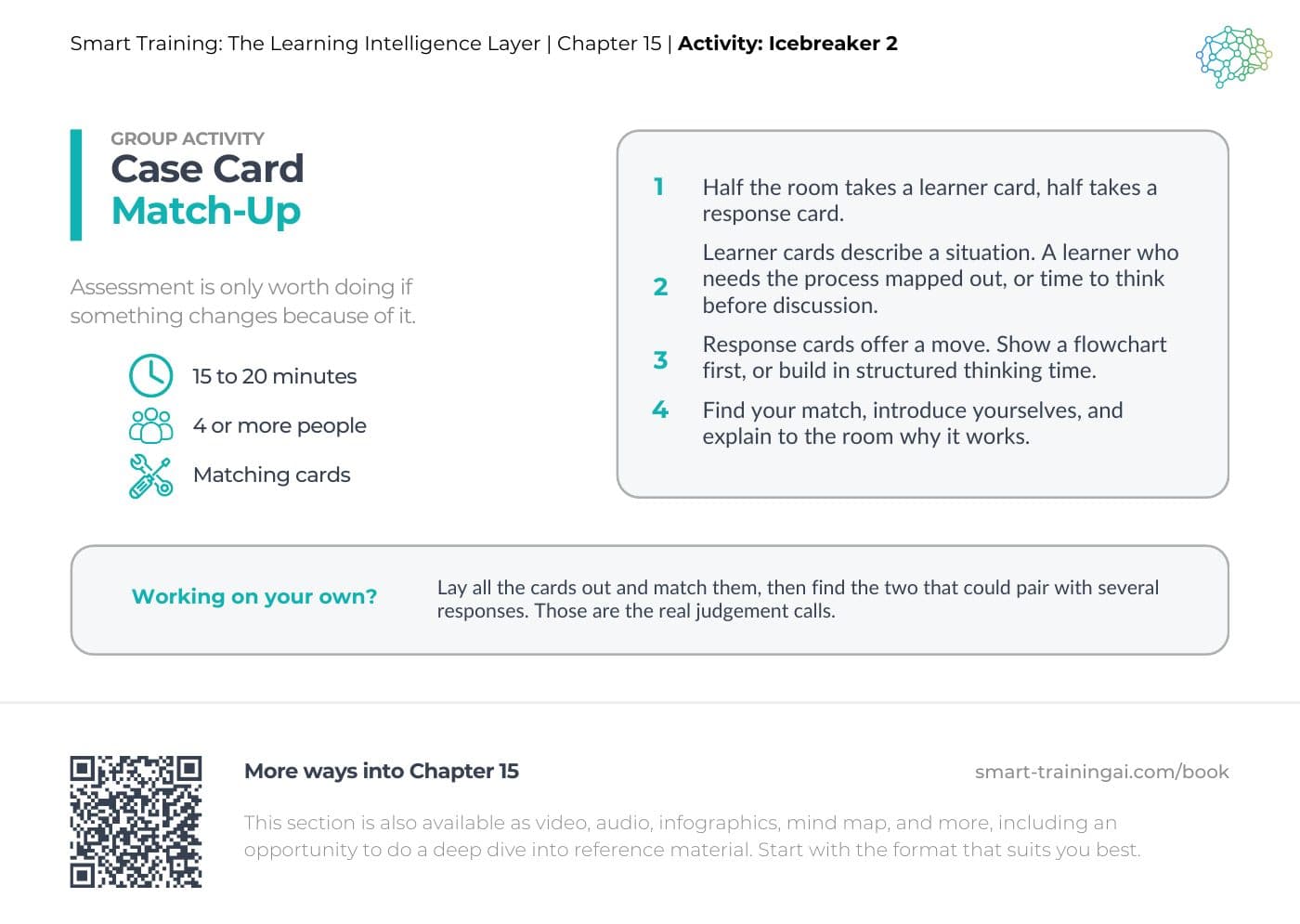
  • Printable card for Case Card Match-Up
    Time
    15 to 20 minutes
    Who
    4 or more people
    You will need
    Matching cards

    Icebreaker

    Case Card Match-Up

    Assessment is only worth doing if something changes because of it.

    1. Half the room takes a learner card, half takes a response card.
    2. Learner cards describe a situation. A learner who needs the process mapped out, or time to think before discussion.
    3. Response cards offer a move. Show a flowchart first, or build in structured thinking time.
    4. Find your match, introduce yourselves, and explain to the room why it works.

    Working on your own? Lay all the cards out and match them, then find the two that could pair with several responses. Those are the real judgement calls.

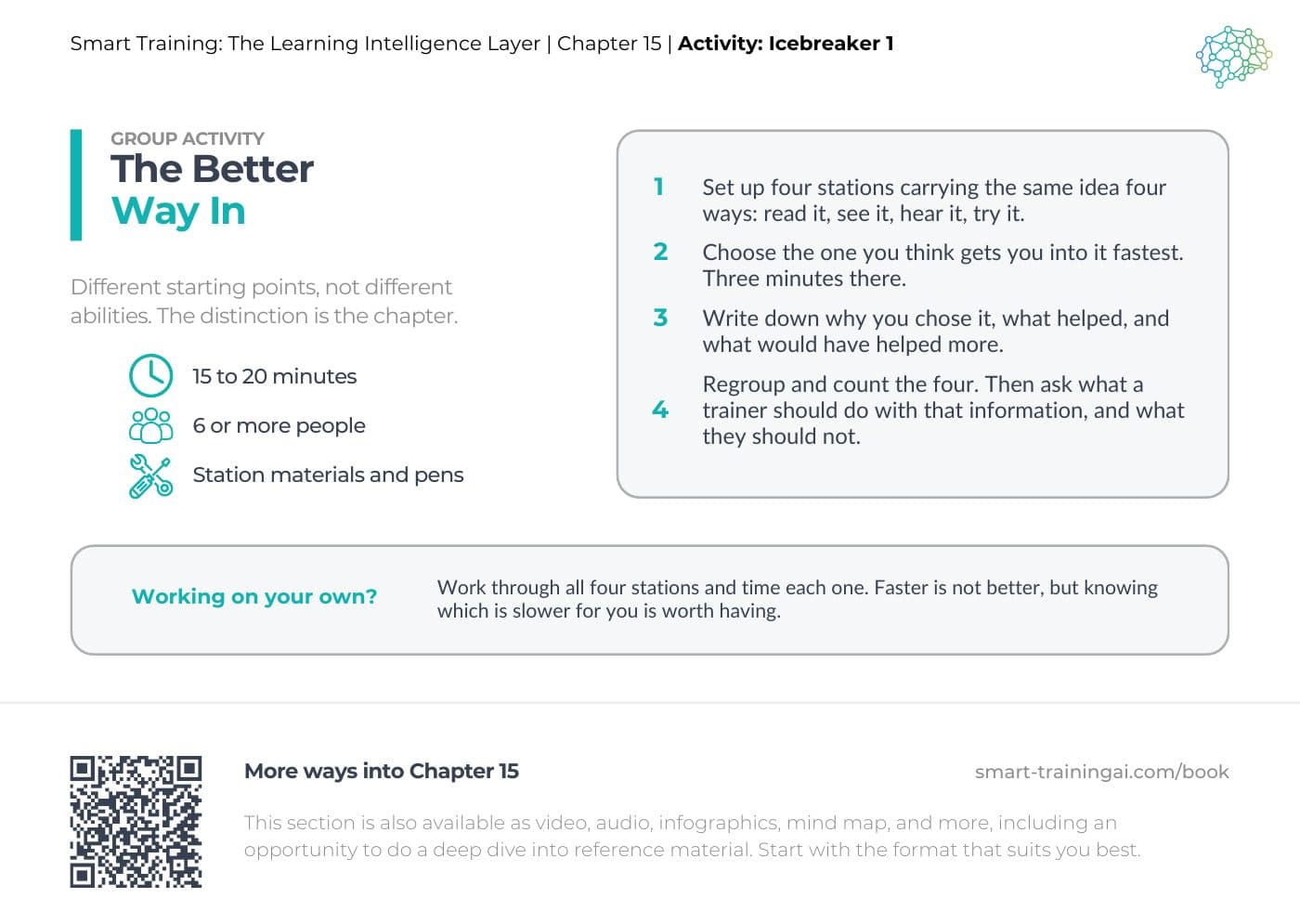
  • Printable card for The Missing Route
    Time
    15 to 20 minutes
    Who
    6 or more people
    You will need
    Statement cards and pens

    Icebreaker

    The Missing Route

    Round one reaches part of the room. The job is to notice which part.

    1. Set a task everyone can see: put six statements in the best order for running a session. Then restrict how it can be done. Instructions given aloud once, written copy across the room, no talking for the first minute, one person allowed to move the cards.
    2. Three minutes, then stop. Who found that easy to enter, and who understood it but could not get at it?
    3. Now redesign the access, not the task. Rewrite the instructions, split it into stages, add roles, allow pairs, whatever opens it up.
    4. Run it again and compare. Was the problem in round one the learners or the design?

    Working on your own? Keep round one short and mild. The aim is a noticeable imbalance, not a frustrating one, and the chapter’s point is lost if anyone feels set up.

On your own (3)

  • Printable card for From Assessment to Adaptation
    Time
    20 to 30 minutes
    Who
    On your own
    You will need
    Notebook or journal and pen

    Journaling

    From Assessment to Adaptation

    Assessment that changes nothing about delivery was only ever a filing exercise.

    1. Write what it means that assessment exists to improve delivery rather than categorise people.
    2. Describe your own preferences without turning them into fixed labels, and say how they have shifted over time.
    3. Name three ways a trainer could adapt a session after seeing cohort information.
    4. Say how adaptation can support a strength and still stretch someone in a weaker mode.

    Working with a group? Write first, then discuss only the third answer. Comparing the practical moves keeps the conversation off personal labels.

  • Printable card for Fix the Misaligned Session
    Time
    25 to 35 minutes
    Who
    On your own
    You will need
    Paper and pen

    Problem solving

    Fix the Misaligned Session

    The trainer used the data. Grouped people by type and stopped there.

    1. Take each decision the trainer made and say what is wrong with it.
    2. Name the risk in using preference data to predict who will perform well.
    3. Rebuild the 90 minutes with varied entry points, and no permanent groupings.
    4. Show how the session supports a strength and still stretches a weaker mode.

    Working with a group? Redesign separately, then check each other’s plans for labels that crept back in. They usually do, in the grouping.

  • Printable card for Insight or Label
    Time
    30 to 40 minutes
    Who
    On your own
    You will need
    Paper and pen

    Worksheet

    Insight or Label

    The same assessment data can inform a session or quietly sort the people in it.

    1. Read Approach A. The trainer reviews cohort information before the session, then adjusts sequencing, builds in varied activities and reflection time, and stays flexible once delivery starts. The data is a starting point for decisions, not a verdict on anyone.
    2. Read Approach B. Each learner is assigned a fixed category and given one type of task. Groupings stay put. The assessment result is read as a prediction of how well each person will do, and nothing in the session varies after that.
    3. Compare them: what the data is being used to decide; whether preferences are treated as tendencies or traits; what happens to a learner in their weaker modes; how much the trainer can still respond in the room.
    4. Critique both. What does informed adaptation beat? Where could flexibility become vagueness? Why is sorting by type so tempting? What is the cost once a label sticks?
    5. Make a judgement. Is this chapter mainly arguing for personalisation, flexibility, or responsibility? Pick one, compare it with the other two, and justify it. Finish the sentence: The unanswered question this chapter leaves me with is…
Smart Training AI logo

Empowering trainers to boost engagement and results through targeted, adaptive learning

© 2025 Smart Training AI™ All rights reserved.