Conditions matter more than tools
A companion to Chapter 16 of the book, The Hole in the Wall. The same ideas in several forms: film, conversation, 2 infographics, a mind map and 6 activities. Start with whichever suits you.
Chapter 16 in two minutes
In 1999, Sugata Mitra set a computer into a wall in a low-income area of New Delhi, with no instructions. Children with no prior experience taught themselves to use it, exploring together and solving problems as a group. Chapter 16 asks what the experiment actually showed, and what training can take from it.
The popular readings are that technology is the answer, teachers are unnecessary and learning happens alone. The chapter reads it differently. Learning self-organised because the conditions allowed it: open access, freedom to explore without fear of failure, voluntary collaboration and curiosity. Knowledge was built socially, and later work showed that a supportive adult still helps learning go deeper.
For training, the lesson is to move from making learning happen to letting it happen. Many constraints in formal training are chosen rather than necessary. Aligning conditions with how people naturally engage, with structure chosen deliberately, surfaces capability that conventional approaches fail to reach.
Conditions matter more than the tools.
Watch or listen
Prefer to take it in by eye or by ear? Both cover the core ideas of Chapter 16 in a few minutes.
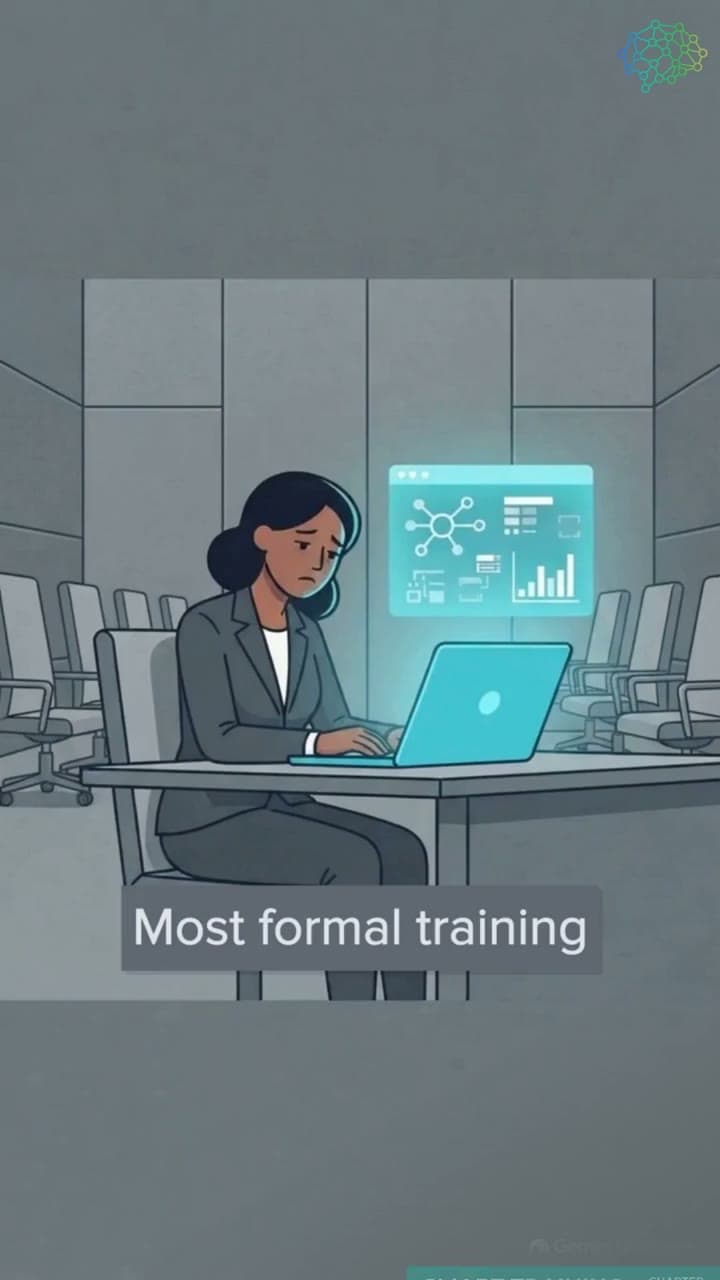
Film, 1 min
How learning actually self-organises
What the Hole in the Wall experiment suggests about the conditions that let people learn without being made to. Captions are built in.
Conversation, 6 min
What the Hole in the Wall actually proved
A conversation about the experiment, the common misreadings of it, and what it means for designing training.
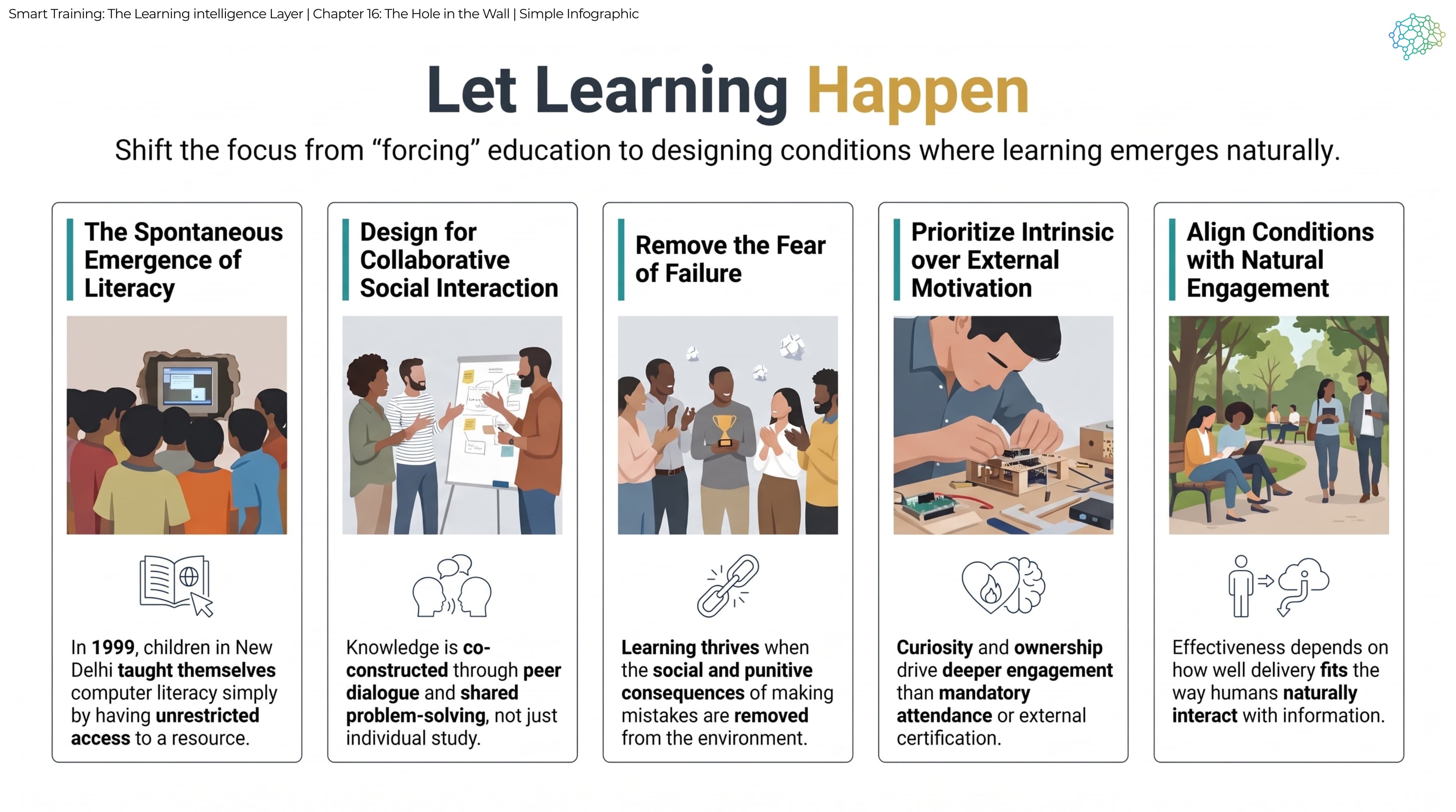
Chapter 16 at a glance
A quick overview, then the full argument with the evidence. Select either one to see it full size.
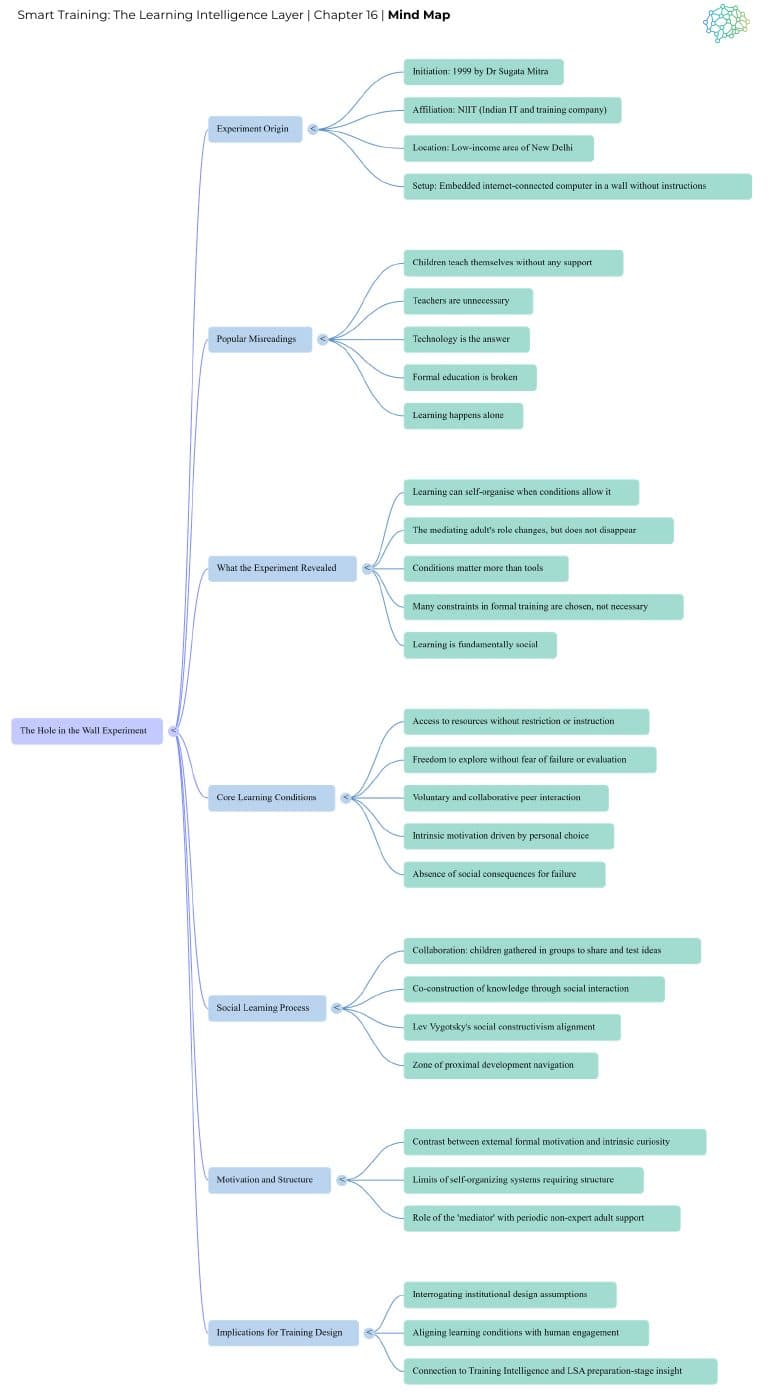
How the ideas connect
Every idea in Chapter 16 on one page. Look at it before you read to see the shape of the argument, or afterwards as a recap.
Put it into practice
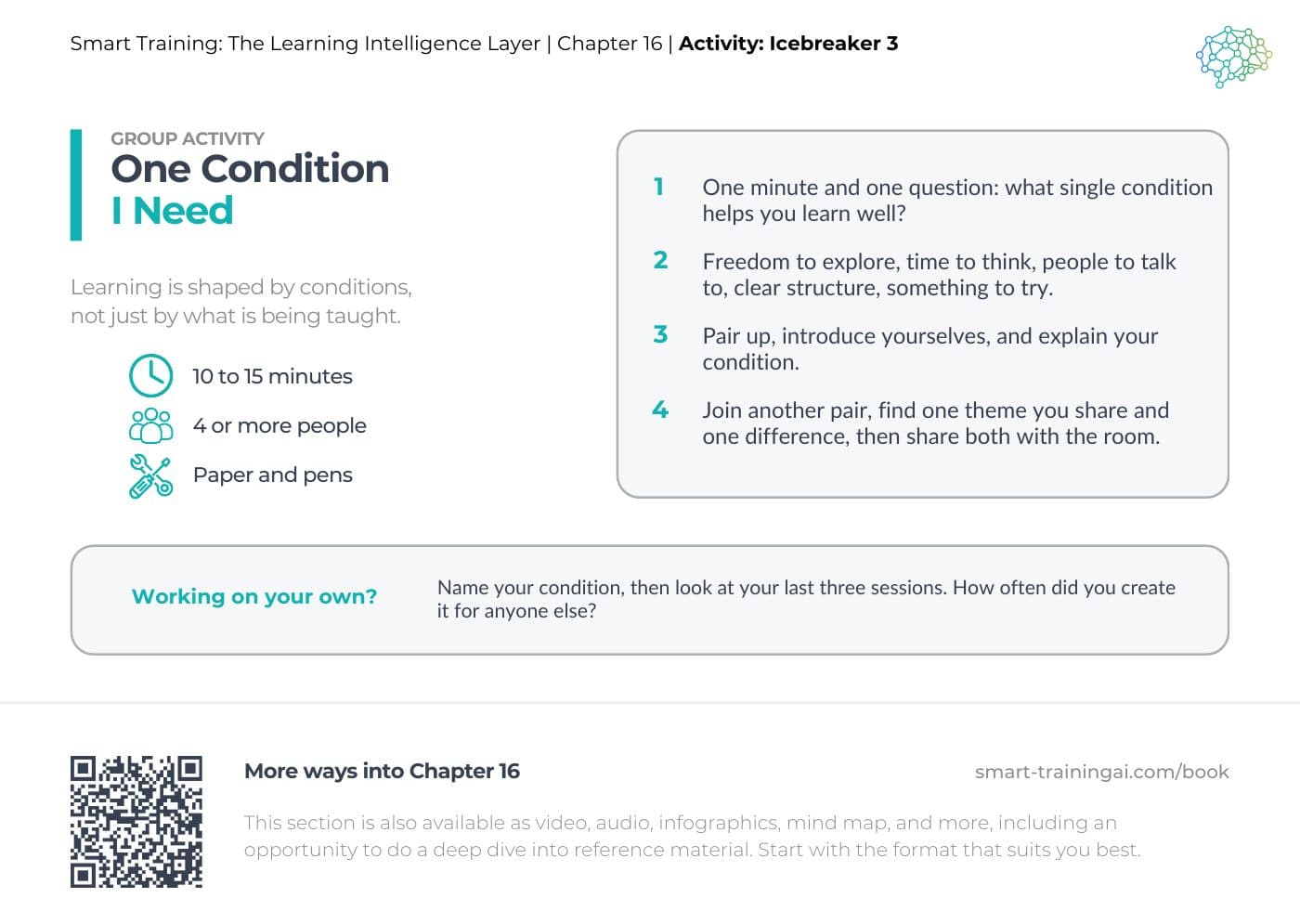
Short activities to run with a group or work through on your own. Each one has a printable card.
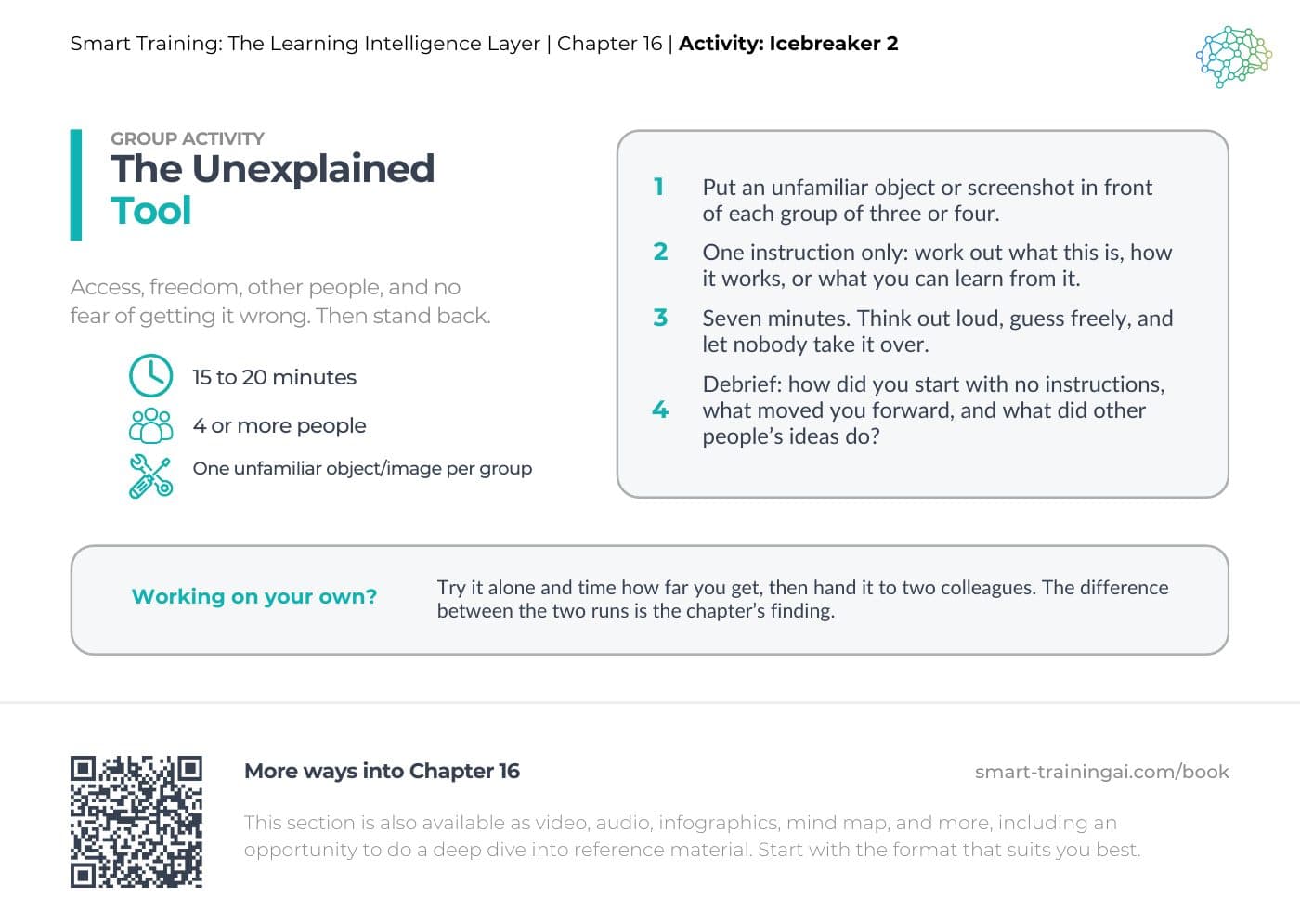
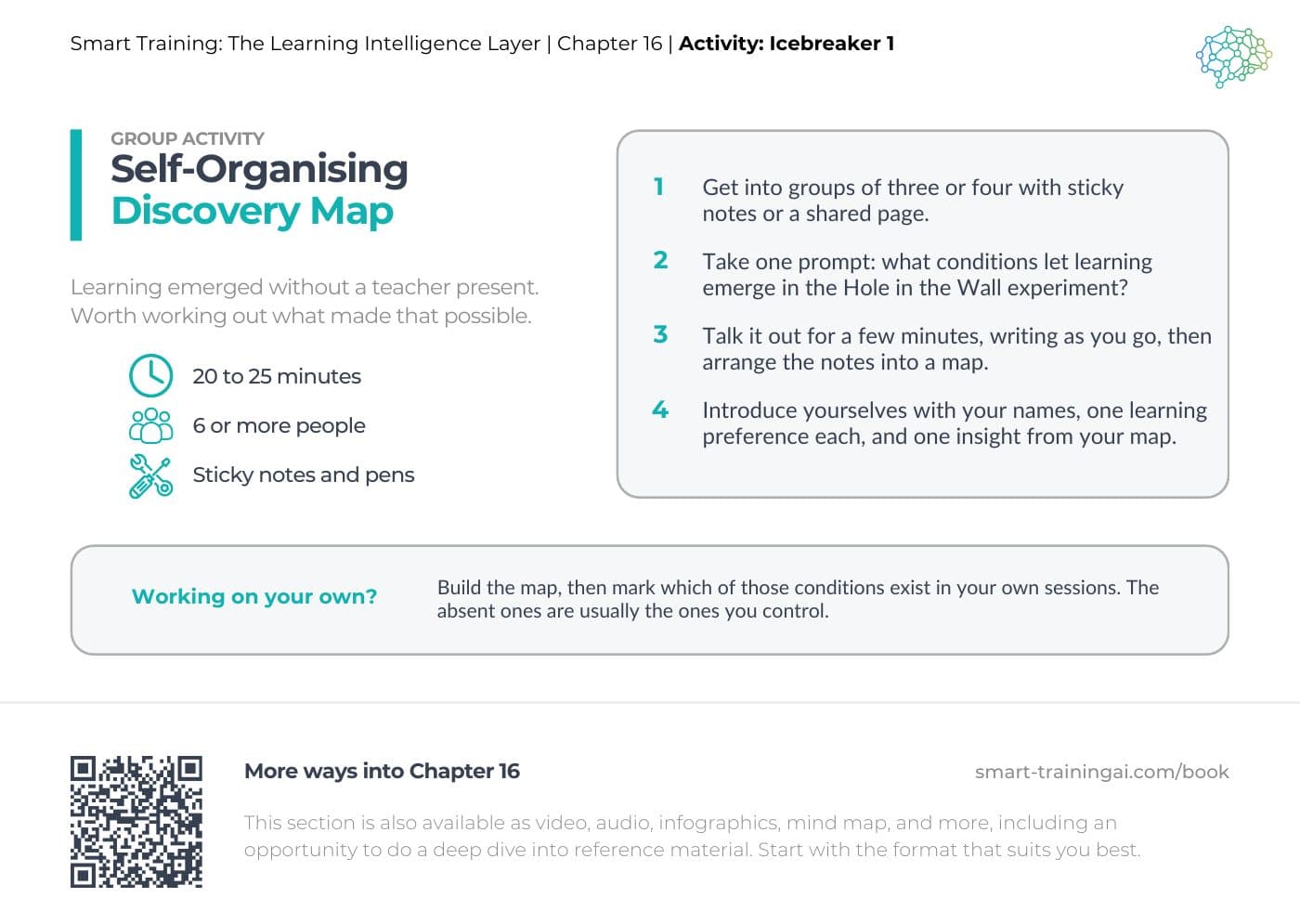
With a group (3)
On your own (3)
Go deeper
The research and writing behind Chapter 16.
- Sugata Mitra, British Journal of Educational Technology, 2003Minimally Invasive Education: A Progress Report on the "Hole-in-the-Wall" ExperimentsMitra's own account of the early experiments and what the children learned.
- Mitra and Dangwal, British Journal of Educational Technology, 2010Limits to Self-Organising Systems of Learning: The Kalikuppam ExperimentThe follow-up study that found a supportive adult mediator helped learning go further.
- Sugata Mitra, ResearchGateBeyond the Hole in the WallMitra's longer reflection on self-organised learning and where it leads.
- Sugata Mitra, TEDBuild a School in the CloudMitra's talk on the experiments, useful to watch alongside the chapter's more careful reading.
- Lev Vygotsky, Harvard University PressMind in SocietyThe social side of learning, and the zone of proximal development the children worked within.