From episodes to a continuous cycle

A companion to Chapter 17 of the book, Lifelong Learning and AI. The same ideas in several forms: film, conversation, 2 infographics, a mind map and 6 activities. Start with whichever suits you.
Chapter 17 in two minutes

The traditional model treats learning as an episode: study, gain a credential, then apply it for years. That assumed a stable link between early learning and later needs. Chapter 17 argues it no longer holds. Professional knowledge is going out of date faster, and new roles keep appearing, so learning has to continue throughout working life.

Adults do not lose the ability to learn. They disengage when time pressure, unclear relevance, low confidence and past experiences of education meet uniform delivery that ignores how much adult learners vary. The chapter proposes a continuous cycle of learning, applying, reflecting and adapting, with delivery adjusted for early, mid and later career stages.

Individuals benefit from understanding their own preferences, which helps them choose resources and learn more efficiently over time. Organisations have a part to play too: treating learning as a strategic capability rather than a compliance box to tick, and extending insight beyond formal events into coaching, mentoring and project work.

Adults don't lose the ability to learn; they disengage when environments fail to adapt to their individual variation.

Watch or listen

Prefer to take it in by eye or by ear? Both cover the core ideas of Chapter 17 in a few minutes.

Film, 1 min

How the continuous learning cycle works

Why one-off training episodes give way to a cycle of learning, applying, reflecting and adapting. Captions are built in.

Conversation, 6 min

Why corporate training fails adult learners

A conversation about what stops adults learning at work, how needs change across a career, and what organisations can do about it.

0:000:00

Chapter 17 at a glance

A quick overview, then the full argument with the evidence. Select either one to see it full size.

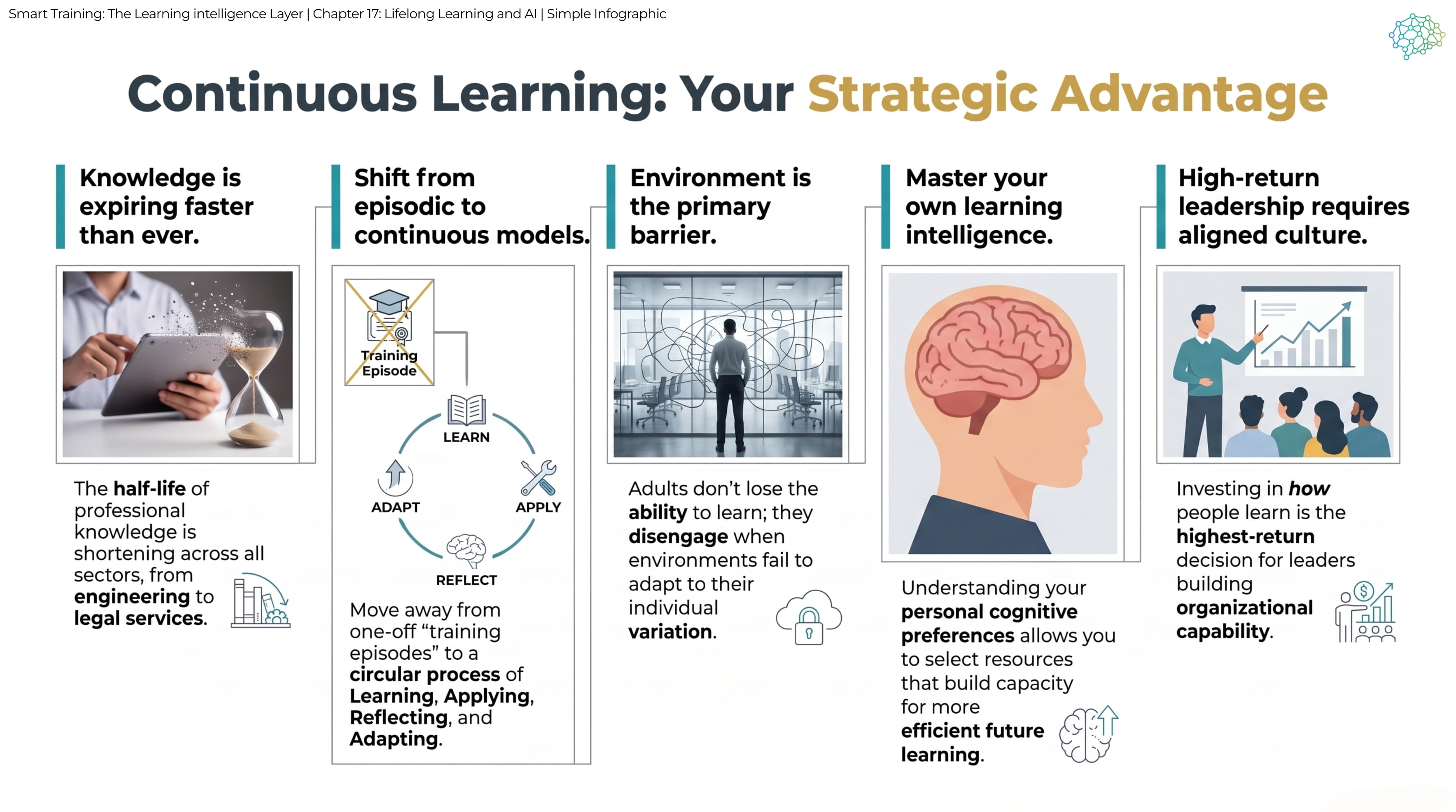
Continuous Learning: Your Strategic Advantage
Infographic: knowledge is expiring faster than ever; shift from one-off training episodes to a cycle of learn, apply, reflect and adapt; environment is the primary barrier, not ability; master your own learning by understanding your preferences; high-return leadership requires an aligned learning culture.
From Episodes to Evolution: The Future of Lifelong Learning
Detailed infographic in two parts. Breaking the episodic habit: the half-life of knowledge is shrinking; a linear learn-then-apply model against a continuous loop of learn, apply, reflect and adapt; environment, not age, limits learning. Building a strategic learning culture: personalising by career stage, with early-career identity, mid-career expertise and late-career anxiety; developing self-directed capability; and a chart showing lower returns from uniform box-ticking mandates and higher returns from aligned delivery.

How the ideas connect

Every idea in Chapter 17 on one page. Look at it before you read to see the shape of the argument, or afterwards as a recap.
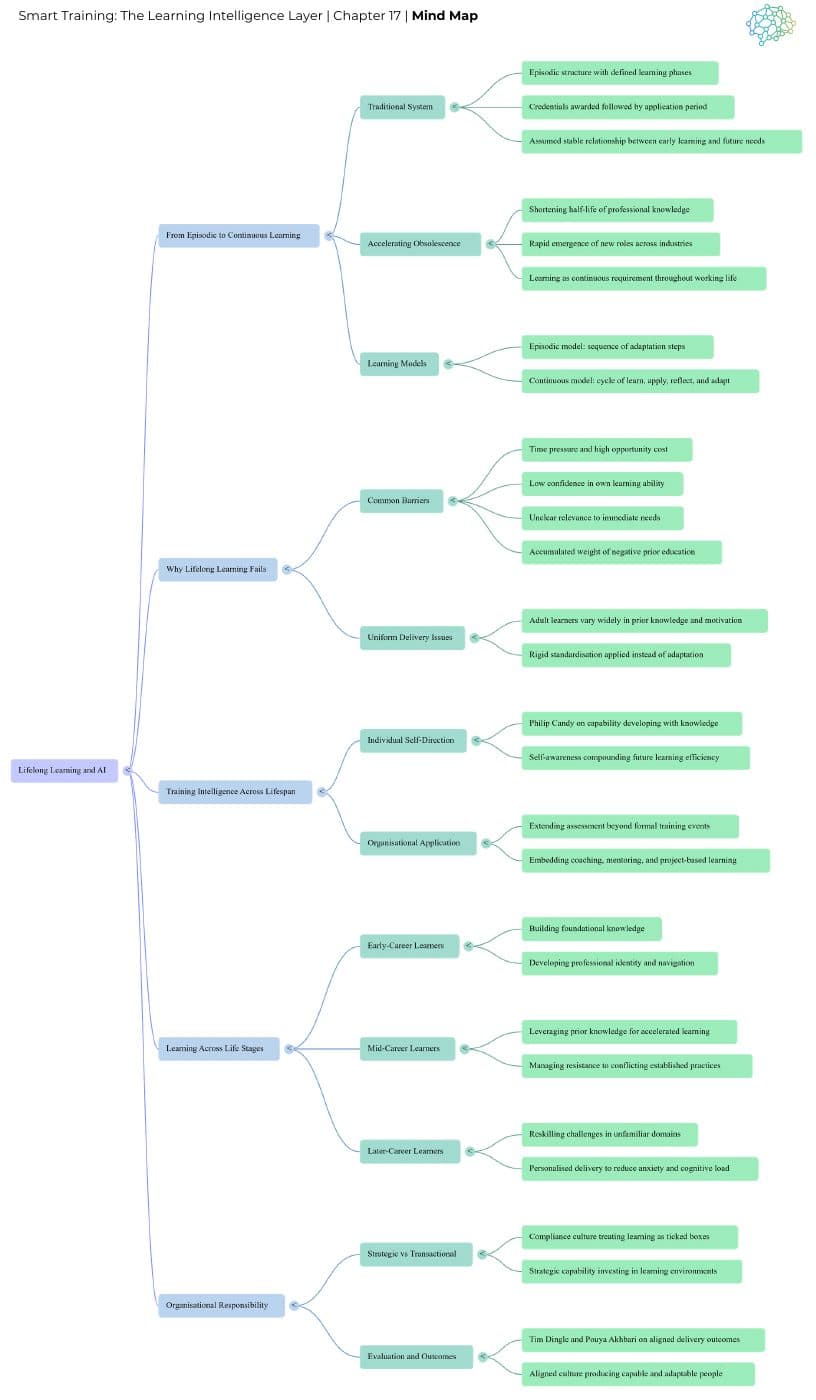
Mind map of Chapter 17.

Put it into practice

Short activities to run with a group or work through on your own. Each one has a printable card.

With a group (3)

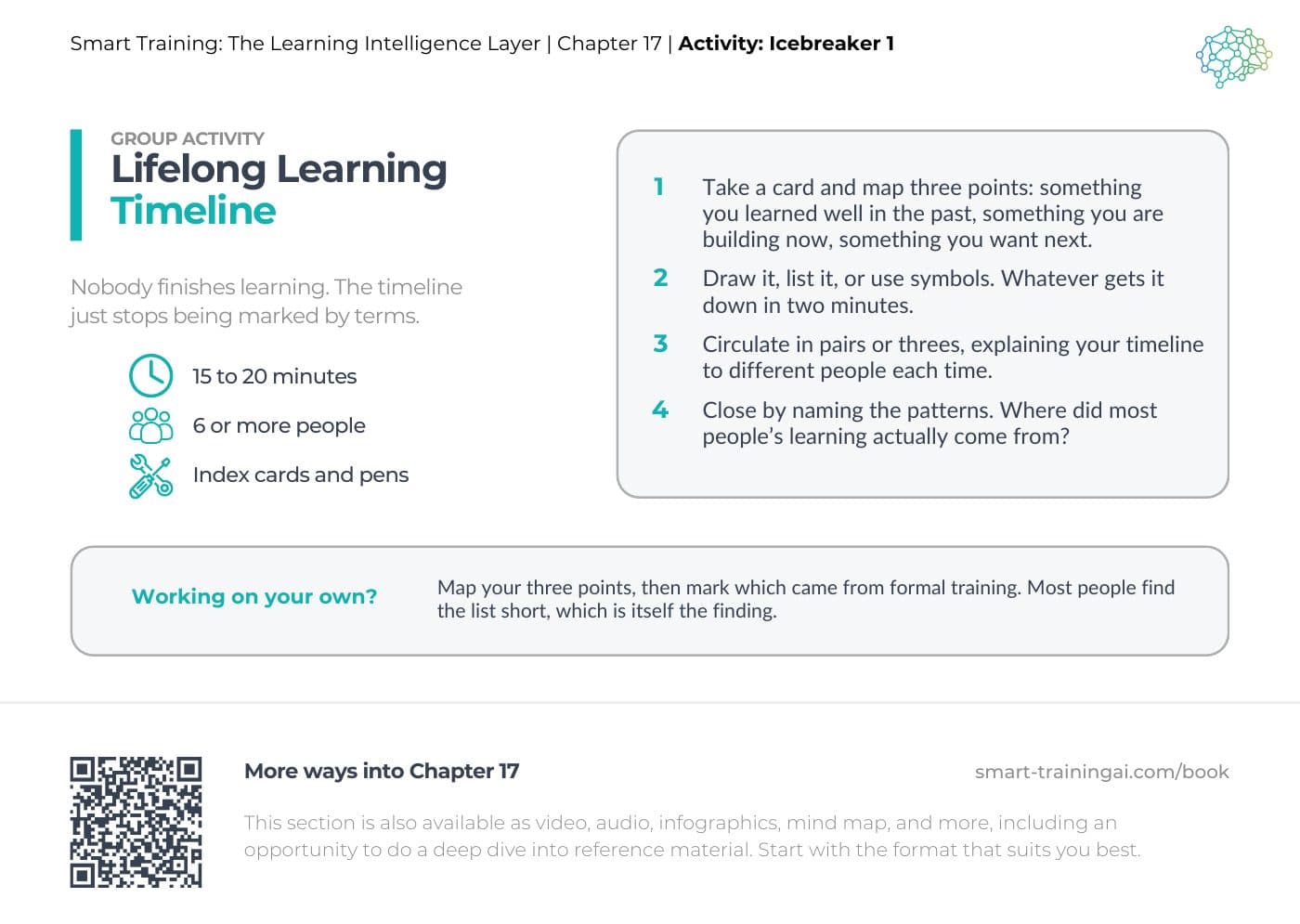
  • Printable card for Lifelong Learning Timeline
    Time
    15 to 20 minutes
    Who
    6 or more people
    You will need
    Index cards and pens

    Icebreaker

    Lifelong Learning Timeline

    Nobody finishes learning. The timeline just stops being marked by terms.

    1. Take a card and map three points: something you learned well in the past, something you are building now, something you want next.
    2. Draw it, list it, or use symbols. Whatever gets it down in two minutes.
    3. Circulate in pairs or threes, explaining your timeline to different people each time.
    4. Close by naming the patterns. Where did most people’s learning actually come from?

    Working on your own? Map your three points, then mark which came from formal training. Most people find the list short, which is itself the finding.

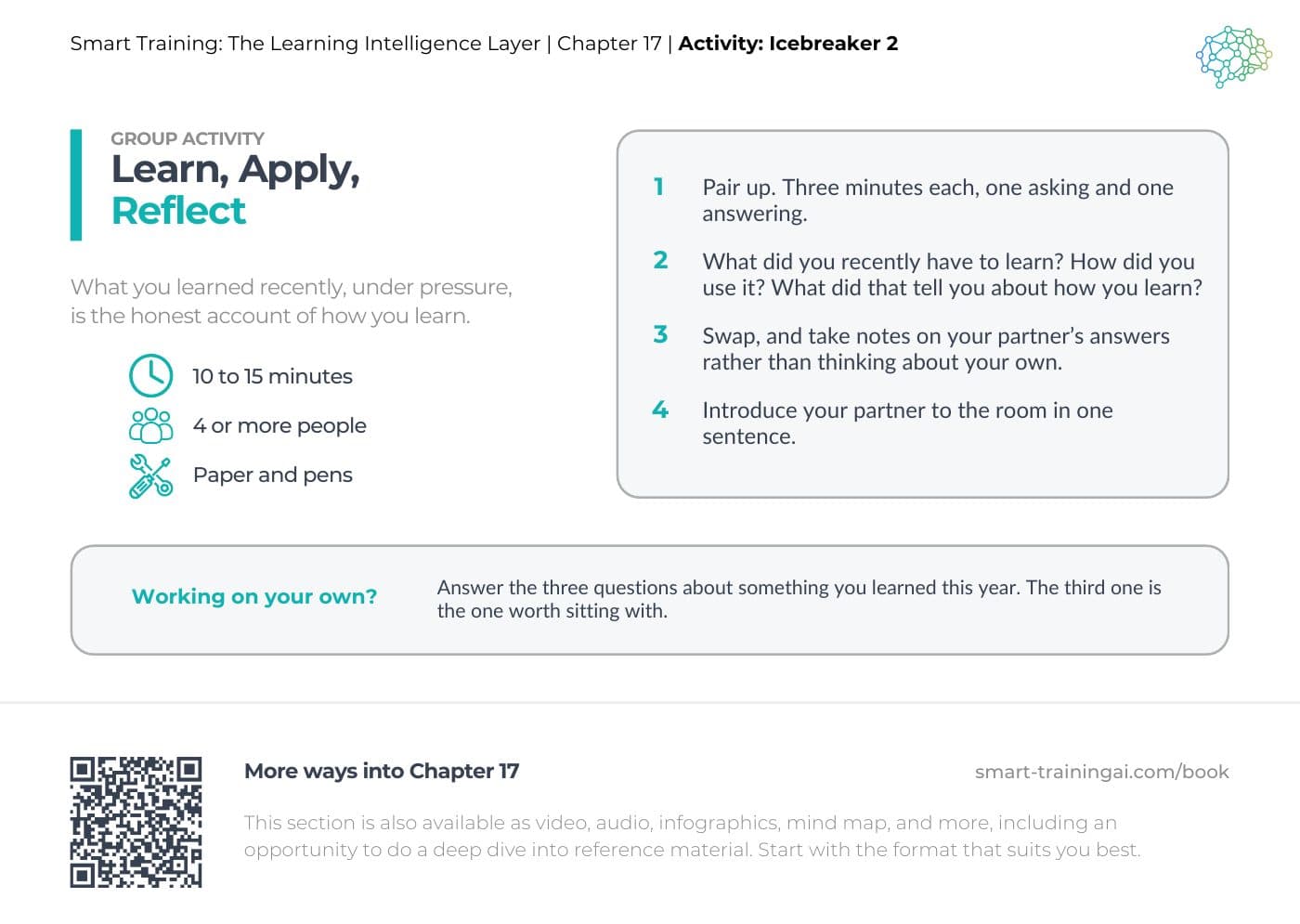
  • Printable card for Learn, Apply, Reflect
    Time
    10 to 15 minutes
    Who
    4 or more people
    You will need
    Paper and pens

    Icebreaker

    Learn, Apply, Reflect

    What you learned recently, under pressure, is the honest account of how you learn.

    1. Pair up. Three minutes each, one asking and one answering.
    2. What did you recently have to learn? How did you use it? What did that tell you about how you learn?
    3. Swap, and take notes on your partner’s answers rather than thinking about your own.
    4. Introduce your partner to the room in one sentence.

    Working on your own? Answer the three questions about something you learned this year. The third one is the one worth sitting with.

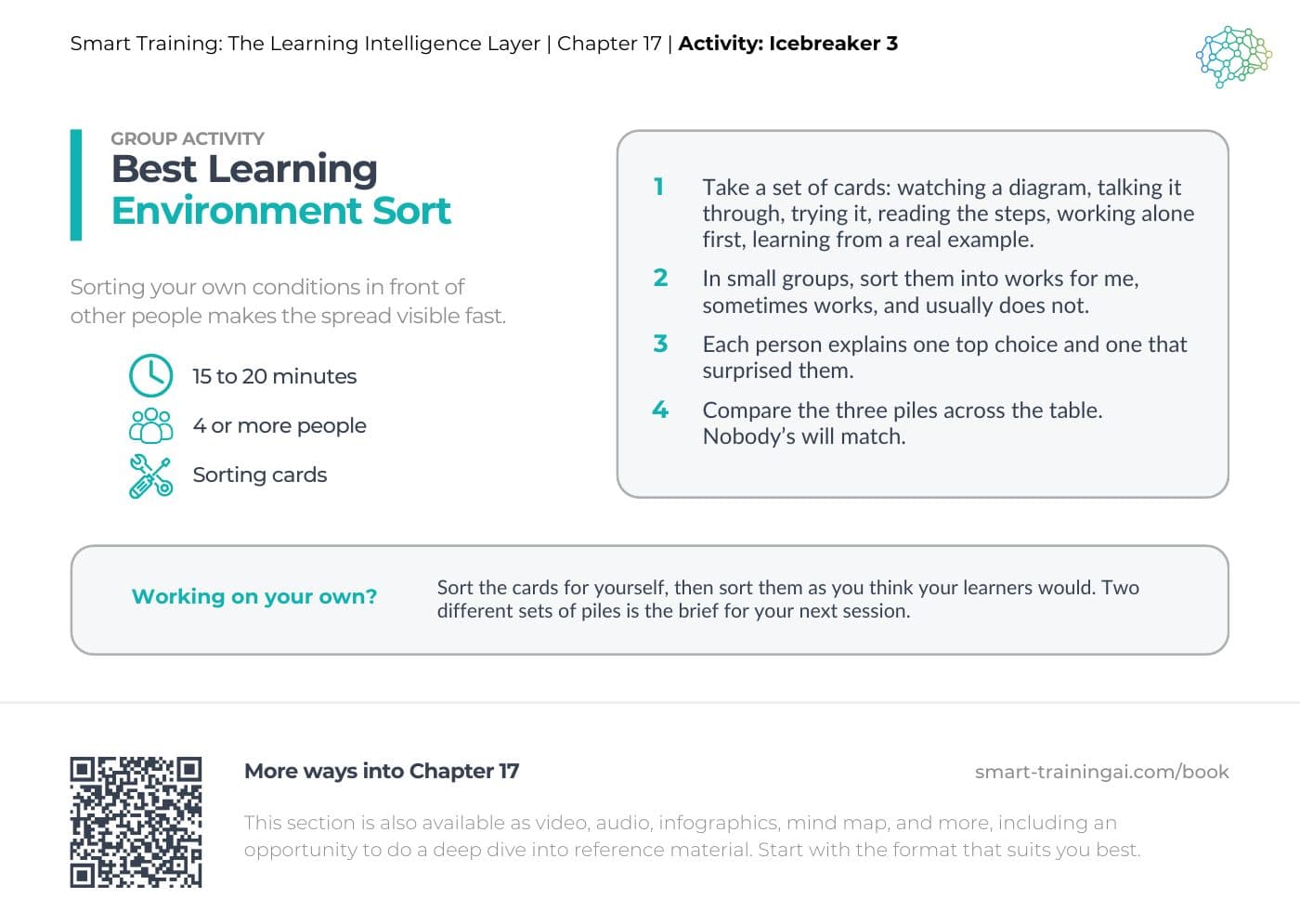
  • Printable card for Best Learning Environment Sort
    Time
    15 to 20 minutes
    Who
    4 or more people
    You will need
    Sorting cards

    Icebreaker

    Best Learning Environment Sort

    Sorting your own conditions in front of other people makes the spread visible fast.

    1. Take a set of cards: watching a diagram, talking it through, trying it, reading the steps, working alone first, learning from a real example.
    2. In small groups, sort them into works for me, sometimes works, and usually does not.
    3. Each person explains one top choice and one that surprised them.
    4. Compare the three piles across the table. Nobody’s will match.

    Working on your own? Sort the cards for yourself, then sort them as you think your learners would. Two different sets of piles is the brief for your next session.

On your own (3)

  • Printable card for From Episodic to Continuous
    Time
    15 to 20 minutes
    Who
    On your own
    You will need
    Notebook or journal and pen

    Journaling

    From Episodic to Continuous

    Lifelong learning is easy to agree with and hard to actually keep doing.

    1. Write the difference between episodic and continuous learning in your own words.
    2. Describe something you learned well outside any formal course, and say what made it work.
    3. Name which barrier has affected you most: time, confidence, unclear relevance, or a bad experience in the past.
    4. Finish with one realistic change you could make this month to learn more effectively.

    Working with a group? Write privately, then share only the barrier. Hearing which one comes up most tells an organisation more than a survey would.

  • Printable card for Redesign a Failing Learning Situation
    Time
    25 to 35 minutes
    Who
    On your own
    You will need
    Paper and pen

    Problem solving

    Redesign a Failing Learning Situation

    Everyone trained, nobody prepared, and the new system now gets avoided.

    1. Say why this approach failed, and which barriers from the chapter are visible in it.
    2. Take three groups: early career, mid career with set habits, later career reskilling. What does each one hit?
    3. Propose three changes to the learning environment, and say how you make it continuous rather than a single event.
    4. Show where coaching, mentoring or support on the job would do the work the session could not.

    Working with a group? Split the three career stages across the room, then bring the redesigns together. One plan will quietly disadvantage one of the groups.

  • Printable card for A Phase or a Cycle
    Time
    30 to 40 minutes
    Who
    On your own
    You will need
    Paper and pen

    Worksheet

    A Phase or a Cycle

    Whether learning has an end date decides what an organisation builds for it.

    1. Read Approach A. Learning is a phase. It happens in formal blocks, is delivered when something changes, and is treated as a transaction to be completed and recorded. When it does not stick, the explanation reaches for motivation or ability.
    2. Read Approach B. Learning is a cycle of learning, applying, reflecting and adapting, running alongside the work. The organisation treats it as a capability rather than an event, and failure is read first as a problem with the environment.
    3. Compare them: what each assumes about adults and learning; where the responsibility sits when it fails; what each costs the organisation, and when; which is more realistic in a busy workplace.
    4. Critique both. What does treating learning as an event make easy? What does it miss about how adults actually learn? What does a continuous cycle make possible? Does the chapter assume support that many organisations lack?
    5. Make a judgement. Understanding how people learn is one of the highest-return decisions available to leaders. Say what that claim means, how far you agree, and why. Finish the sentence: The argument in this chapter needing most qualification is…
Smart Training AI logo

Empowering trainers to boost engagement and results through targeted, adaptive learning

© 2025 Smart Training AI™ All rights reserved.