Working memory is the bottleneck
A companion to Chapter 2 of the book, Understanding How Learning Works. The same ideas in several forms: film, conversation, 2 infographics, a mind map and 6 activities. Start with whichever suits you.

Chapter 2 in two minutes
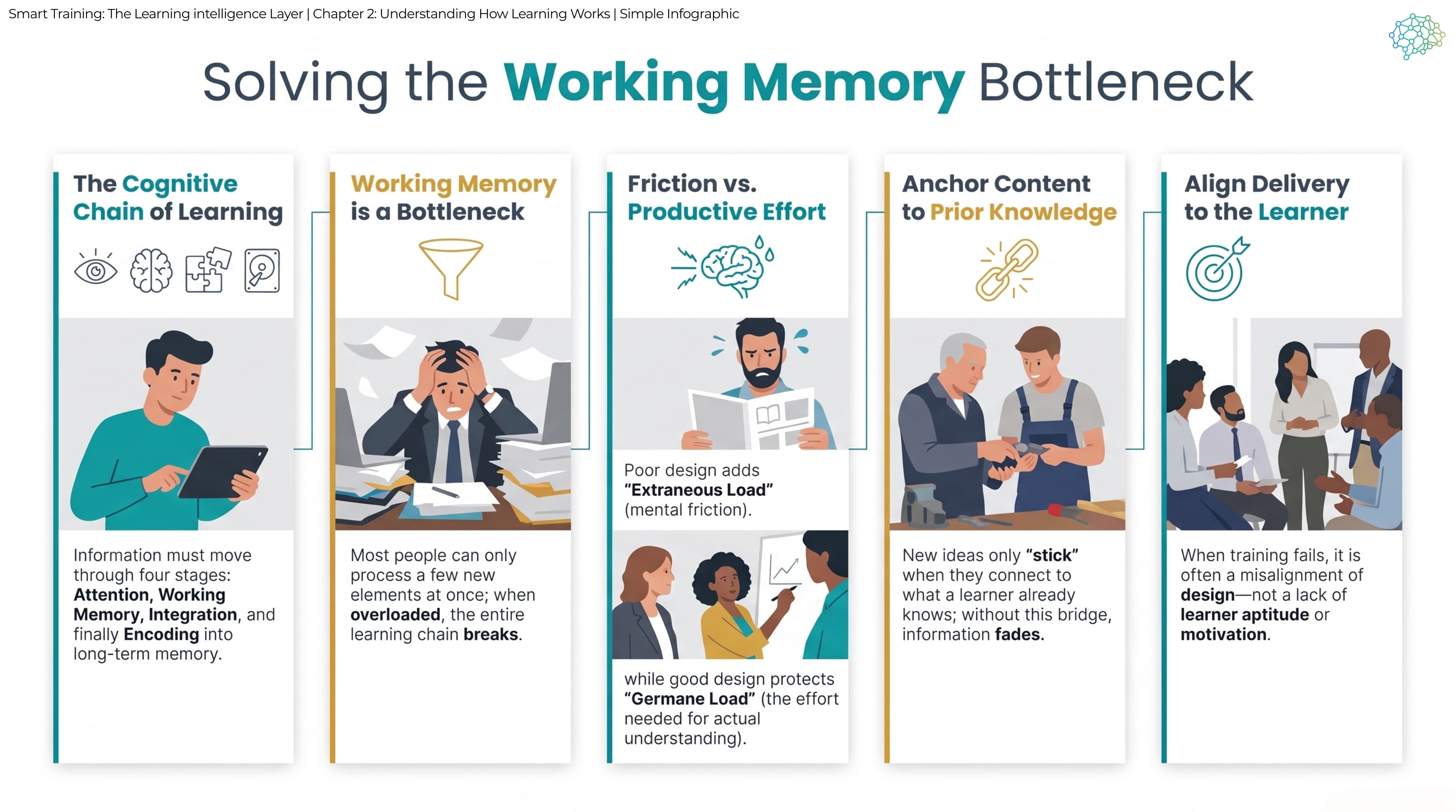
Learning is an active process that runs through a chain of stages: attention, working memory, integration with what is already known, and finally encoding into long-term memory. If any link fails, the learning does not become usable.
Working memory is the narrowest point. Most people can only handle a few new elements at once, and when it overloads the chain breaks. Poor design adds unnecessary mental friction, while good design protects capacity for the effort that builds real understanding.
New ideas also need something to attach to. Content anchored to prior knowledge holds; content that is not tends to fade. When training fails, Chapter 2 argues, the cause is usually a mismatch of design rather than a lack of ability or motivation.
New ideas only hold when they connect to something the learner already knows.
Watch or listen
Prefer to take it in by eye or by ear? Both cover the core ideas of Chapter 2 in a few minutes.
Film, 1 min
How cognitive load blocks learning
What happens when a session asks working memory to hold more than it can, and how design can take the load off. Captions are built in.
Conversation, 6 min
Why corporate training overloads working memory
A conversation about the cognitive chain of learning, and why dense sessions look fine on the day and leave little behind.
Chapter 2 at a glance
A quick overview, then the full argument with the evidence. Select either one to see it full size.
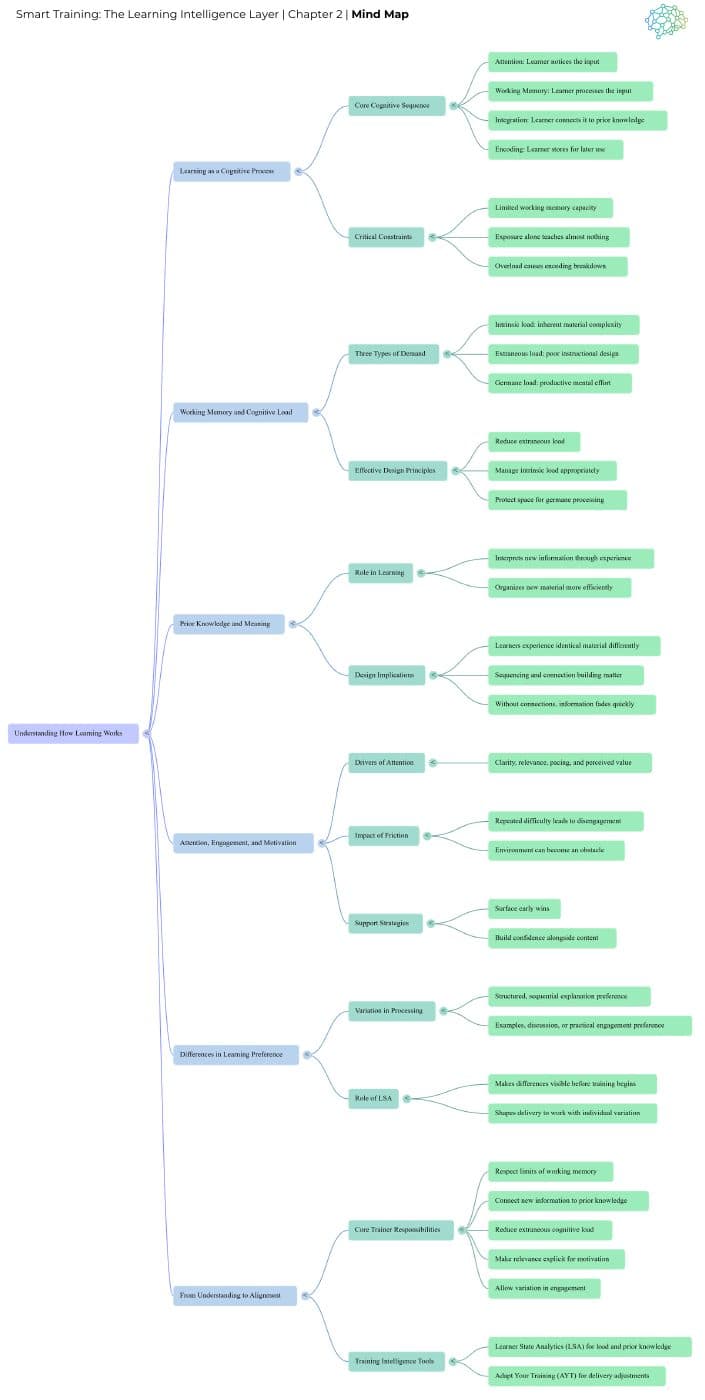
How the ideas connect
Every idea in Chapter 2 on one page. Look at it before you read to see the shape of the argument, or afterwards as a recap.
Put it into practice
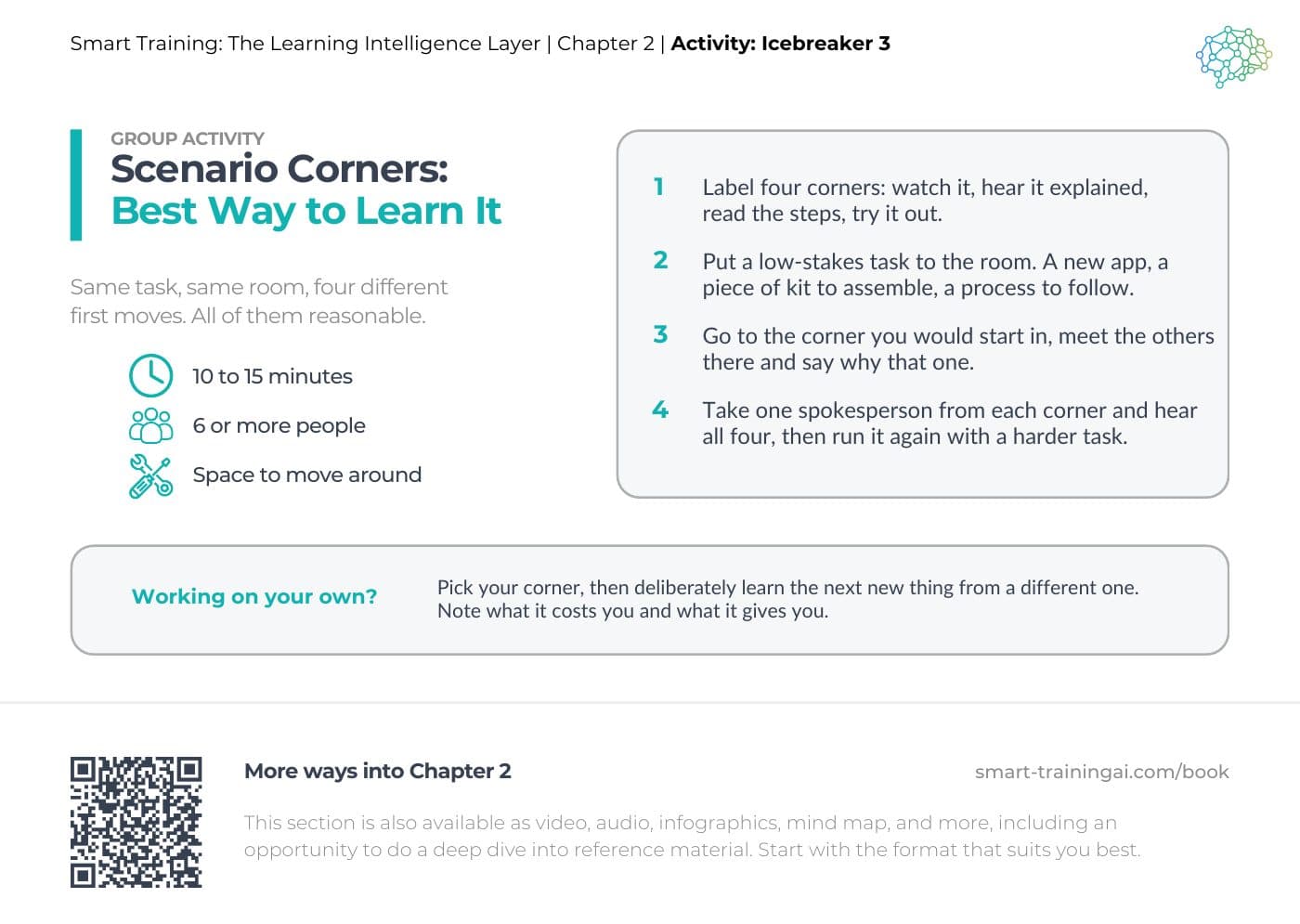
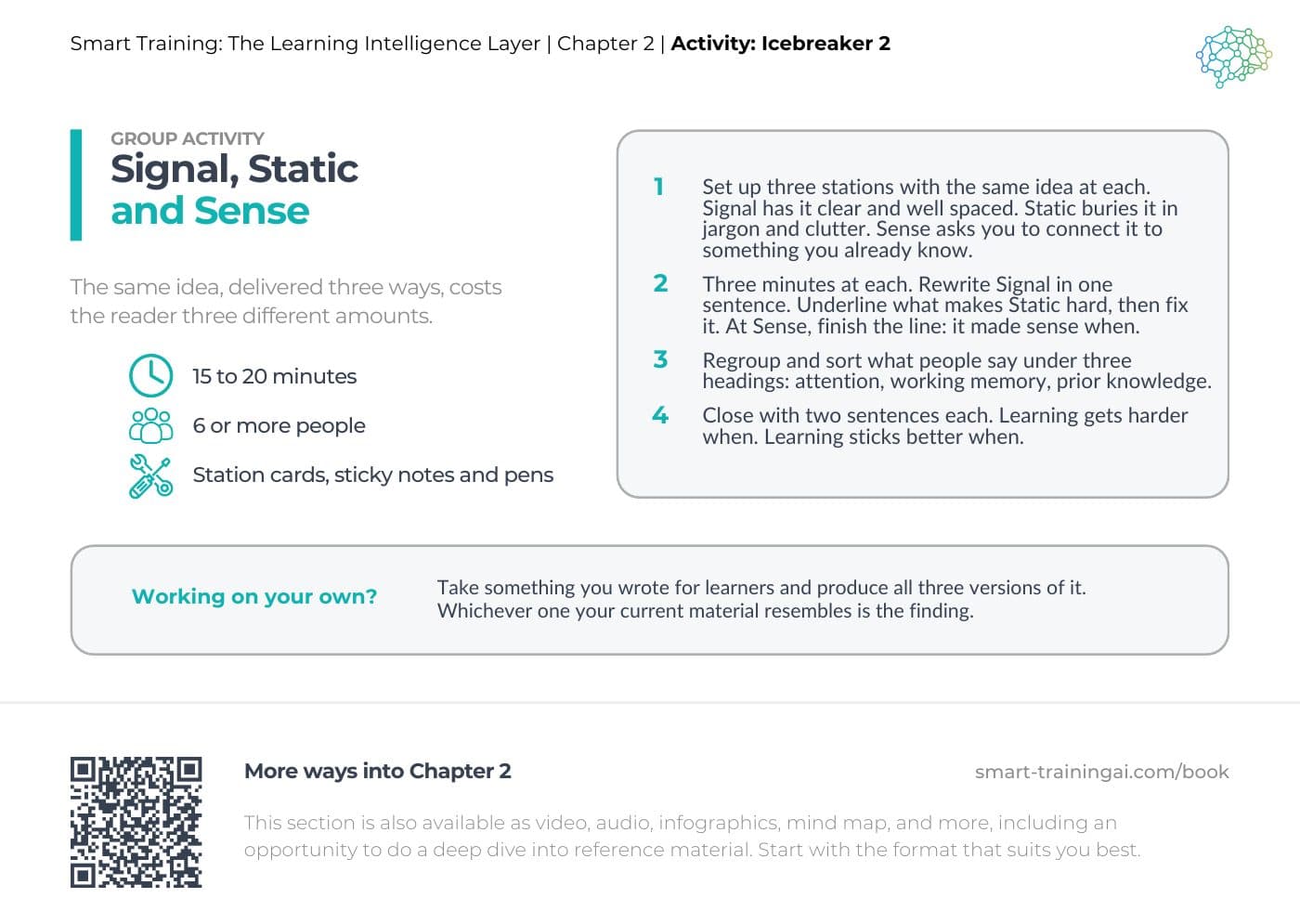
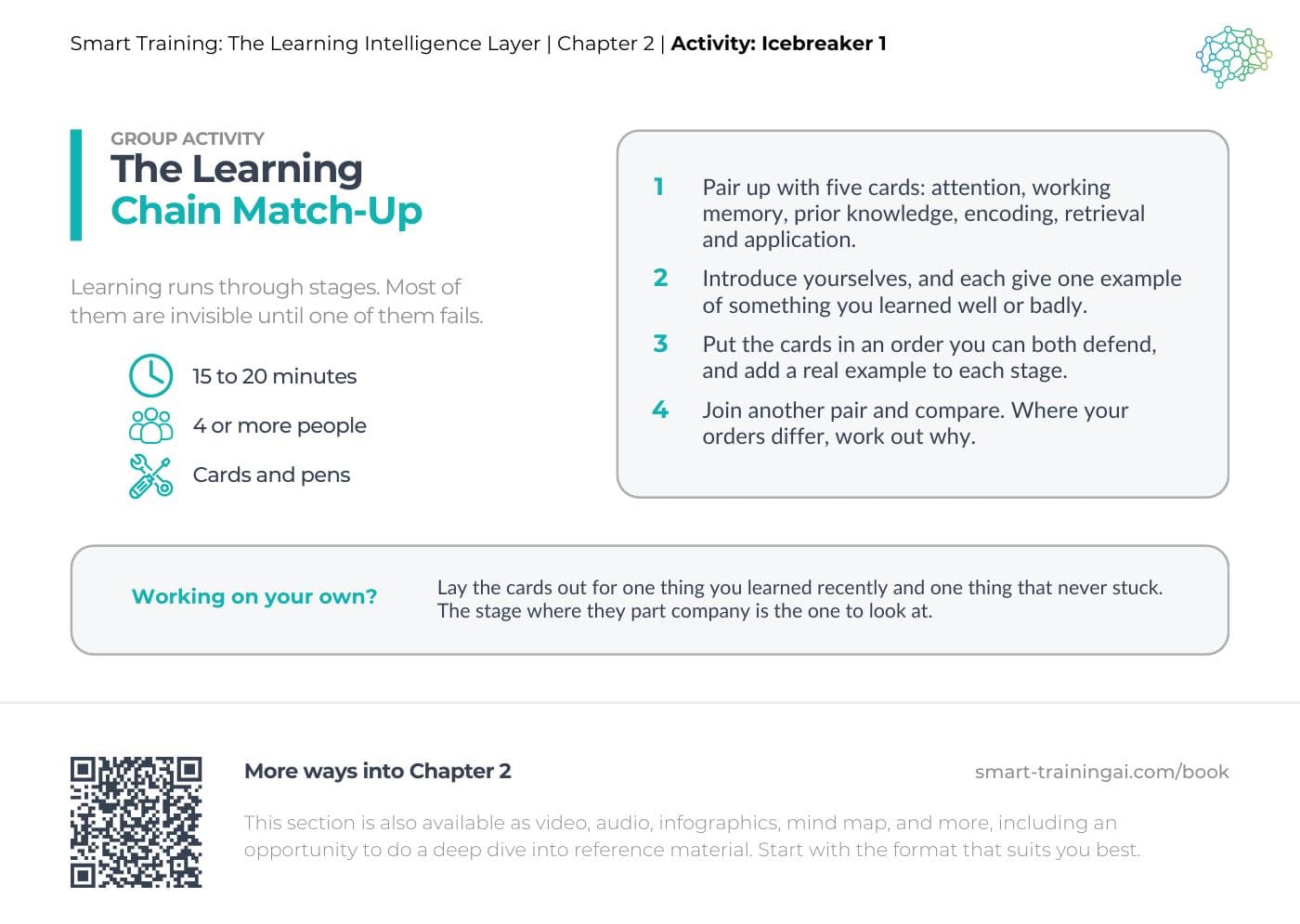
Short activities to run with a group or work through on your own. Each one has a printable card.
With a group (3)
On your own (3)
Go deeper
The research and writing behind Chapter 2.
- Atkinson and Shiffrin, 1968Human Memory: A Proposed System and its Control ProcessesThe classic model of memory as a series of stores, from sensory input to long-term memory.
- Alan Baddeley, Science, 1992Working MemoryA short overview of working memory as a limited system for holding and handling information.
- John Sweller, Cognitive Science, 1988Cognitive Load During Problem Solving: Effects on LearningThe paper that introduced cognitive load theory.
- Sweller, Ayres and Kalyuga, SpringerCognitive Load TheoryThe full account of the theory, and what it means for designing instruction.