The missing step

A companion to Chapter 3 of the book, Teaching and Learning Today. The same ideas in several forms: film, conversation, 2 infographics, a mind map and 6 activities. Start with whichever suits you.


Chapter 3 in two minutes

Most training is built around coverage. Objectives are set, materials prepared and sessions scheduled so that everything fits, and everyone gets the same materials, pace and structure. Chapter 3 calls this the standardisation trap: consistency of exposure does not guarantee consistency of learning.

Technology has not closed the gap on its own. Digital platforms often reproduce the old lecture model instead of rethinking the design. And assessment that only measures outcomes shows what happened, not why learning broke down.

The chapter's answer is a step between design and delivery: preparation intelligence. Understanding how a particular group is likely to engage, before the session, lets trainers move from broadcasting content to delivery aligned with the people in the room.

Consistency of exposure does not guarantee consistency of learning.

Watch or listen

Prefer to take it in by eye or by ear? Both cover the core ideas of Chapter 3 in a few minutes.

Film, 1 min

The missing step in corporate training

Why training goes straight from design to delivery, and what changes when understanding the group comes in between. Captions are built in.

Conversation, 6 min

Why one-size-fits-all training fails

A conversation about the coverage model, the assessment blind spot, and what preparation can do that reacting in the room cannot.

0:000:00

Chapter 3 at a glance

A quick overview, then the full argument with the evidence. Select either one to see it full size.

Training That Works: The Missing Step
Infographic showing the missing preparation step between training design and delivery.
Bridging Training Design and Delivery
Detailed infographic: the standardisation trap, technology without pedagogy, and the assessment blind spot; preparation intelligence as the missing step between design and delivery; and a workflow comparison of content-led broadcast delivery against an aligned, learner-centred experience.

How the ideas connect

Every idea in Chapter 3 on one page. Look at it before you read to see the shape of the argument, or afterwards as a recap.
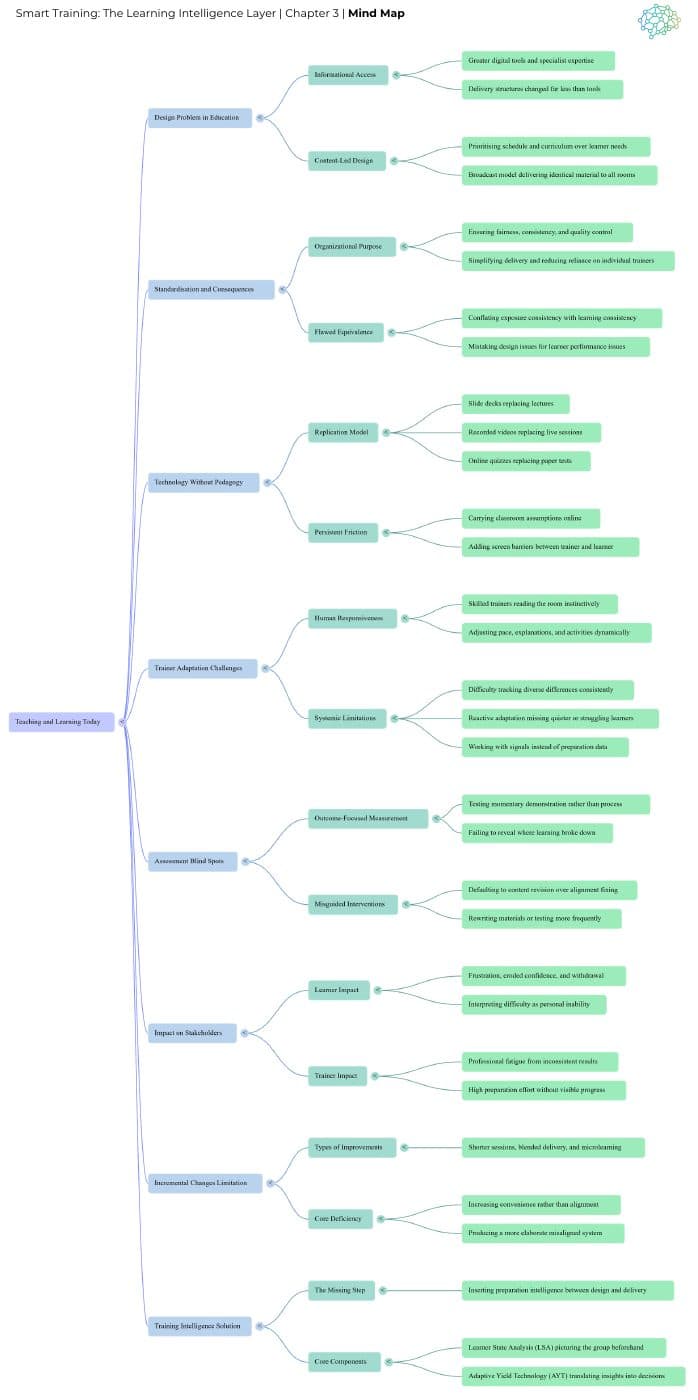
Mind map of Chapter 3.

Put it into practice

Short activities to run with a group or work through on your own. Each one has a printable card.

With a group (3)

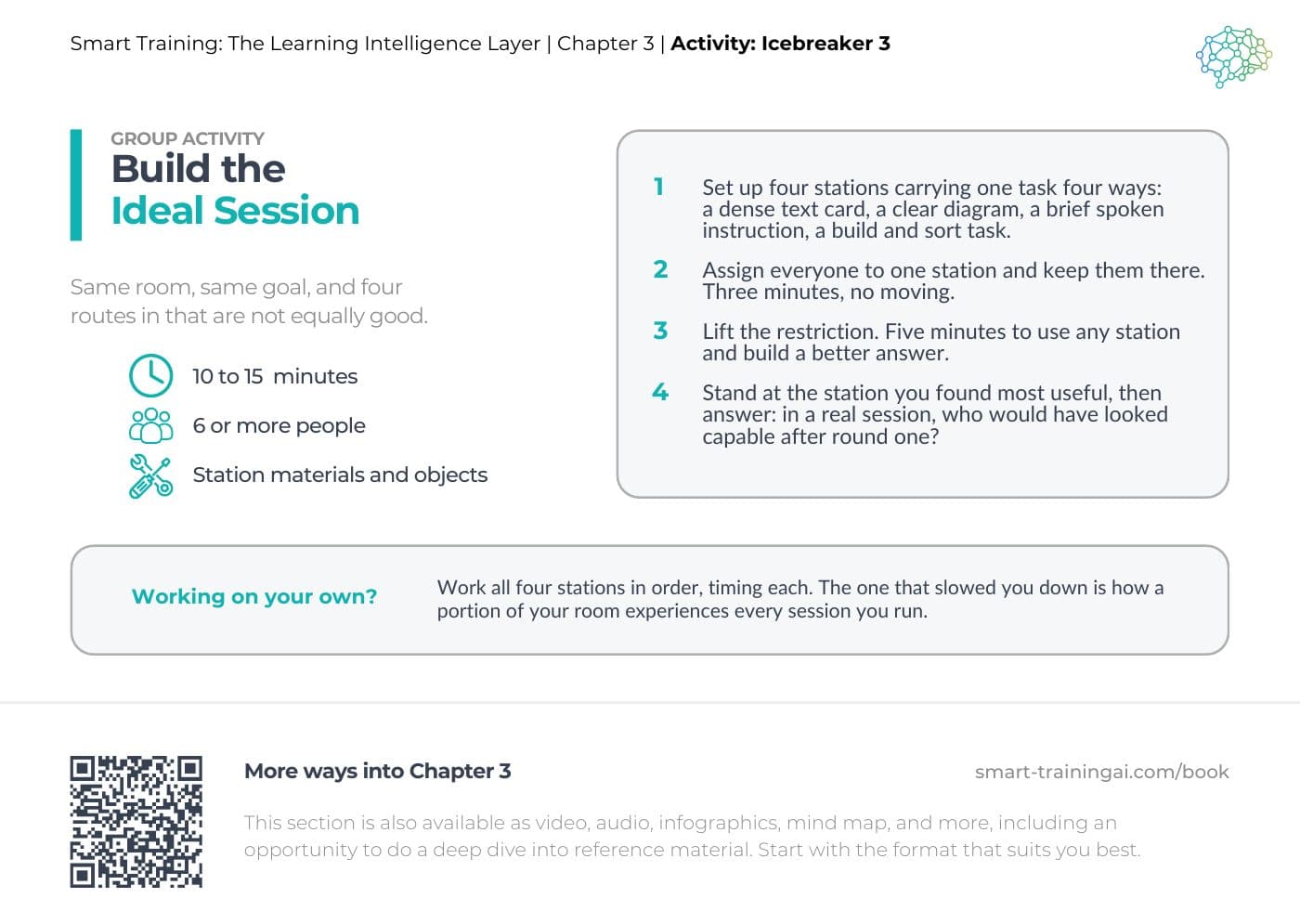
  • Printable card for Same Task, Different Experience
    Time
    10 to 15 minutes
    Who
    6 or more people
    You will need
    Prompt sheet and pens

    Icebreaker

    Same Task, Different Experience

    Standardised delivery does not produce standardised learning. Easier to feel than to argue.

    1. Give everyone the same problem, written out densely and nothing else. A trainer runs the same material with three groups and gets three different results. List three reasons, without assuming the content changed.
    2. Two minutes, working alone. No discussion, no diagrams, no rewriting it.
    3. Now open it up. Three more minutes, and rework it any way you like. Sketch it, talk it through, map the causes, put it in your own words.
    4. Debrief: did it get easier because you got smarter, or because the method changed?

    Working on your own? Run both rounds yourself and time them. The second round is the same problem with the restrictions lifted, which is the whole chapter in five minutes.

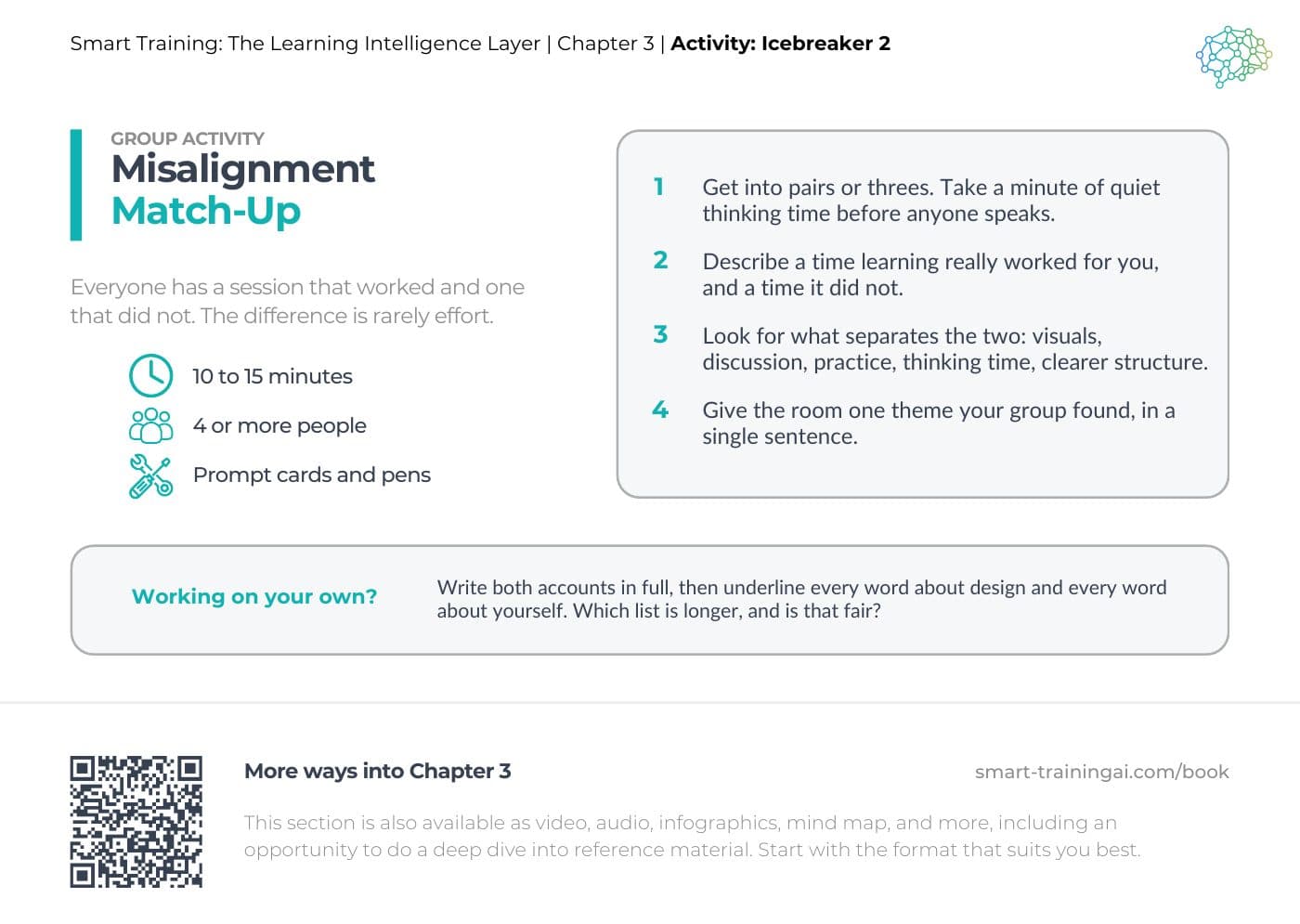
  • Printable card for Misalignment Match-Up
    Time
    10 to 15 minutes
    Who
    4 or more people
    You will need
    Prompt cards and pens

    Icebreaker

    Misalignment Match-Up

    Everyone has a session that worked and one that did not. The difference is rarely effort.

    1. Get into pairs or threes. Take a minute of quiet thinking time before anyone speaks.
    2. Describe a time learning really worked for you, and a time it did not.
    3. Look for what separates the two: visuals, discussion, practice, thinking time, clearer structure.
    4. Give the room one theme your group found, in a single sentence.

    Working on your own? Write both accounts in full, then underline every word about design and every word about yourself. Which list is longer, and is that fair?

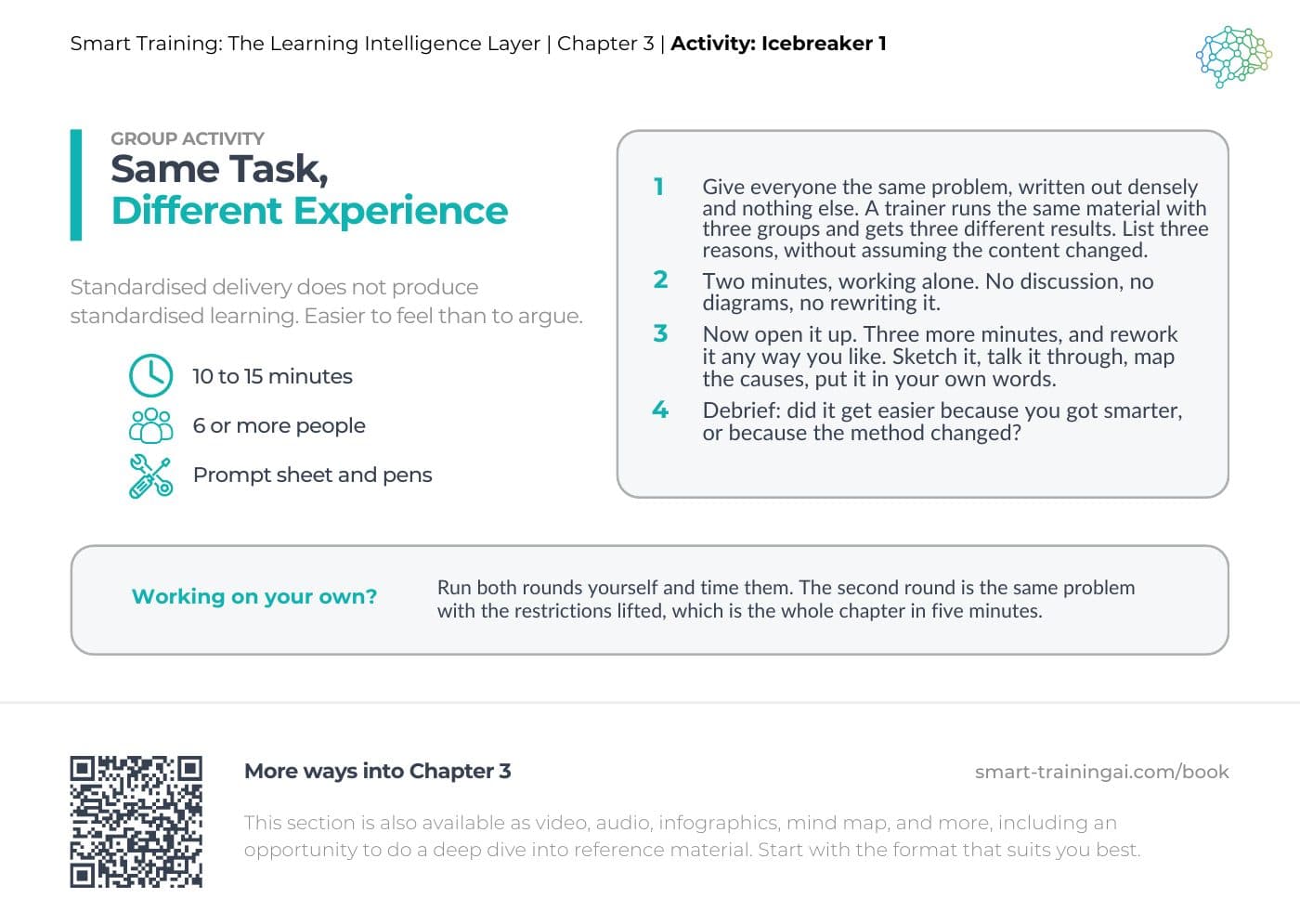
  • Printable card for Build the Ideal Session
    Time
    10 to 15 minutes
    Who
    6 or more people
    You will need
    Station materials and objects

    Icebreaker

    Build the Ideal Session

    Same room, same goal, and four routes in that are not equally good.

    1. Set up four stations carrying one task four ways: a dense text card, a clear diagram, a brief spoken instruction, a build and sort task.
    2. Assign everyone to one station and keep them there. Three minutes, no moving.
    3. Lift the restriction. Five minutes to use any station and build a better answer.
    4. Stand at the station you found most useful, then answer: in a real session, who would have looked capable after round one?

    Working on your own? Work all four stations in order, timing each. The one that slowed you down is how a portion of your room experiences every session you run.

On your own (3)

  • Printable card for How Did the Learning Work for Me?
    Time
    10 to 15 minutes
    Who
    On your own
    You will need
    Notebook or journal and pen

    Journaling

    How Did the Learning Work for Me?

    Most reflection records what was covered. This one records how it landed.

    1. Name the three ideas that mattered most, the one that came easily, and the one that did not.
    2. Say when it started to make sense, and what did it: reading, writing, discussing, seeing it done, trying it.
    3. Find where you lost track. What caused it? Pace, missing examples, too long listening, too little structure.
    4. Finish with what would change if the session were built for you, and the line: I learn best when.

    Working with a group? Collect the answers rather than discuss them. Repeated comments on pace or structure tell a trainer more than any feedback form.

  • Printable card for What Is Actually Going Wrong Here?
    Time
    20 to 25 minutes
    Who
    On your own
    You will need
    Paper and pen

    Problem solving

    What Is Actually Going Wrong Here?

    One session, three groups, three sets of results. The trainer added more slides.

    1. State what the trainer believes about teaching, and which part of that belief is doing the damage.
    2. Say what the quiz shows, and what it cannot show. The gap between those is the blind spot.
    3. Explain why reading the third group as less capable is the risky conclusion rather than the obvious one.
    4. Name what should be found out before the session is redesigned, without adding a single slide.

    Working with a group? Have everyone answer alone, then compare what each person would investigate first. The order people choose says a lot about how they diagnose.

  • Printable card for Covering It or Landing It
    Time
    30 to 40 minutes
    Who
    On your own
    You will need
    Paper and pen

    Worksheet

    Covering It or Landing It

    Consistency guarantees that everyone gets the same session. Nothing beyond that.

    1. Read Approach A. Training is built around what has to be covered. Objectives are set, materials prepared, and sessions scheduled so that everything required fits. Everyone gets the same materials, pace and structure, and success is measured by what learners can show at the end.
    2. Read Approach B. Training is built around how this particular group is likely to process and engage with the material, with those decisions made before anyone walks in. Delivery adapts , and reflection is used to find where learning broke down rather than only what was retained.
    3. Compare them: what each approach assumes a session is for; what standardisation guarantees, and what it does not; what outcome assessment shows and misses; instinct in the room against insight before it.
    4. Critique both. What should be kept from the coverage model? How does the blind spot send trainers the wrong way? What does preparation give that reacting cannot? Where does it get harder at scale?
    5. Make a judgement. Adding more tools or more content is often a weak answer to the wrong problem. Say what the wrong problem is, argue it from the chapter, and state how far you agree. Finish the sentence: The argument in this chapter I would question most is…
Smart Training AI logo

Empowering trainers to boost engagement and results through targeted, adaptive learning

© 2025 Smart Training AI™ All rights reserved.