From reactive to intentional

A companion to Chapter 4 of the book, How AI Can Personalise Learning. The same ideas in several forms: film, conversation, 2 infographics, a mind map and 6 activities. Start with whichever suits you.

Chapter 4 in two minutes

Conventional training adapts in the room. The trainer reads the group as the session runs and adjusts when confusion becomes visible, often too late, and always while delivering at the same time.

Chapter 4 describes how AI-supported learning intelligence can close that preparation gap. It identifies patterns in how a group is likely to engage before the session begins, giving the trainer's instinct a baseline to work from rather than replacing it.

The personalisation happens at group level: adjusting pace and emphasis for the whole cohort, not building separate pathways for each person. Flexible session design also supports neurodiversity and differences in background without singling anyone out. The content and curriculum stay the same; the technology follows the pedagogy.

Knowledge gain, in percentage points

+40.9

Adaptive, AI-supported: 39.6% before, 80.5% after

+21.2

Conventional: 38.2% before, 59.4% after

Pre- and post-course scores for adaptive and conventional training using identical content.

Watch or listen

Prefer to take it in by eye or by ear? Both cover the core ideas of Chapter 4 in a few minutes.

Film, 1 min

How AI personalises group training

How seeing the group's preferences before delivery lets a trainer plan the session instead of improvising it. Captions are built in.

Conversation, 6 min

How learner insight improves group training

A conversation about group-level personalisation, what the evidence shows, and why the trainer's judgement stays at the centre.

0:000:00

Chapter 4 at a glance

A quick overview, then the full argument with the evidence. Select either one to see it full size.

Smart Training Transition Principles
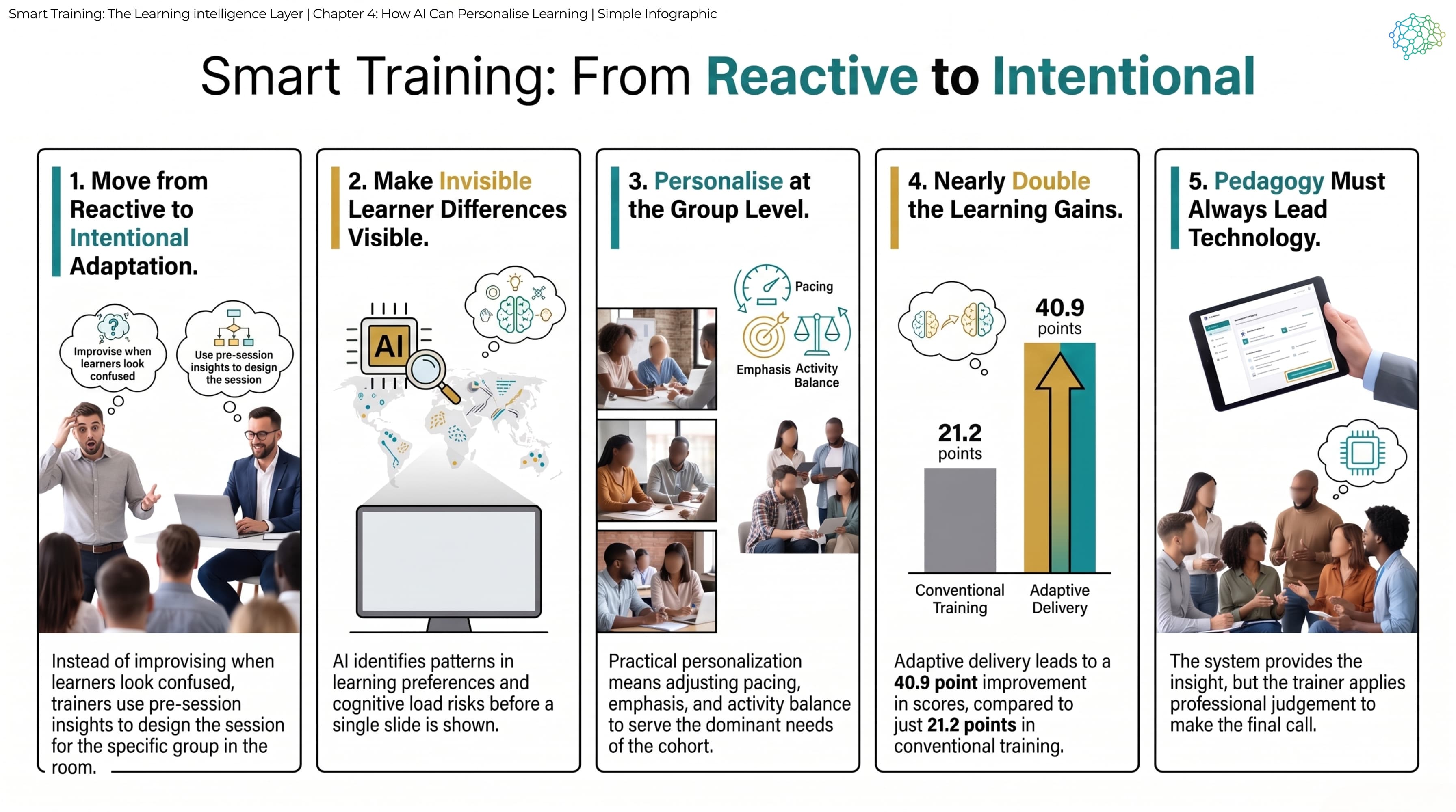
Infographic setting out the principles for moving from reactive to intentional, learner-aligned training.
From Reactive to Intentional Learning
Detailed infographic: closing the preparation gap, visibility before delivery, inclusion by design, technology following pedagogy and group-level personalisation, with a table of outcomes. Conventional training went from 38.2% to 59.4%, a gain of 21.2 points; adaptive, AI-supported training went from 39.6% to 80.5%, a gain of 40.9 points.

How the ideas connect

Every idea in Chapter 4 on one page. Look at it before you read to see the shape of the argument, or afterwards as a recap.
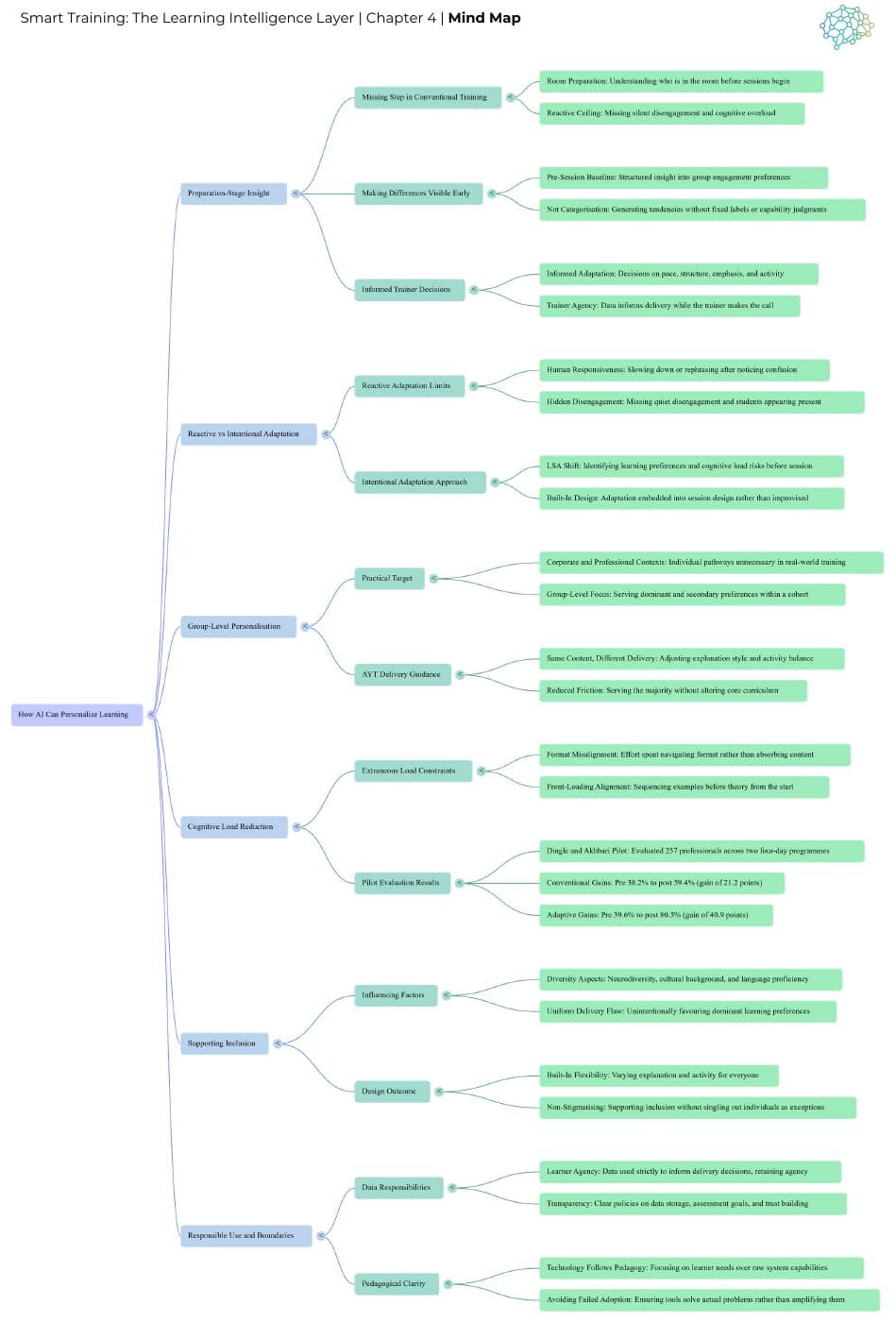
Mind map of Chapter 4.

Put it into practice

Short activities to run with a group or work through on your own. Each one has a printable card.

With a group (3)

  • Printable card for The Training Build Challenge
    Time
    15 to 20 minutes
    Who
    6 or more people
    You will need
    Three card envelopes per team

    Icebreaker

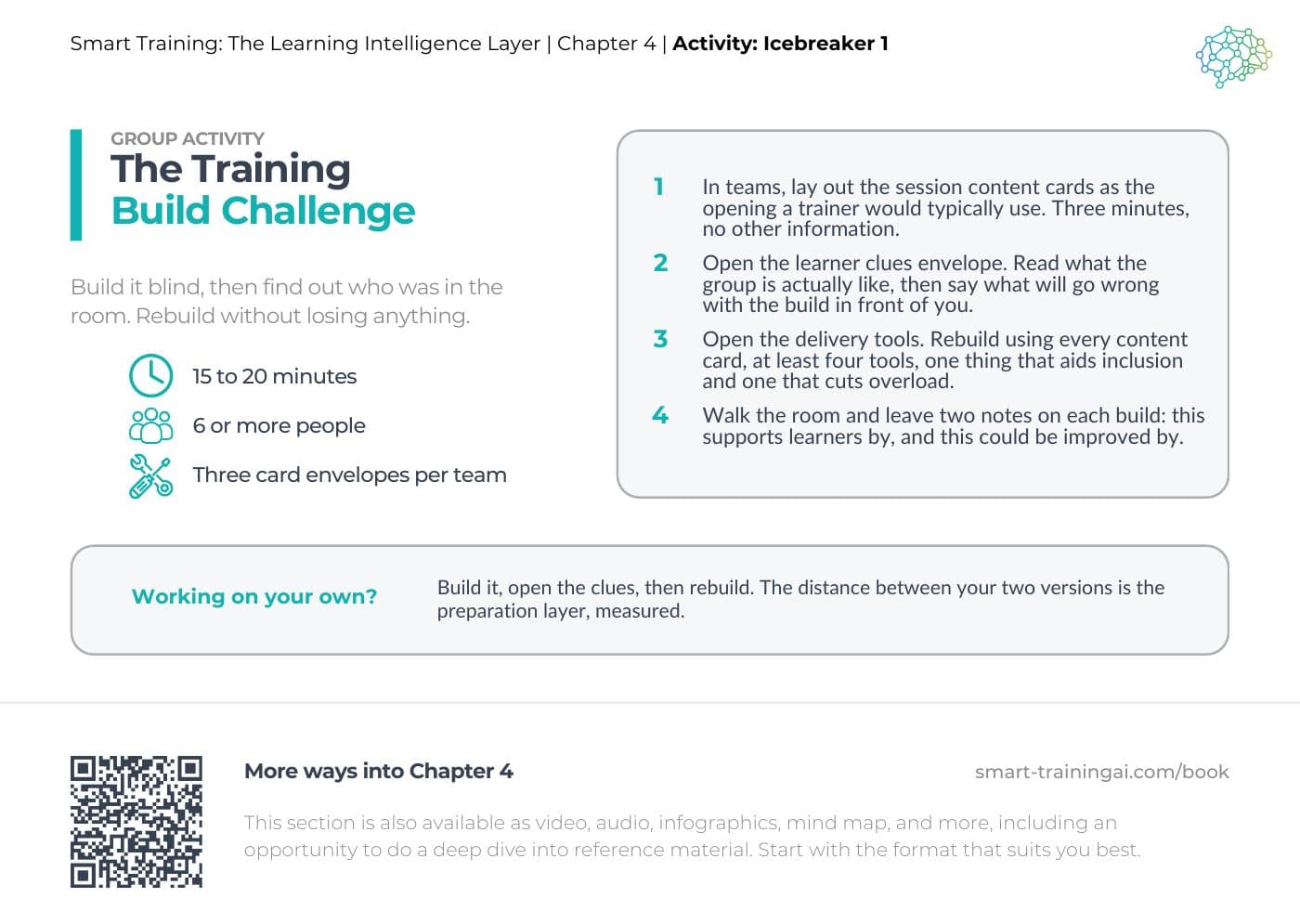
    The Training Build Challenge

    Build it blind, then find out who was in the room. Rebuild without losing anything.

    1. In teams, lay out the session content cards as the opening a trainer would typically use. Three minutes, no other information.
    2. Open the learner clues envelope. Read what the group is actually like, then say what will go wrong with the build in front of you.
    3. Open the delivery tools. Rebuild using every content card, at least four tools, one thing that aids inclusion and one that cuts overload.
    4. Walk the room and leave two notes on each build: this supports learners by, and this could be improved by.

    Working on your own? Build it, open the clues, then rebuild. The distance between your two versions is the preparation layer, measured.

  • Printable card for Design the Room Before the Room
    Time
    15 to 20 minutes
    Who
    4 or more people
    You will need
    Sticky notes and pens

    Icebreaker

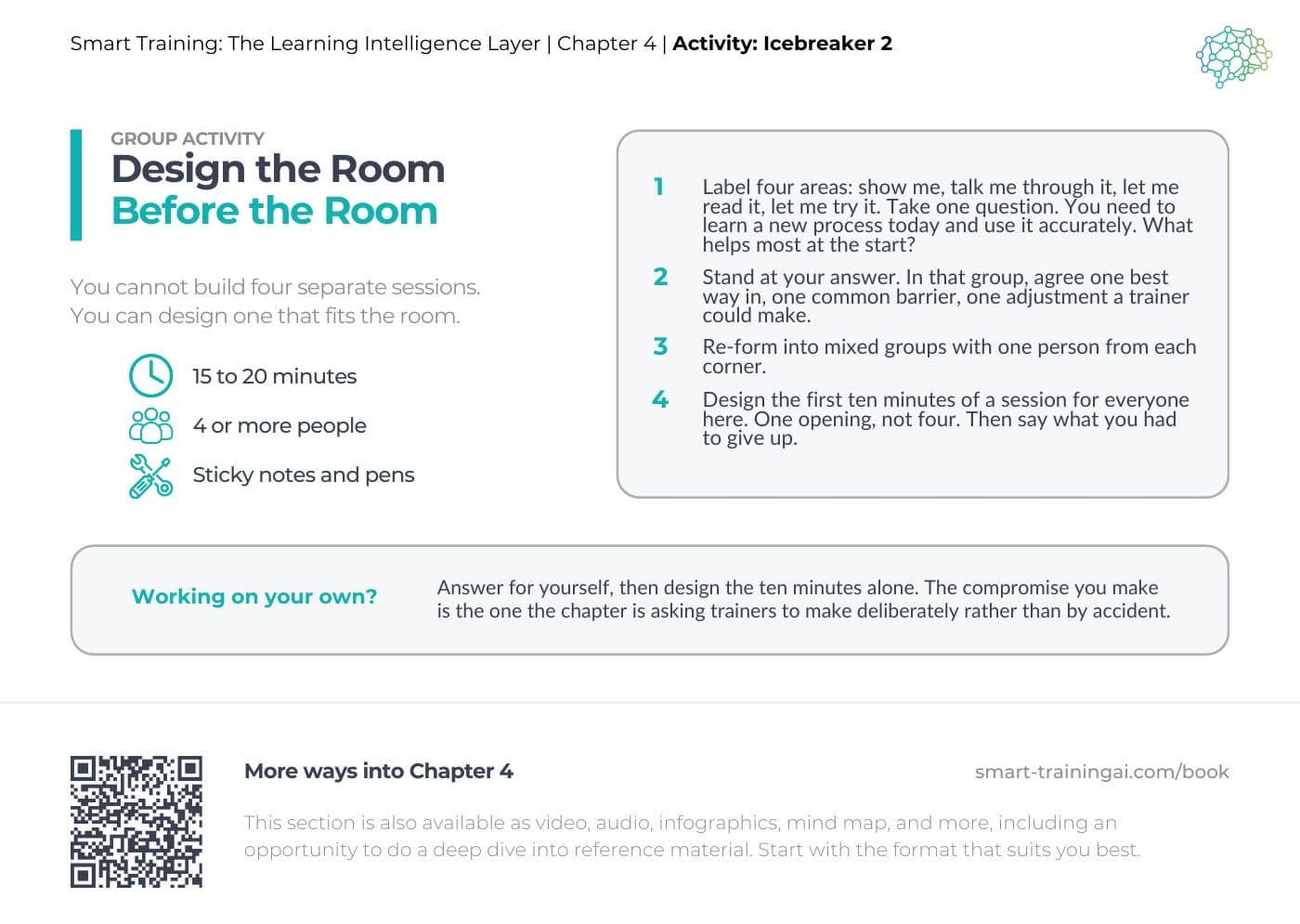
    Design the Room Before the Room

    You cannot build four separate sessions. You can design one that fits the room.

    1. Label four areas: show me, talk me through it, let me read it, let me try it. Take one question. You need to learn a new process today and use it accurately. What helps most at the start?
    2. Stand at your answer. In that group, agree one best way in, one common barrier, one adjustment a trainer could make.
    3. Re-form into mixed groups with one person from each corner.
    4. Design the first ten minutes of a session for everyone here. One opening, not four. Then say what you had to give up.

    Working on your own? Answer for yourself, then design the ten minutes alone. The compromise you make is the one the chapter is asking trainers to make deliberately rather than by accident.

  • Printable card for Scenario Sort: Best Way to Teach It
    Time
    15 to 20 minutes
    Who
    4 or more people
    You will need
    Scenario cards and pens

    Icebreaker

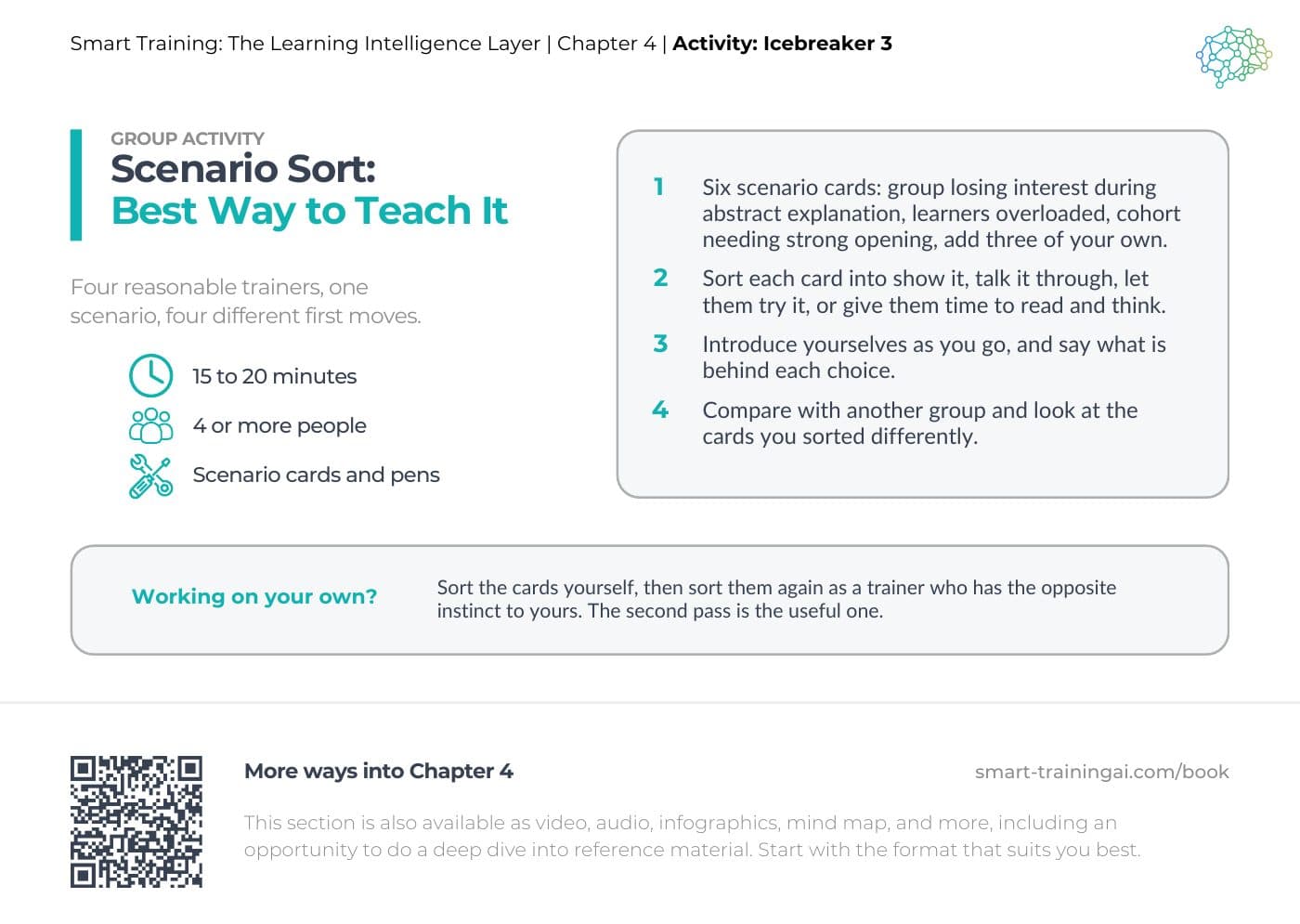
    Scenario Sort: Best Way to Teach It

    Four reasonable trainers, one scenario, four different first moves.

    1. Six scenario cards: group losing interest during abstract explanation, learners overloaded, cohort needing strong opening, add three of your own.
    2. Sort each card into show it, talk it through, let them try it, or give them time to read and think.
    3. Introduce yourselves as you go, and say what is behind each choice.
    4. Compare with another group and look at the cards you sorted differently.

    Working on your own? Sort the cards yourself, then sort them again as a trainer who has the opposite instinct to yours. The second pass is the useful one.

On your own (3)

  • Printable card for Same Content Better Delivery
    Time
    20 to 25 minutes
    Who
    On your own
    You will need
    Notebook or journal and pen

    Journaling

    Same Content Better Delivery

    The missing step sits before the session, not inside it.

    1. Write what the missing step in training design is, and what technology adds at the preparation stage.
    2. Explain the difference between reactive adaptation and intentional adaptation, in your own words.
    3. Say why learner differences stay invisible in conventional training until they become problems.
    4. If you had learner insight before your next session, name the three things you would change, and what professional judgement still decides.

    Working with a group? Write first, then underline one sentence that explains the chapter well, one question still open, and one action you would take. Collect the questions.

  • Printable card for Redesign the Session
    Time
    25 to 35 minutes
    Who
    On your own
    You will need
    Paper and pen

    Problem solving

    Redesign the Session

    You know the room before you walk in. The content stays. The delivery does not.

    1. List what goes wrong if the session runs one uniform way, and who carries that cost.
    2. Rebuild the opening 45 mins. Decide what comes first: theory, example, discussion, writing, or doing.
    3. Pick three design decisions and say what each one takes off the learner rather than adds.
    4. Say how you handle the spread in prior knowledge without singling anybody out.

    Working with a group? Redesign separately, then compare opening moves. The disagreement about what comes first is where the thinking is.

  • Printable card for Adapting Late or Planning Early
    Time
    30 to 40 minutes
    Who
    On your own
    You will need
    Paper and pen

    Worksheet

    Adapting Late or Planning Early

    Identical content, aligned delivery, different results. Worth checking what that proves.

    1. Read Approach A. Conventional design adapts in the room. Trainer prepares the material, reads the group as sessions run, adjusting where something is not working. Learner difference becomes visible late, if at all, and whatever is noticed has to be handled while delivering at the same time.
    2. Read Approach B. Insight into how the group is likely to engage gathered before the session. Trainer uses it to set pace, structure, emphasis and activity in advance. Content and curriculum remain unchanged. Data informs decisions, doesn’t replace trainer judgement.
    3. Compare them: what happens before anyone walks in; when learner difference becomes visible; what the trainer is deciding, and when; which model carries less unnecessary load.
    4. Critique both. What does reading the room in real time do well? What stays invisible until it is too late to act? What does deciding in advance make possible? What happens if learner insight is overapplied?
    5. Make a judgement. The content was identical, the delivery was aligned, and the outcome differed. Say what that evidence supports, and what conclusion would be reaching too far. Finish the sentence: Responsible use of learner insight would require…
Smart Training AI logo

Empowering trainers to boost engagement and results through targeted, adaptive learning

© 2025 Smart Training AI™ All rights reserved.