Seventy years of theory, waiting for the tools

A companion to Chapter 5 of the book, The History of Learning Theories. The same ideas in several forms: film, conversation, 2 infographics, a mind map and 6 activities. Start with whichever suits you.

Chapter 5 in two minutes

Chapter 5 traces how thinking about learning has changed. In the 1950s and 60s, behaviourism's stimulus and response gave way to cognitive theory and the mind as an active processor. In the 1970s and 80s, constructivism and experiential learning showed people building meaning through doing, reflecting and working with others.

By the 1990s, instructional design models such as ADDIE brought consistency and quality to programmes, but they fixed the design before the learner entered the room. Theory recognised that people learn differently; practice had no practical way to act on it.

The chapter argues that the 2020s mark a convergence. Training intelligence gives trainers an operational tool to apply principles that have been established for decades, adapting delivery to the people in front of them.

Any subject can be taught effectively in some intellectually honest form to any child at any stage of development.
Jerome Bruner, The Process of Education, 1960

Watch or listen

Prefer to take it in by eye or by ear? Both cover the core ideas of Chapter 5 in a few minutes.

Film, 2 min

The century-long quest to fix corporate training

From Pavlov to ADDIE to the present: how learning theory developed, and why practice took so long to follow. Captions are built in.

Conversation, 5 min

Why most corporate training fails

A conversation about the learning theories behind the book, and the gap between knowing how people learn and acting on it.

0:000:00

Chapter 5 at a glance

A quick overview, then the full argument with the evidence. Select either one to see it full size.

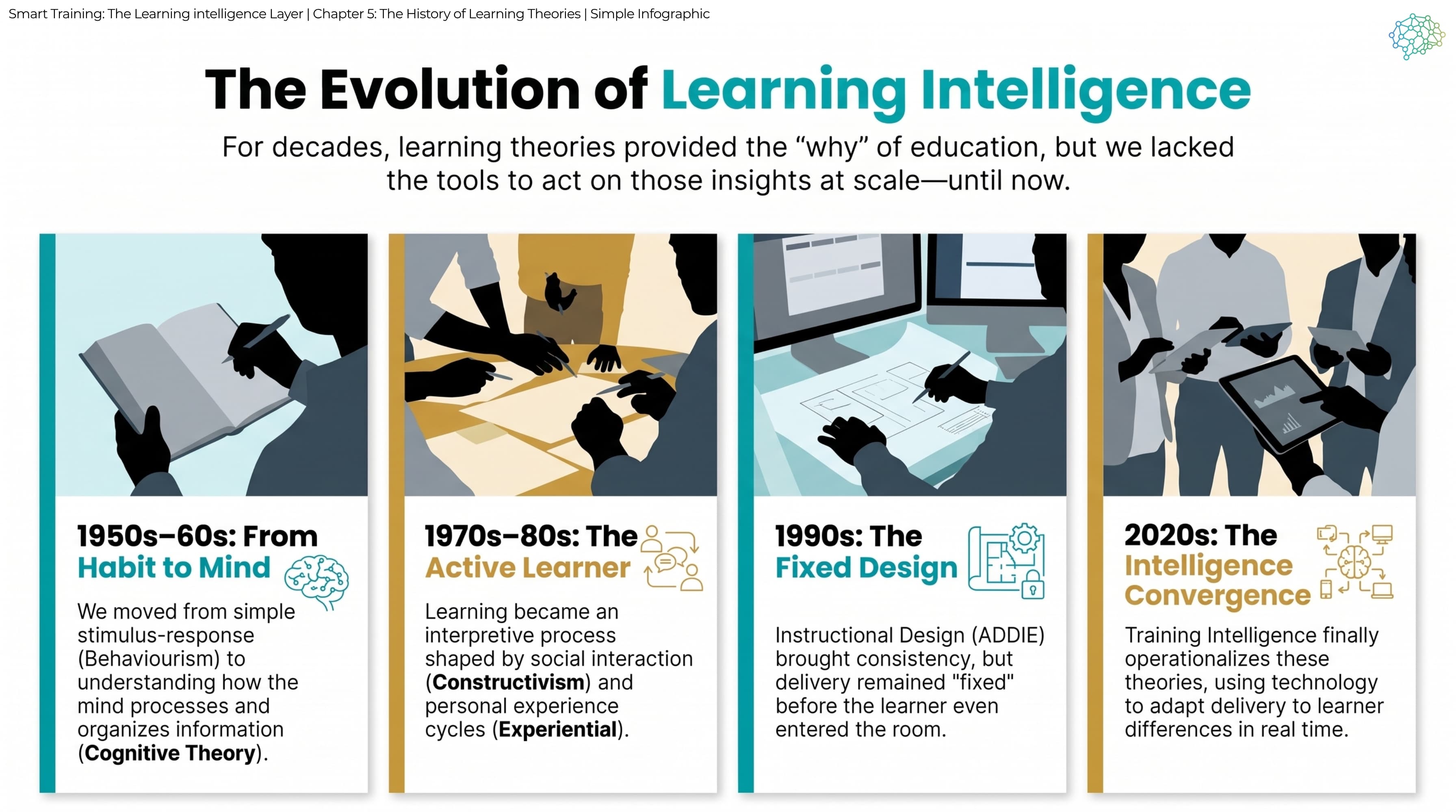
The Evolution of Learning Intelligence
Timeline infographic: 1950s and 60s from habit to mind; 1970s and 80s the active learner; 1990s the fixed design of ADDIE; 2020s the intelligence convergence.
Seven Decades of Learning
Detailed infographic: from stimulus to meaning, the diversity of capability, the fixed-design limitation and the missing operational tool, with a table of eras and dominant theories and Jerome Bruner's 1960 hypothesis.

How the ideas connect

Every idea in Chapter 5 on one page. Look at it before you read to see the shape of the argument, or afterwards as a recap.
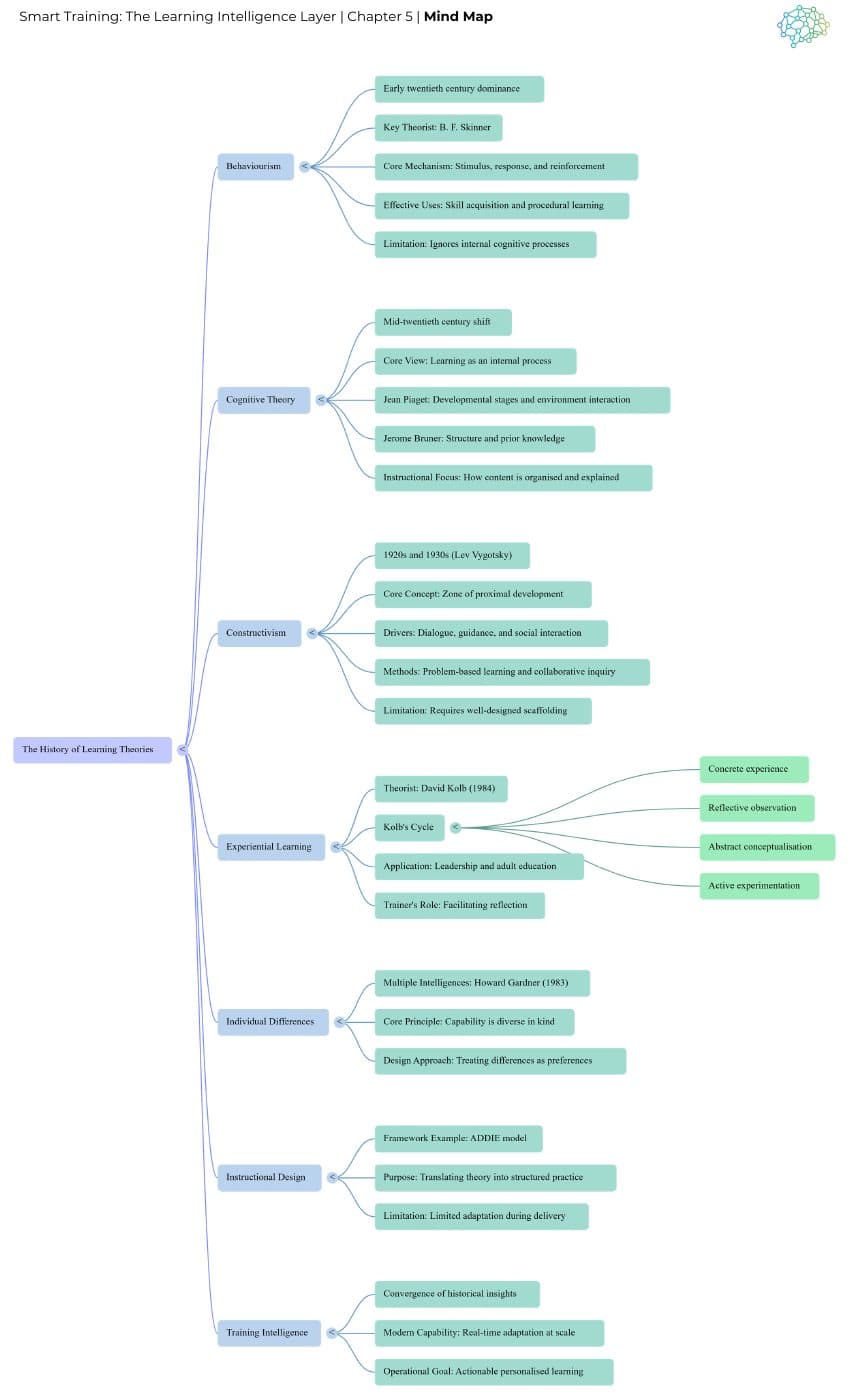
Mind map of Chapter 5.

Put it into practice

Short activities to run with a group or work through on your own. Each one has a printable card.

With a group (3)

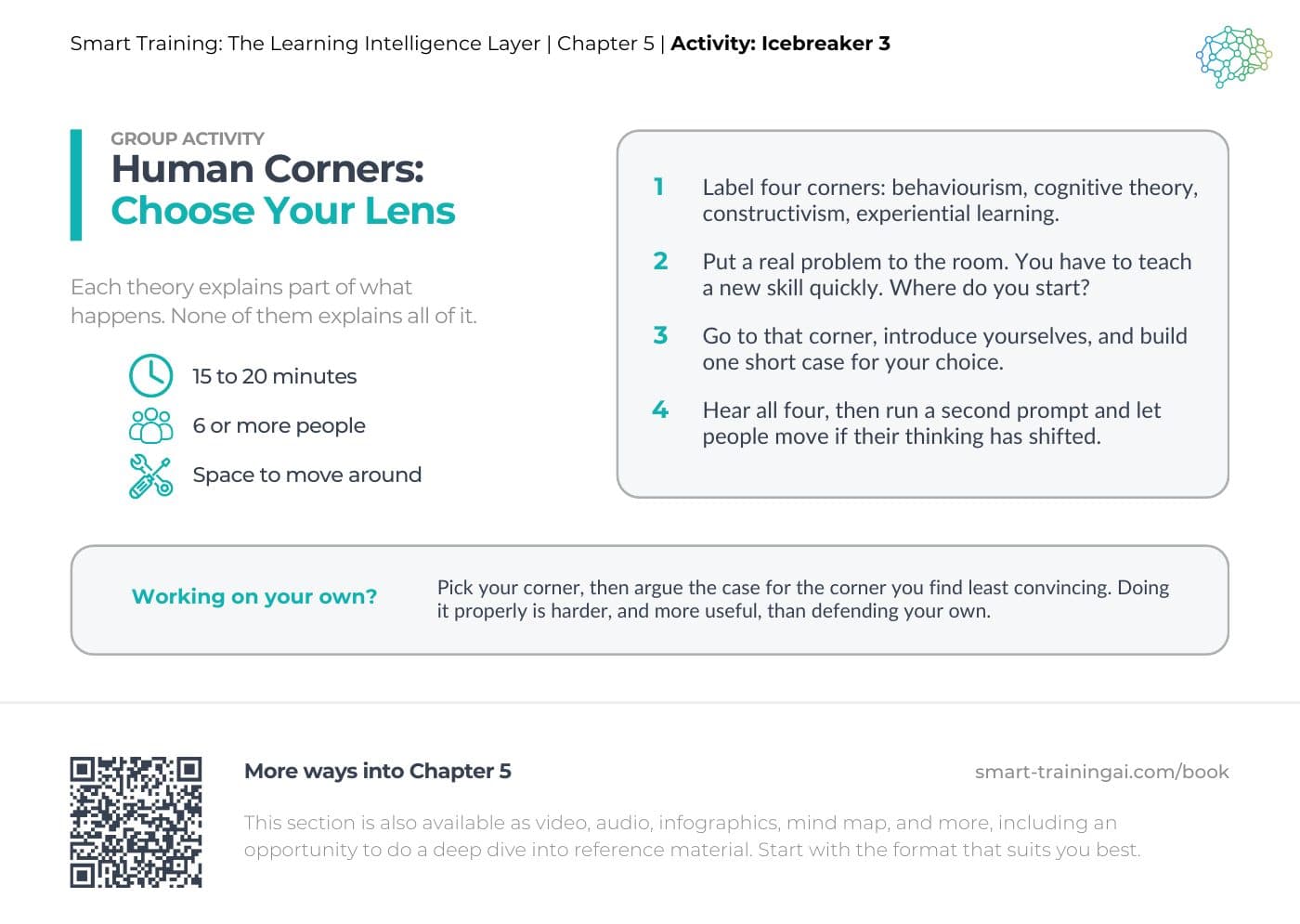
  • Printable card for Learning Theory Timeline Match-Up
    Time
    20 to 25 minutes
    Who
    4 or more people
    You will need
    Cards and a large surface

    Icebreaker

    Learning Theory Timeline Match-Up

    Every idea about how people learn arrived in answer to the one before it.

    1. Lay out two sets of cards: the theories, and the names and ideas that belong to them.
    2. In small groups, match them up and place them along a timeline you can all defend.
    3. Argue the order. Where a card could sit in two places, work out why.
    4. Each person introduces themselves and names the theory or thinker they connect with most.

    Working on your own? Lay the timeline out, then mark which theory the last training you ran was built on. Most sessions quietly belong to one of them.

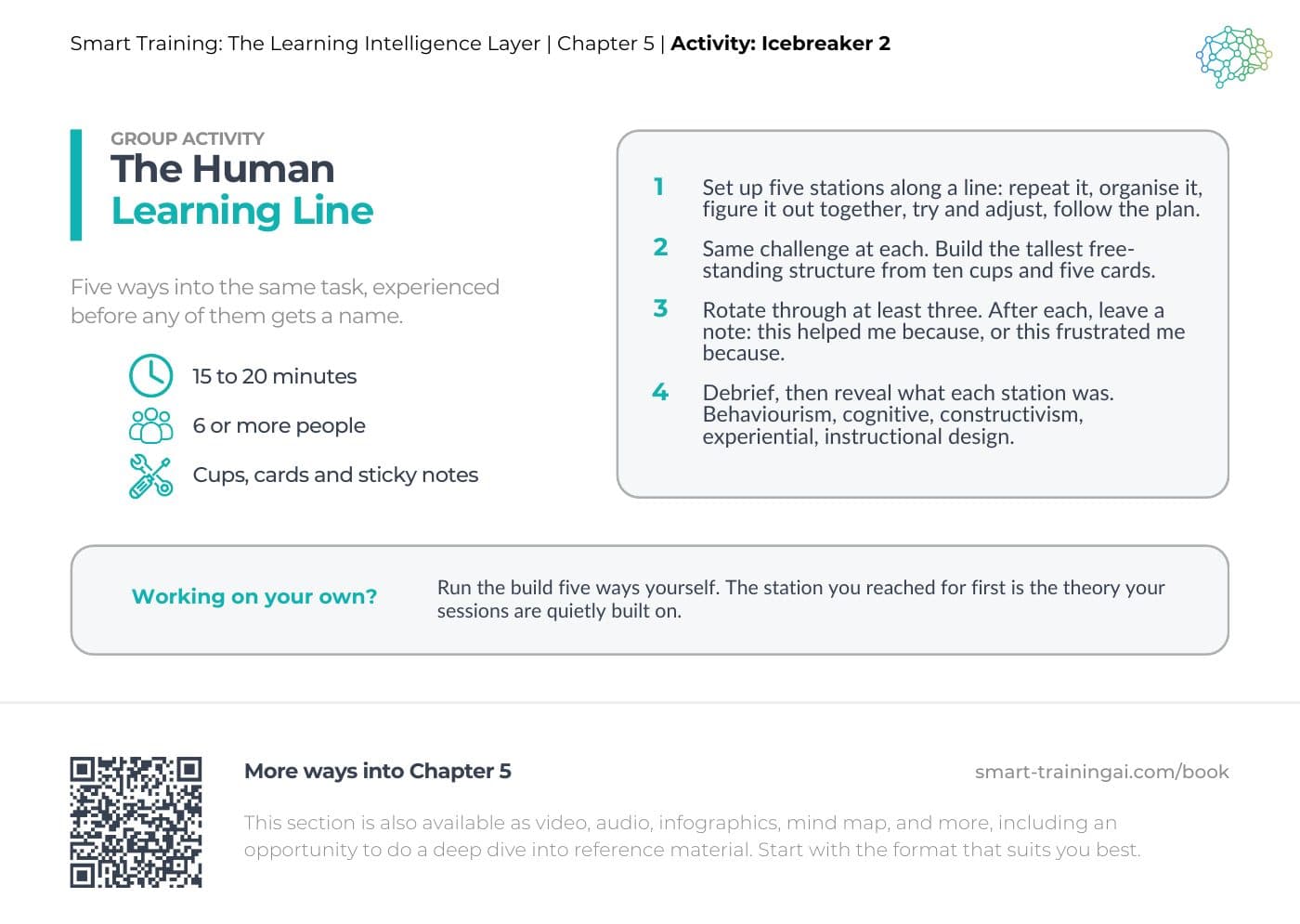
  • Printable card for The Human Learning Line
    Time
    15 to 20 minutes
    Who
    6 or more people
    You will need
    Cups, cards and sticky notes

    Icebreaker

    The Human Learning Line

    Five ways into the same task, experienced before any of them gets a name.

    1. Set up five stations along a line: repeat it, organise it, figure it out together, try and adjust, follow the plan.
    2. Same challenge at each. Build the tallest free- standing structure from ten cups and five cards.
    3. Rotate through at least three. After each, leave a note: this helped me because, or this frustrated me because.
    4. Debrief, then reveal what each station was. Behaviourism, cognitive, constructivism, experiential, instructional design.

    Working on your own? Run the build five ways yourself. The station you reached for first is the theory your sessions are quietly built on.

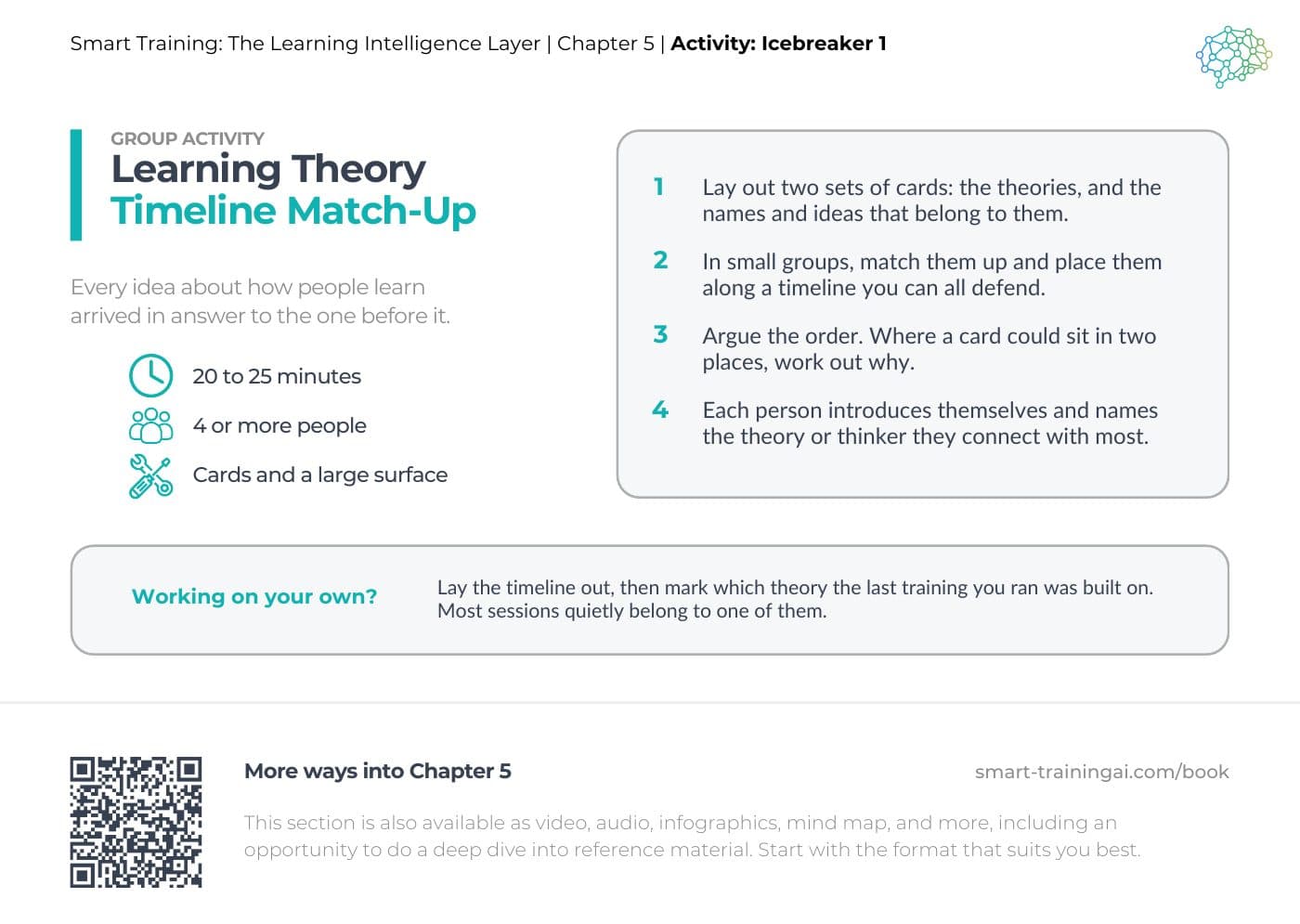
  • Printable card for Human Corners: Choose Your Lens
    Time
    15 to 20 minutes
    Who
    6 or more people
    You will need
    Space to move around

    Icebreaker

    Human Corners: Choose Your Lens

    Each theory explains part of what happens. None of them explains all of it.

    1. Label four corners: behaviourism, cognitive theory, constructivism, experiential learning.
    2. Put a real problem to the room. You have to teach a new skill quickly. Where do you start?
    3. Go to that corner, introduce yourselves, and build one short case for your choice.
    4. Hear all four, then run a second prompt and let people move if their thinking has shifted.

    Working on your own? Pick your corner, then argue the case for the corner you find least convincing. Doing it properly is harder, and more useful, than defending your own.

On your own (3)

  • Printable card for Tracing the Meaning of Learning
    Time
    20 to 25 minutes
    Who
    On your own
    You will need
    Notebook or journal and pen

    Journaling

    Tracing the Meaning of Learning

    Five theories, each correcting the one before it, none of them finished.

    1. Take each theory in turn: behaviourism, cognitive, constructivism, experiential, instructional design. Three sentences each on what it says, one strength and one limit.
    2. Name the theory closest to how you learn, and the one that covers something you need more of.
    3. Say why it is risky for a trainer to lean on a single theory, and who gets overlooked when they do.
    4. Finish with three things you would change in your next session because of this chapter.

    Working with a group? Split the five theories across the room, one each, then teach them to each other in three minutes. Having to explain one properly is how the set gets learned.

  • Printable card for Why Didn’t the Training Work
    Time
    25 to 35 minutes
    Who
    On your own
    You will need
    Paper and pen

    Problem solving

    Why Didn’t the Training Work

    An hour of slides, one task under time pressure, and almost nothing transferred.

    1. List four things wrong with the session design, in the order you would fix them.
    2. Against each one, name the theory from the chapter that explains why it fails.
    3. Redesign the hour: how it opens, where learners do something, where support is added, where reflection goes.
    4. Say which single change would make the biggest difference, and why that one comes first.

    Working with a group? Have everyone pick their single biggest change alone, then defend it. The theories people reach for say as much as the fixes they choose.

  • Printable card for Shaping Behaviour or Building Meaning
    Time
    30 to 40 minutes
    Who
    On your own
    You will need
    Paper and pen

    Worksheet

    Shaping Behaviour or Building Meaning

    Five theories, each right about something. None of them right about everything.

    1. Read Approach A. Behaviourism and instructional design work from the outside in. Learning shows as observable behaviour, shaped by reinforcement and practice, with objectives and sequence planned in advance. Structure is the strength. The plan cannot see what happens inside the learner.
    2. Read Approach B. Cognitive theory, constructivism and experiential learning work from the inside out. Learning depends on attention, prior knowledge and meaning the learner builds through doing and reflecting. Without scaffolding, that same freedom leaves some learners stranded.
    3. Compare them: what each treats as evidence that learning happened; where the trainer’s effort goes: planning or responding; how each explains two people getting different results; what each one cannot account for on its own.
    4. Critique both. Why does reinforcement still earn its place? Where does a fixed plan fall short in the room? What does building meaning give that drilling cannot? What goes wrong without scaffolding?
    5. Make a judgement. No single learning theory is enough for effective training design. Agree or disagree, drawing on at least three of the five, and say what that means for a trainer on Monday morning. Finish the sentence: Effective training should…
Smart Training AI logo

Empowering trainers to boost engagement and results through targeted, adaptive learning

© 2025 Smart Training AI™ All rights reserved.