From events to impact

A companion to Chapter 8 of the book, Training Futures. The same ideas in several forms: film, conversation, 2 infographics, a mind map and 6 activities. Start with whichever suits you.
Chapter 8 in two minutes

Training is under pressure from several sides. Learners expect relevance, organisations want measurable outcomes, L&D teams are asked to do more with less, and skills change faster than courses can be scheduled. Chapter 8 argues that the single training event no longer fits, and that development has to become an ongoing process of reinforcement and application.

That changes what counts as success. Completion rates say little about learning; the chapter points to Kirkpatrick's four levels and to capability and behaviour change as the measures that matter. It also changes the trainer's role. Subject expertise remains the foundation, but trainers increasingly design learning experiences and adapt delivery using insight gathered before the session.

Technology is the enabler, not the answer. It provides infrastructure at scale, while human connection and judgement stay at the centre. The aim is scalability without uniformity: consistent objectives, delivery flexed to fit different groups. For organisations, that means investing in insight before delivery and treating alignment with learners as a design standard.

Measure capability, not completion.

Watch or listen

Prefer to take it in by eye or by ear? Both cover the core ideas of Chapter 8 in a few minutes.

Film, 2 min

How adaptive training actually works

Why one-off courses give way to continuous development, and what changes when success is measured by what people can do afterwards. Captions are built in.

Conversation, 5 min

Why corporate training must be adaptive

A conversation about the pressures on training, the trainer's expanding role, and why technology should support judgement rather than replace it.

0:000:00

Chapter 8 at a glance

A quick overview, then the full argument with the evidence. Select either one to see it full size.

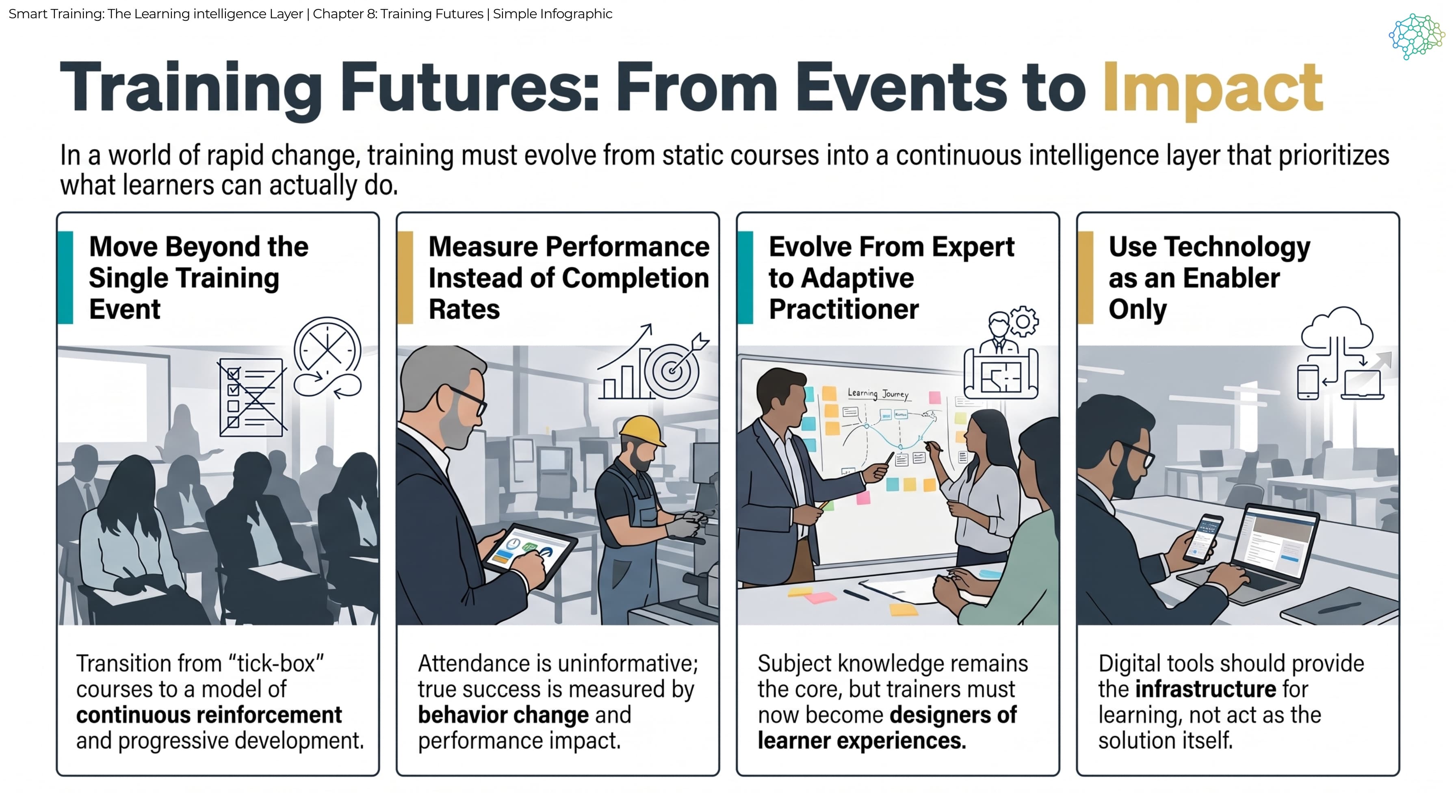
Training Futures: From Events to Impact
Four-panel infographic: move beyond the single training event to continuous reinforcement and progressive development; measure performance and behaviour change instead of completion rates; evolve from expert to adaptive practitioner who designs learner experiences; and use technology as an enabler only, providing infrastructure rather than being the solution.
Training Reimagined: From Static Events to Adaptive Growth
Detailed infographic in three columns: the strategic shift from box-ticking events to outcomes, measuring capability rather than completion, and scalability without uniformity; the new trainer, from expert to adaptive designer, using pre-delivery intelligence and technology as the enabler; and a table comparing the traditional and future-ready models. The primary goal moves from attendance and completion to capability and behaviour change, delivery from uniform to adaptive, and the trainer from information transmitter to experience facilitator.

How the ideas connect

Every idea in Chapter 8 on one page. Look at it before you read to see the shape of the argument, or afterwards as a recap.
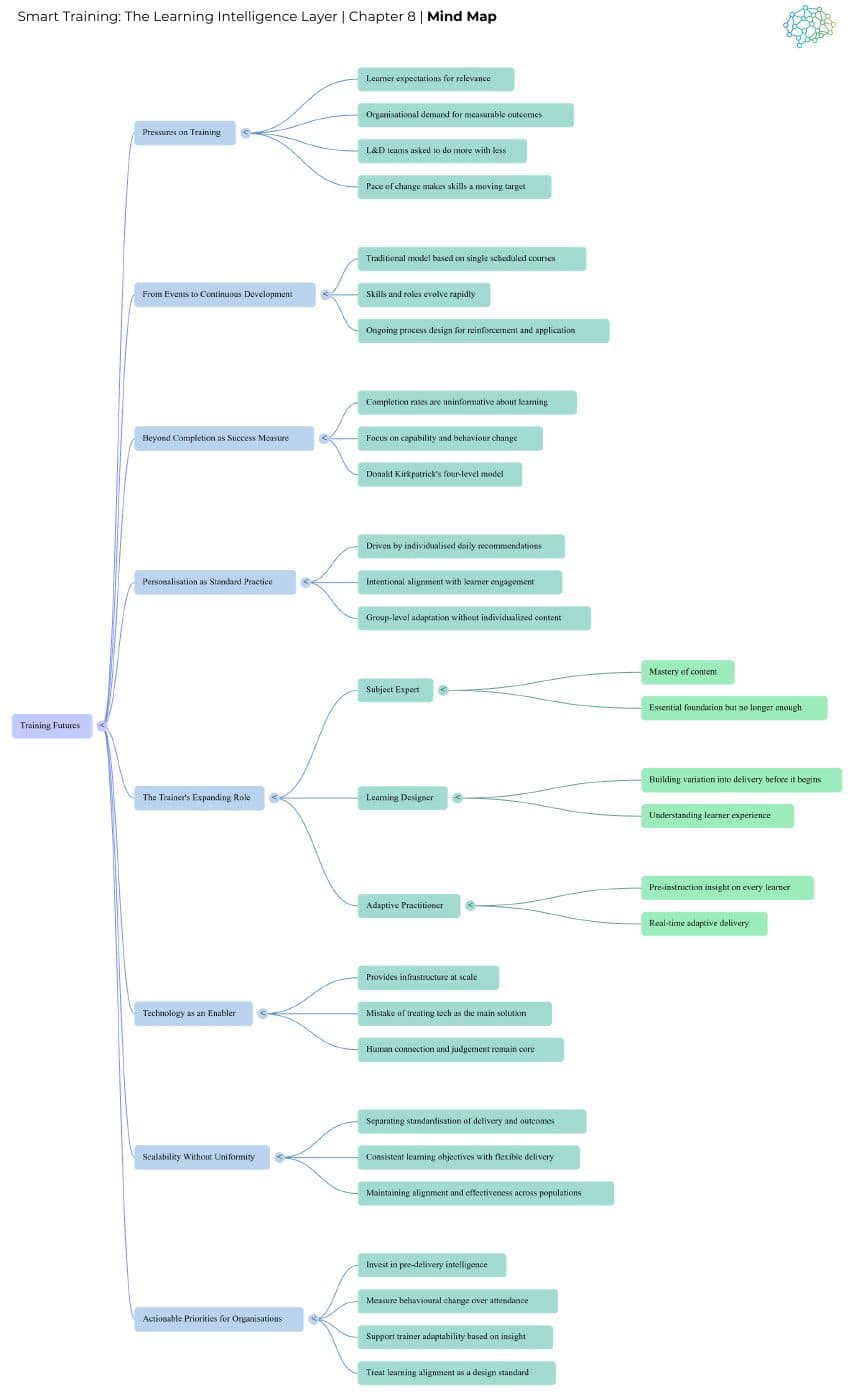
Mind map of Chapter 8.

Put it into practice

Short activities to run with a group or work through on your own. Each one has a printable card.

With a group (3)

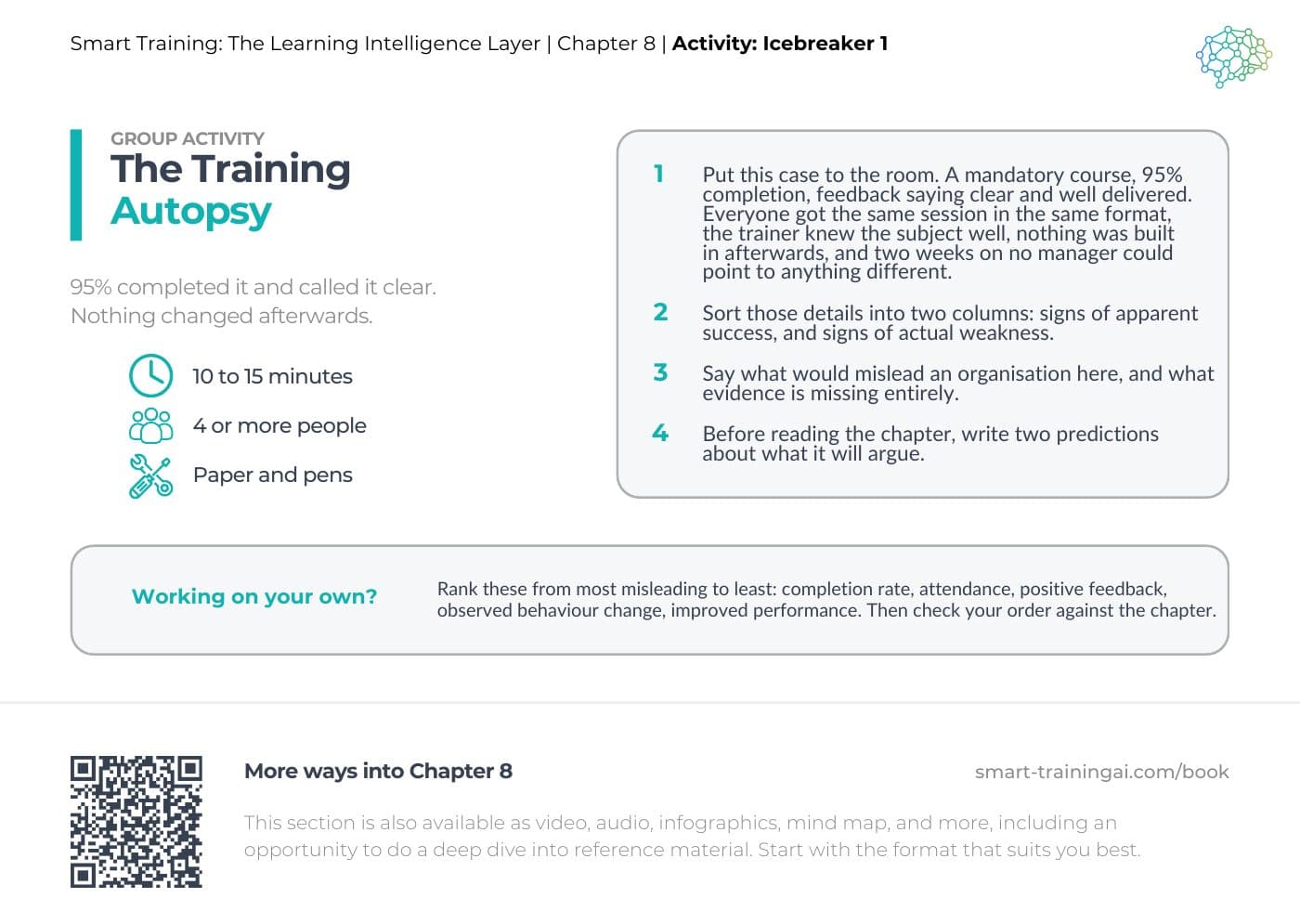
  • Printable card for The Training Autopsy
    Time
    10 to 15 minutes
    Who
    4 or more people
    You will need
    Paper and pens

    Icebreaker

    The Training Autopsy

    95% completed it and called it clear. Nothing changed afterwards.

    1. Put this case to the room. A mandatory course, 95% completion, feedback saying clear and well delivered. Everyone got the same session in the same format, the trainer knew the subject well, nothing was built in afterwards, and two weeks on no manager could point to anything different.
    2. Sort those details into two columns: signs of apparent success, and signs of actual weakness.
    3. Say what would mislead an organisation here, and what evidence is missing entirely.
    4. Before reading the chapter, write two predictions about what it will argue.

    Working on your own? Rank these from most misleading to least: completion rate, attendance, positive feedback, observed behaviour change, improved performance. Then check your order against the chapter.

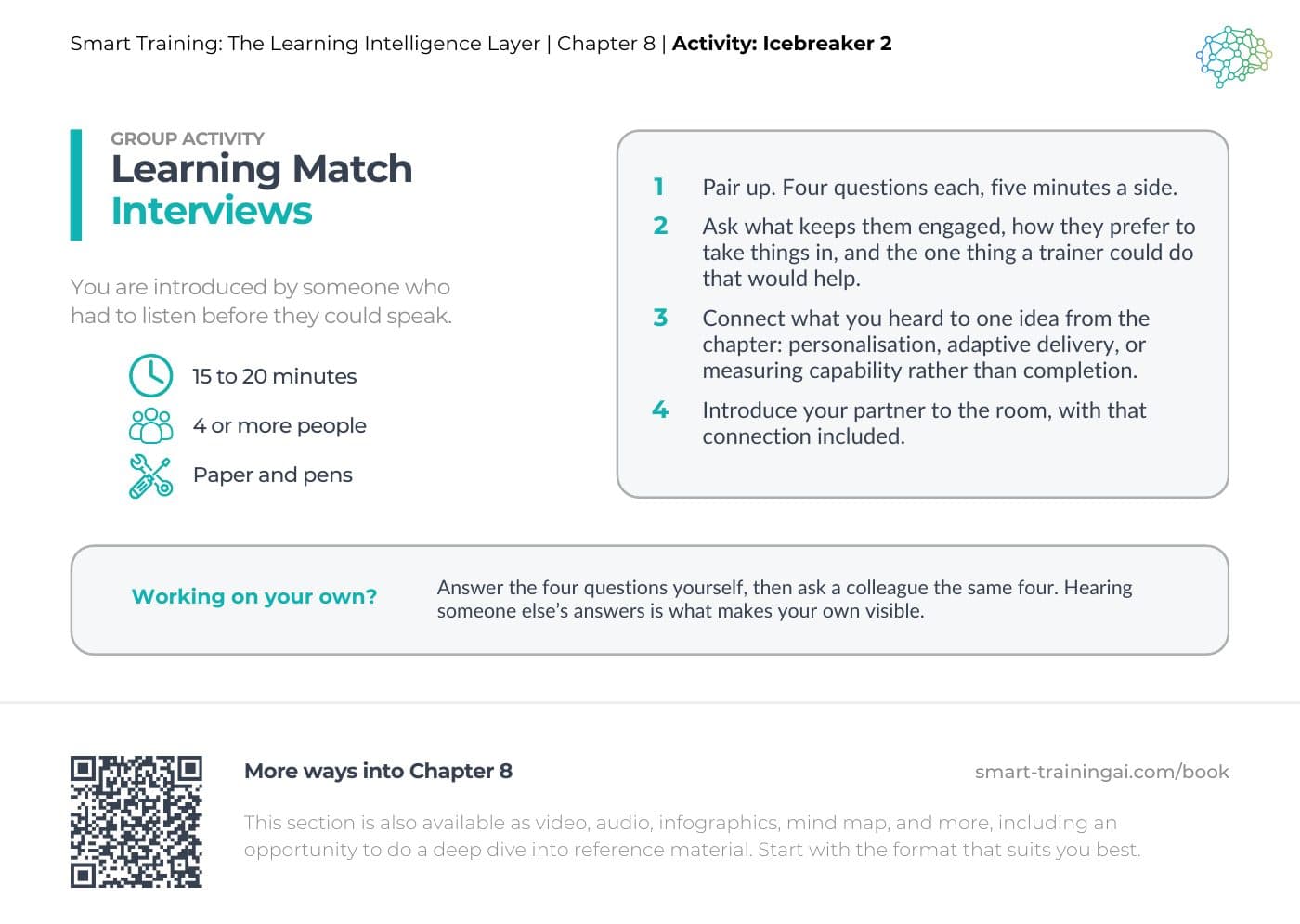
  • Printable card for Learning Match Interviews
    Time
    15 to 20 minutes
    Who
    4 or more people
    You will need
    Paper and pens

    Icebreaker

    Learning Match Interviews

    You are introduced by someone who had to listen before they could speak.

    1. Pair up. Four questions each, five minutes a side.
    2. Ask what keeps them engaged, how they prefer to take things in, and the one thing a trainer could do that would help.
    3. Connect what you heard to one idea from the chapter: personalisation, adaptive delivery, or measuring capability rather than completion.
    4. Introduce your partner to the room, with that connection included.

    Working on your own? Answer the four questions yourself, then ask a colleague the same four. Hearing someone else’s answers is what makes your own visible.

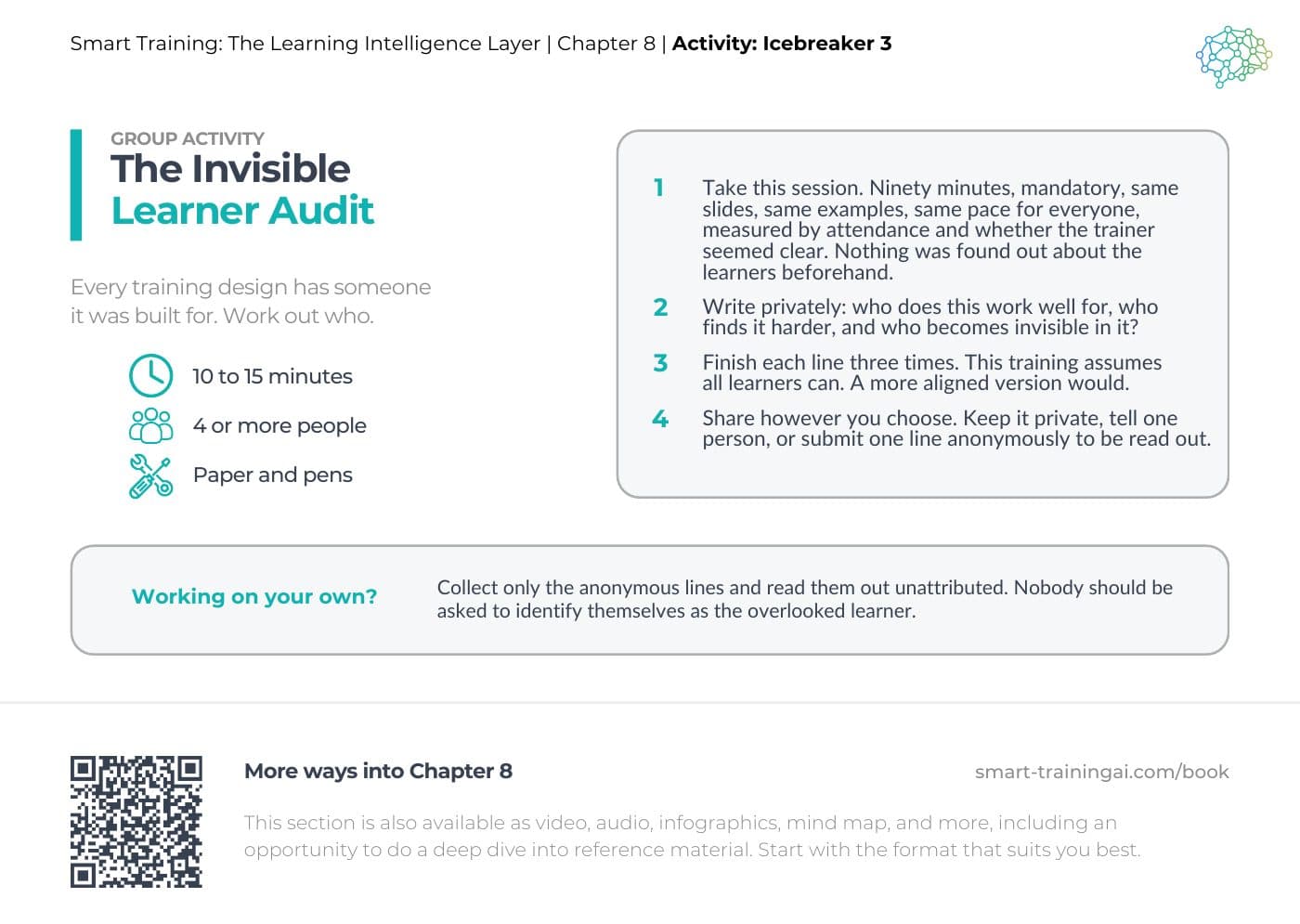
  • Printable card for The Invisible Learner Audit
    Time
    10 to 15 minutes
    Who
    4 or more people
    You will need
    Paper and pens

    Icebreaker

    The Invisible Learner Audit

    Every training design has someone it was built for. Work out who.

    1. Take this session. Ninety minutes, mandatory, same slides, same examples, same pace for everyone, measured by attendance and whether the trainer seemed clear. Nothing was found out about the learners beforehand.
    2. Write privately: who does this work well for, who finds it harder, and who becomes invisible in it?
    3. Finish each line three times. This training assumes all learners can. A more aligned version would.
    4. Share however you choose. Keep it private, tell one person, or submit one line anonymously to be read out.

    Working on your own? Collect only the anonymous lines and read them out unattributed. Nobody should be asked to identify themselves as the overlooked learner.

On your own (3)

  • Printable card for From Events to Continuous Development
    Time
    20 to 30 minutes
    Who
    On your own
    You will need
    Notebook or journal and pen

    Journaling

    From Events to Continuous Development

    A session attended is an event. A capability changed is something else.

    1. Write what goes wrong when training is a single event, and why completion is a weak measure.
    2. Set out the old model against the future-ready one. What changes for the learner, and for the trainer?
    3. Think of a session you attended. Event, or part of something ongoing? What made it stick?
    4. Finish three times: if I were redesigning training based on this chapter, I would.

    Working with a group? Write first, then pool only the redesign lines. Reading twenty specific changes together is more persuasive than any summary of the chapter.

  • Printable card for Redesign a One-Off Training Event
    Time
    25 to 35 minutes
    Who
    On your own
    You will need
    Paper and pen

    Problem solving

    Redesign a One-Off Training Event

    Two hours, full attendance, good feedback. Managers see nothing change.

    1. Name four weaknesses in the current programme and what each one costs.
    2. Redesign it. Build in reinforcement, make it ongoing, and change what counts as success.
    3. If you could change one thing first, say which and why.
    4. Say what you would want to know before delivery, and how you would tell whether it worked.

    Working with a group? Each person picks their single first change, then defends it. Where the group starts tells you what it really believes is broken.

  • Printable card for Event-Based or Future-Ready
    Time
    30 to 40 minutes
    Who
    On your own
    You will need
    Paper and pen

    Worksheet

    Event-Based or Future-Ready

    Identical content, aligned delivery, different results. Worth checking what that proves.

    1. Read Approach A. Training arrives as a one-off event. Delivery is standardised, the trainer is there as subject expert, and success is attendance and completion. The numbers look healthy. Whether anything changed at work is never really asked.
    2. Read Approach B. Training is continuous, with reinforcement and application built in. Delivery flexes to fit the group while the objectives hold. The trainer is also a learning designer. Success is judged by capability and behaviour, which is harder to measure.
    3. Compare them: what each one is for; what gets counted as success; what the trainer is expected to be; what is still true six months later.
    4. Critique both. What does a single clear event still do well? Why do completion rates mislead? What does continuous design make possible? Can flexibility cost consistency?
    5. Make a judgement. Scalability without uniformity is desirable but hard to achieve. Argue both sides from the chapter, then say what an organisation with limited budget should do first. Finish the sentence: If an organisation wants to know whether training worked, it should measure…
Smart Training AI logo

Empowering trainers to boost engagement and results through targeted, adaptive learning

© 2025 Smart Training AI™ All rights reserved.