The average learner does not exist

A companion to Chapter 9 of the book, Think Different in Training Design. The same ideas in several forms: film, conversation, 2 infographics, a mind map and 6 activities. Start with whichever suits you.

Chapter 9 in two minutes

The biggest barriers to effective training are often assumptions nobody examines: that covering material is the same as teaching it, that clear explanation guarantees understanding, that uniform delivery is fair, and that poor results reflect low motivation. Chapter 9 argues these beliefs shape content, structure and pace, and quietly reproduce the same design problems.

One of the strongest is the average learner. Designing for the notional middle of a group simplifies planning, but nobody actually sits there, and most of the cohort is underserved. The chapter asks trainers to shift from subject expert to learning designer: subject knowledge is necessary, but the core question becomes how this group will receive it.

Efficiency is redefined too. Finishing on time is throughput; real efficiency is understanding, retention and application with little wasted effort. Drawing on Argyris and Schön, the chapter treats reflection as design practice, so poor outcomes become design information rather than individual failure. The learner, not the content, becomes the starting point for every session.

The average learner does not exist.

Watch or listen

Prefer to take it in by eye or by ear? Both cover the core ideas of Chapter 9 in a few minutes.

Film, 1 min

How designing for the average learner fails

Why a session built for the middle of the group serves few of the people actually in it. Captions are built in.

Conversation, 6 min

Why training for average learners fails

A conversation about the assumptions behind familiar training, why they persist, and what changes when the learner becomes the starting point.

0:000:00

Chapter 9 at a glance

A quick overview, then the full argument with the evidence. Select either one to see it full size.

Four Steps to Better Learning
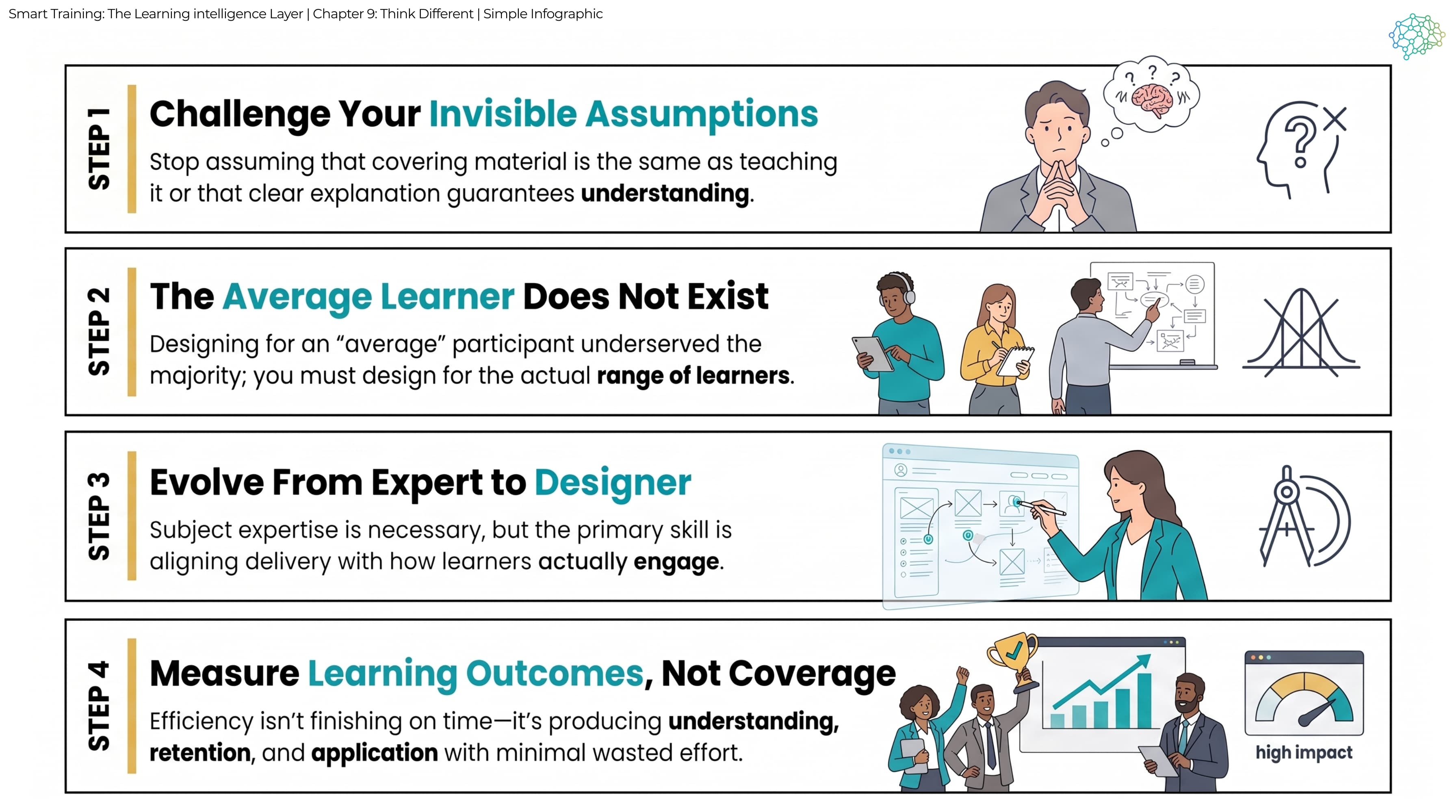
Four-step infographic: challenge your invisible assumptions, since covering material is not teaching it; the average learner does not exist, so design for the actual range of learners; evolve from expert to designer who aligns delivery with how learners engage; and measure learning outcomes, not coverage, defining efficiency as understanding, retention and application.
Thinking Differently: The Shift to Smart Training
Detailed infographic: invisible assumptions stall progress; the average learner is a myth; efficiency is not throughput; design above expertise; start with the learner, not content; and reflection as design practice. A table compares traditional and smart training: the design target moves from the imagined middle to the actual range of learners, the efficiency goal from covering content to understanding and application, and the primary value from subject expertise to learning design skill.

How the ideas connect

Every idea in Chapter 9 on one page. Look at it before you read to see the shape of the argument, or afterwards as a recap.
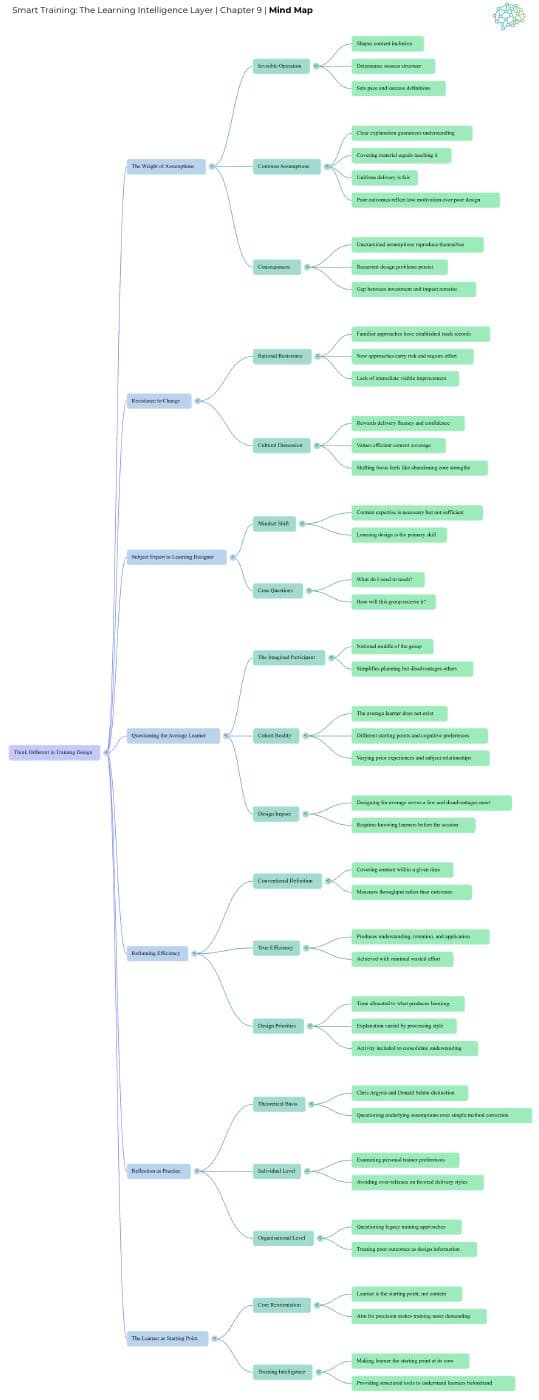
Mind map of Chapter 9.

Put it into practice

Short activities to run with a group or work through on your own. Each one has a printable card.

With a group (3)

  • Printable card for The Assumption Spectrum
    Time
    10 to 15 minutes
    Who
    6 or more people
    You will need
    Space to move around

    Icebreaker

    The Assumption Spectrum

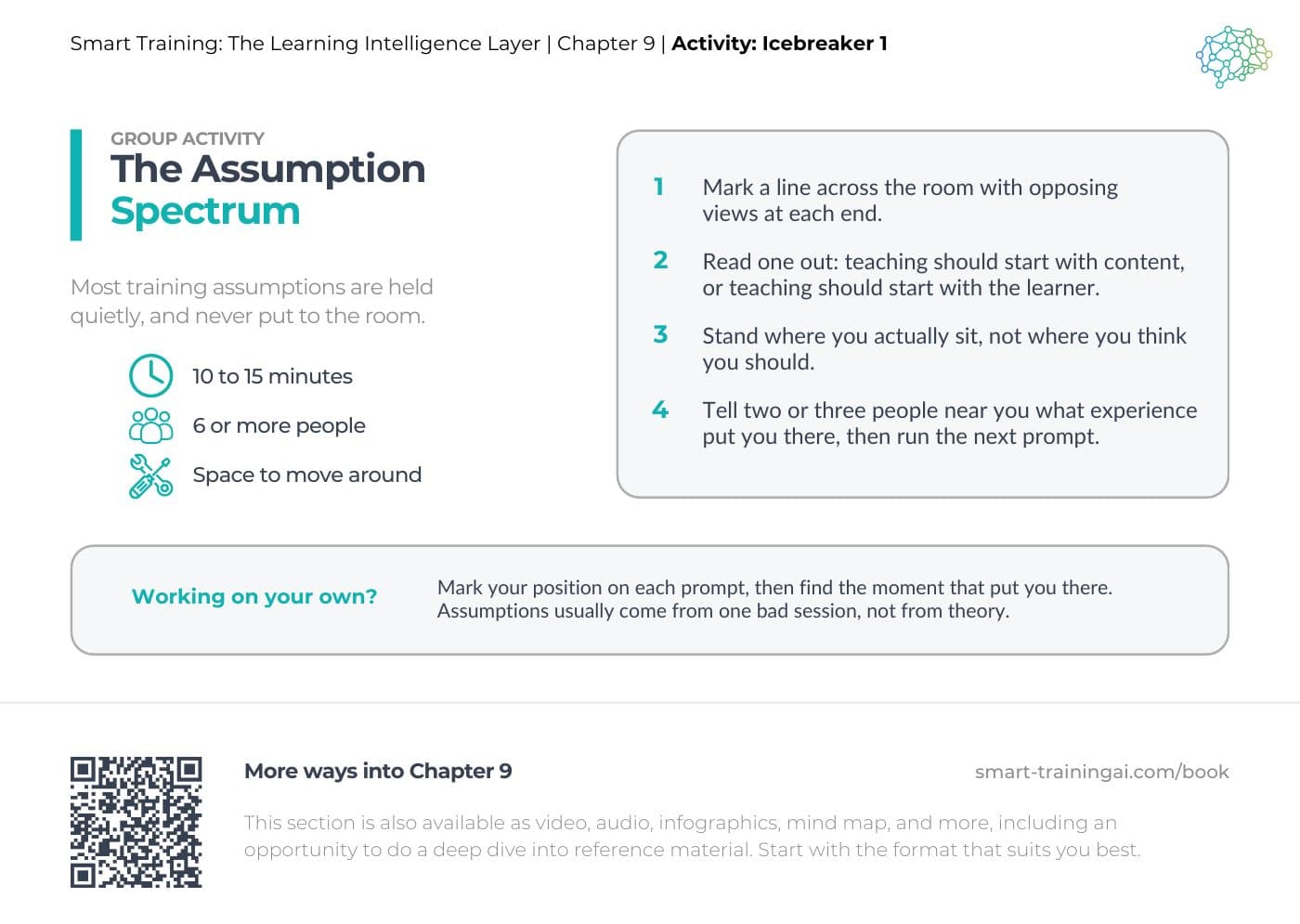
    Most training assumptions are held quietly, and never put to the room.

    1. Mark a line across the room with opposing views at each end.
    2. Read one out: teaching should start with content, or teaching should start with the learner.
    3. Stand where you actually sit, not where you think you should.
    4. Tell two or three people near you what experience put you there, then run the next prompt.

    Working on your own? Mark your position on each prompt, then find the moment that put you there. Assumptions usually come from one bad session, not from theory.

  • Printable card for Learner Profile Match Cards
    Time
    15 to 20 minutes
    Who
    4 or more people
    You will need
    Profile cards and pens

    Icebreaker

    Learner Profile Match Cards

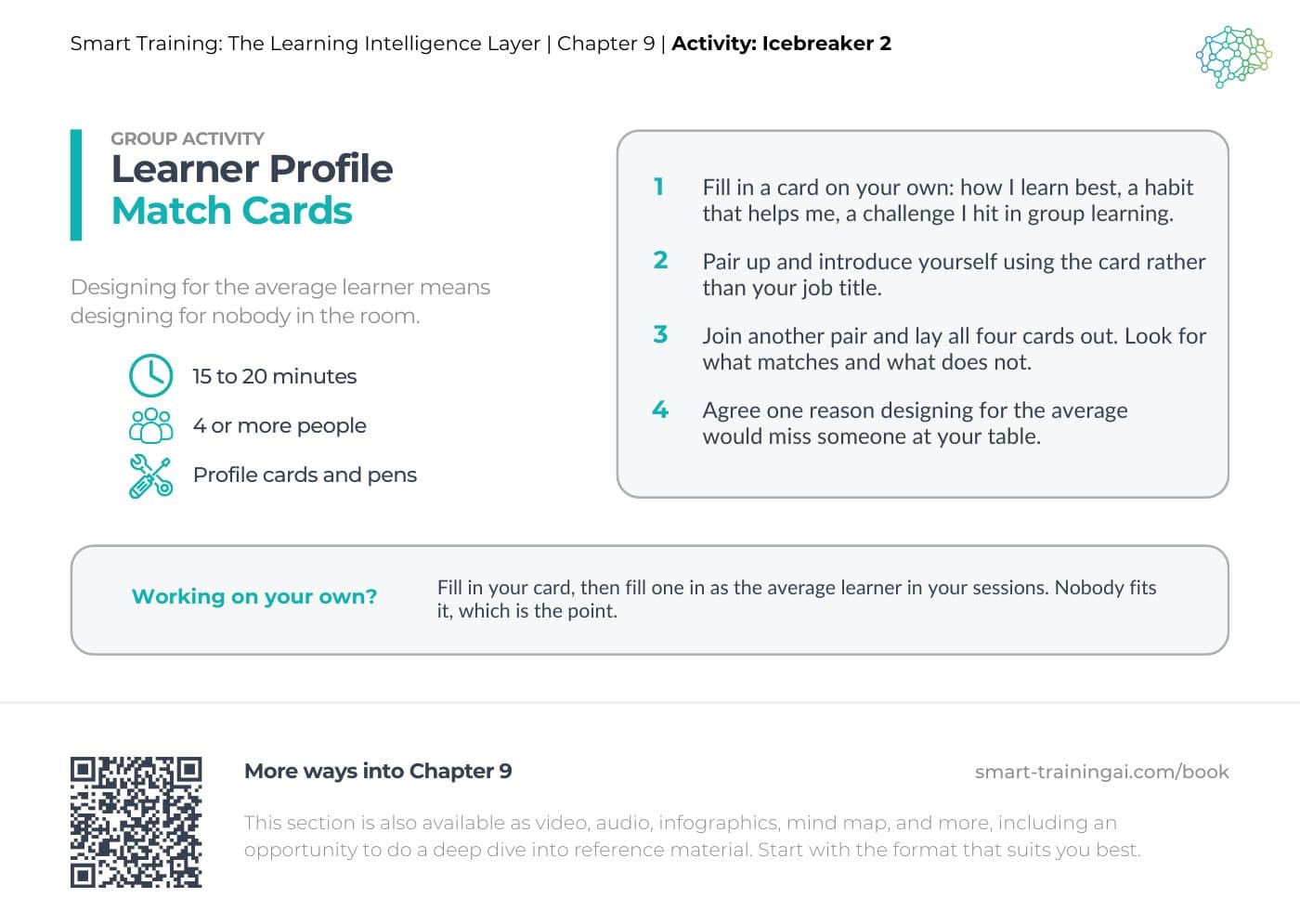
    Designing for the average learner means designing for nobody in the room.

    1. Fill in a card on your own: how I learn best, a habit that helps me, a challenge I hit in group learning.
    2. Pair up and introduce yourself using the card rather than your job title.
    3. Join another pair and lay all four cards out. Look for what matches and what does not.
    4. Agree one reason designing for the average would miss someone at your table.

    Working on your own? Fill in your card, then fill one in as the average learner in your sessions. Nobody fits it, which is the point.

  • Printable card for Design a Better Introduction
    Time
    15 to 20 minutes
    Who
    6 or more people
    You will need
    Paper and pens

    Icebreaker

    Design a Better Introduction

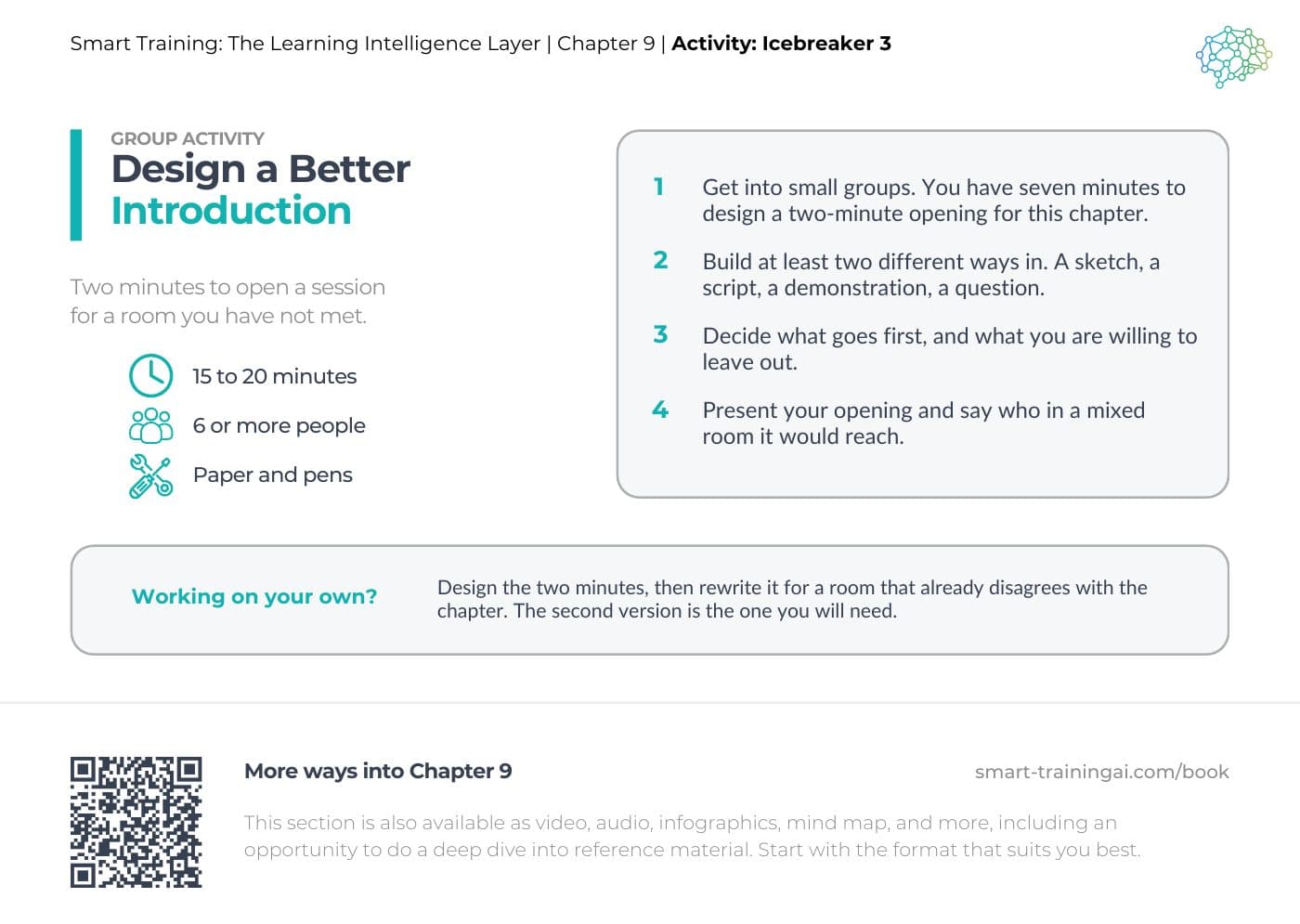
    Two minutes to open a session for a room you have not met.

    1. Get into small groups. You have seven minutes to design a two-minute opening for this chapter.
    2. Build at least two different ways in. A sketch, a script, a demonstration, a question.
    3. Decide what goes first, and what you are willing to leave out.
    4. Present your opening and say who in a mixed room it would reach.

    Working on your own? Design the two minutes, then rewrite it for a room that already disagrees with the chapter. The second version is the one you will need.

On your own (3)

  • Printable card for Thinking Differently About Training
    Time
    15 to 20 minutes
    Who
    On your own
    You will need
    Notebook or journal and pen

    Journaling

    Thinking Differently About Training

    A session that covers everything may still teach very little.

    1. List three assumptions about training the chapter challenges, and why each one limits what is possible.
    2. Explain the average learner does not exist in your own words.
    3. Describe a time you were taught as if you were that average learner. What helped, and what did not?
    4. Name two things you would do differently, and how you would find out about learners beforehand.

    Working with a group? Write alone, then share only the assumptions. Seeing the same three come up around a table is the argument in miniature.

  • Printable card for Fix the Session Design Problem
    Time
    25 to 35 minutes
    Who
    On your own
    You will need
    Paper and pen

    Problem solving

    Fix the Session Design Problem

    Every slide covered, on time, clearly explained. A week later, nothing held.

    1. Name the assumptions behind this session, and why they produced the result.
    2. List four design flaws, each with what it costs and which chapter idea explains it.
    3. Redesign it: what you would want to know before, and how you would check learning as it happens.
    4. Define success differently from the original trainer, and say what the difference is between a subject expert and a learning designer.

    Working with a group? Diagnose alone, then compare assumptions rather than fixes. People who agree on the fix often disagree about what went wrong.

  • Printable card for Content First or Learner First
    Time
    30 to 40 minutes
    Who
    On your own
    You will need
    Paper and pen

    Worksheet

    Content First or Learner First

    Designing for the middle sounds practical until you look for who is standing there.

    1. Read Approach A. Planning starts with the content that must be delivered. A session is efficient when everything is covered on time, and a clear explanation from an expert is taken as evidence that learning happened. The target is the average participant in the middle.
    2. Read Approach B. Planning starts with the learners who will receive it. Efficiency means understanding, retention and application, so coverage alone proves nothing. The target is the actual range in the room, which is harder to design for and more demanding of the trainer.
    3. Compare them: how each one defines an efficient session; what counts as evidence that learning happened; who each approach is designed for; what happens to the people it was not designed for.
    4. Critique both. Why is content-first planning so durable? Who is underserved, and why is that invisible? What improves once the learner comes first? What makes it harder to sustain?
    5. Make a judgement. Designing for everyone is unrealistic, so design for the middle. Say why that argument appeals, where it fails, and what you would put in its place. Finish the sentence: One assumption about training I now question is…
Smart Training AI logo

Empowering trainers to boost engagement and results through targeted, adaptive learning

© 2025 Smart Training AI™ All rights reserved.