Fix the design, not the learner

A companion to the Conclusion of the book. The same ideas in several forms: film, conversation, 2 infographics, a mind map and 6 activities. Start with whichever suits you.

The Conclusion in two minutes

The Conclusion brings the book's argument together. When learning falters, the cause is rarely motivation or content. It is a design problem: uniform delivery assumes everyone takes in information at the same speed and in the same way, and that assumption breaks down in real groups.

Uniform delivery only feels fair to the people who already match the norm. Aligned delivery keeps the same content but pays attention to how it is received. In a retrospective pilot of 257 participants, adaptive delivery produced nearly twice the gain, with markedly less variation in final scores, though better conditions do not guarantee final outcomes.

Training intelligence is the preparation layer that makes this practical. The Learning Strength Assessment builds the picture of the group and Adapt Your Training turns it into action, while the trainer remains the professional. The book ends with a challenge for each audience: begin with learners, invest in capability over compliance, and reward effectiveness over activity.

Training intelligence is the practice of understanding learners before delivery begins.

Watch or listen

Prefer to take it in by eye or by ear? Both cover the core ideas of the Conclusion in a few minutes.

Film, 1 min

How aligned delivery fixes corporate training

The book's argument in brief: why uniform training falls short, and what changes when delivery is aligned to the people in the room. Captions are built in.

Conversation, 5 min

Why uniform corporate training fails

A closing conversation about design rather than motivation, the evidence for aligned delivery, and what educators, organisations and policymakers can do next.

0:000:00

The Conclusion at a glance

A quick overview, then the full argument with the evidence. Select either one to see it full size.

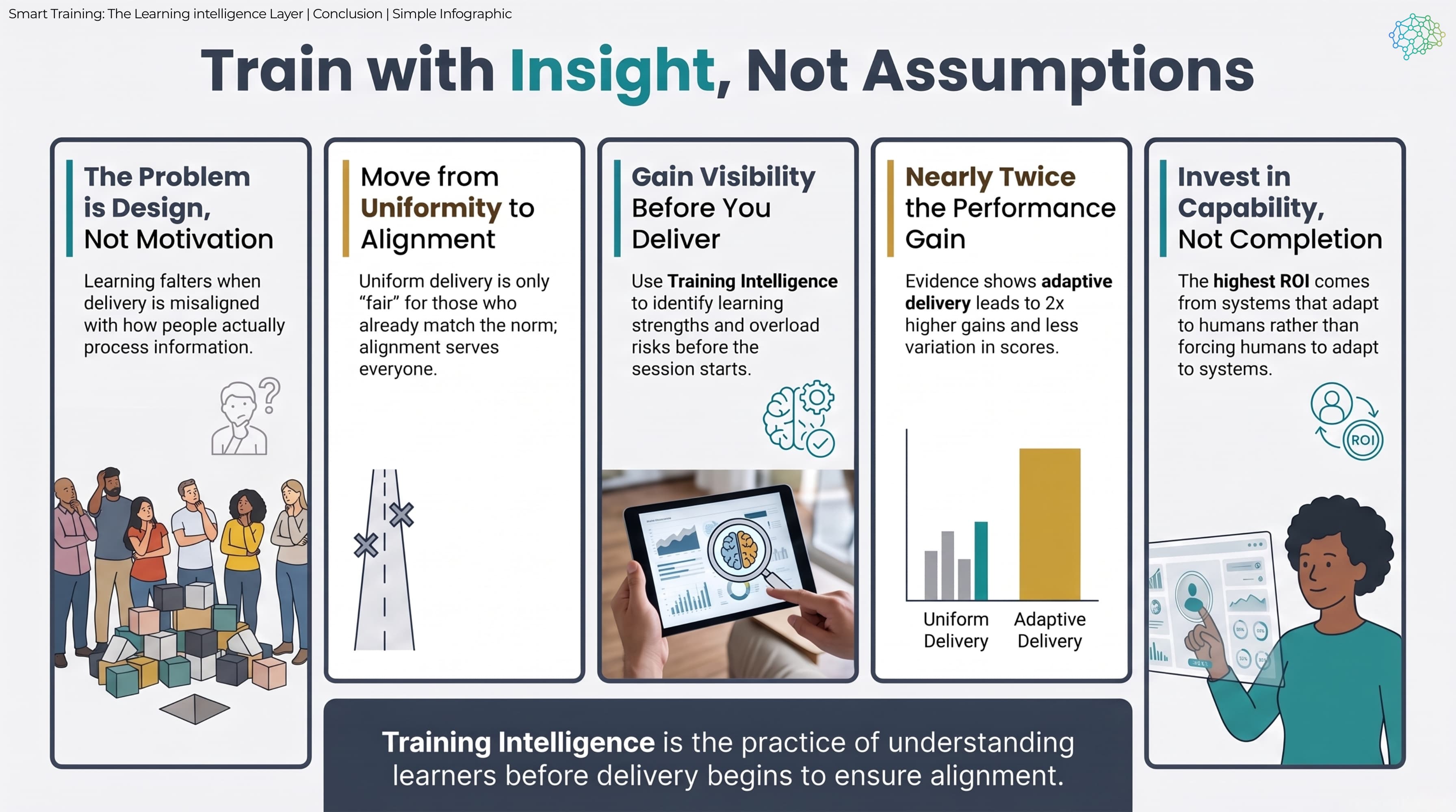
Train with Insight, Not Assumptions
Five-panel infographic: the problem is design, not motivation; move from uniformity to alignment; gain visibility before you deliver; nearly twice the performance gain, with a bar chart of uniform against adaptive delivery; and invest in capability, not completion. A footer defines training intelligence as understanding learners before delivery begins.
Train with Insight, Not Assumption
Detailed infographic: the myth of uniformity, a design problem rather than a learner or content problem, visibility of learning strengths and potential overload before the session, and nearly twice the learning gain with less variation in final scores, under the heading capability over completion.

How the ideas connect

Every idea in the Conclusion on one page. Look at it before you read to see the shape of the argument, or afterwards as a recap.
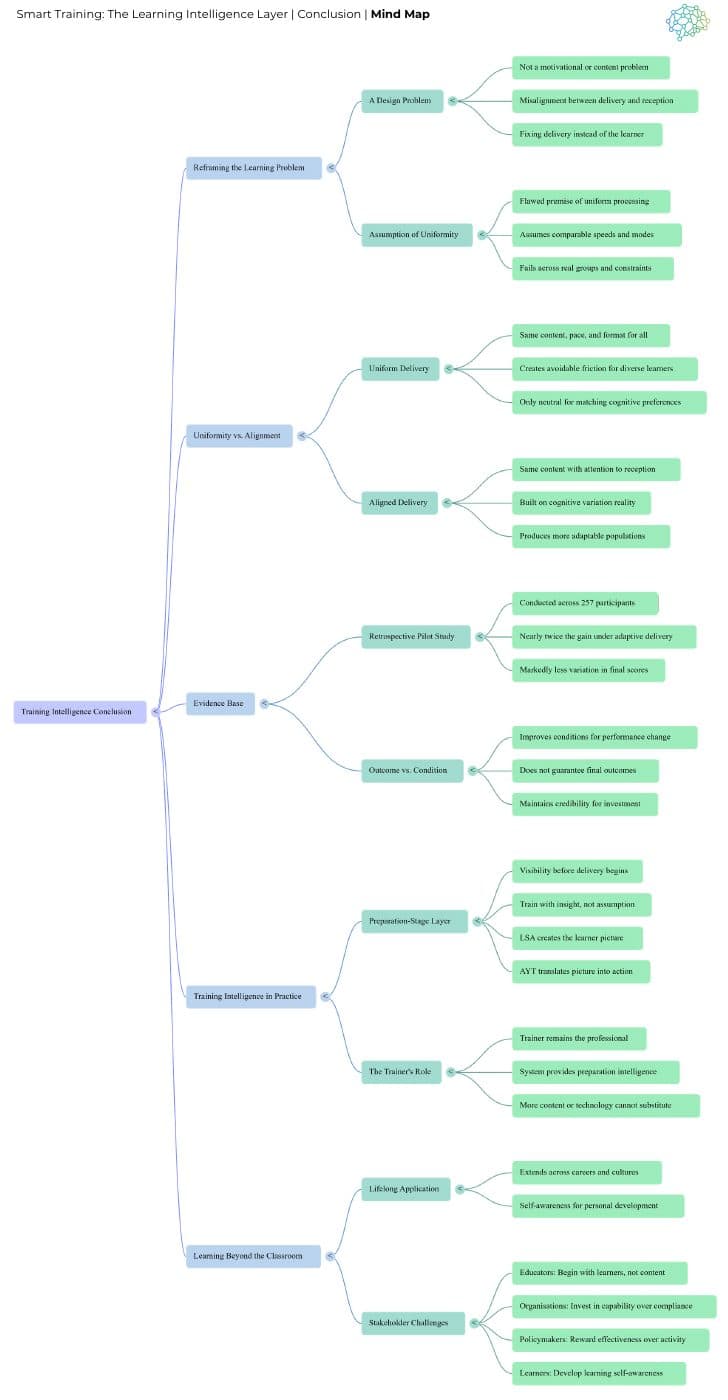
Mind map of the Conclusion.

Put it into practice

Short activities to run with a group or work through on your own. Each one has a printable card.

With a group (3)

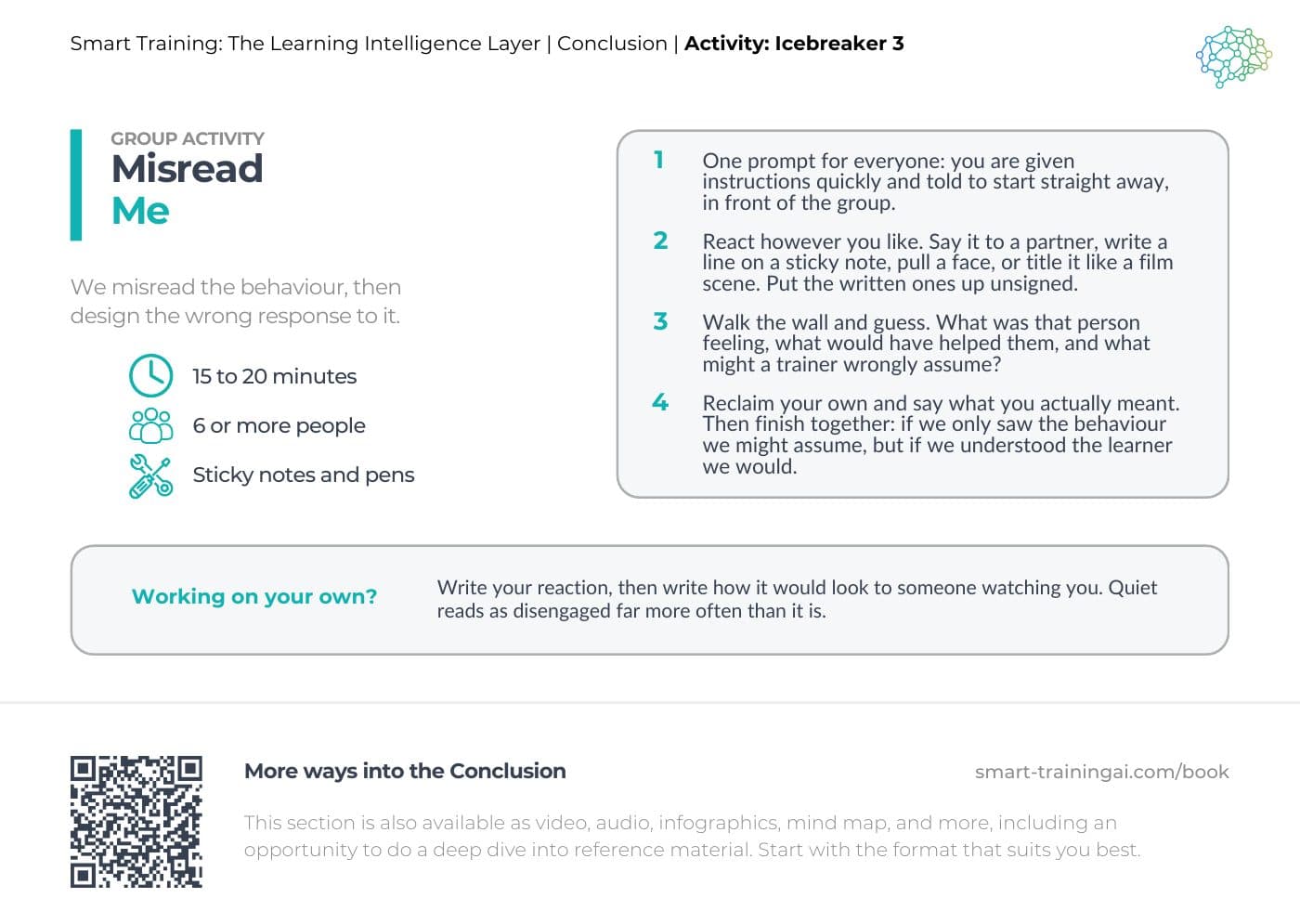
  • Printable card for Human Blueprint Rebuild
    Time
    15 to 20 minutes
    Who
    6 or more people
    You will need
    Cups, cards and pens

    Icebreaker

    Human Blueprint Rebuild

    You did not need easier content. You needed a better design.

    1. Set one build for everyone: a standing structure from 10 cups and five cards, three layers, three minutes. Partial written instructions only, no questions, fixed pace.
    2. Stop before anyone finishes. Move to one of three spots: I knew what to do, I partly knew, I was stuck.
    3. Now rebuild the design, not the structure. Take three changes: add a demonstration, allow questions, break it into steps, assign roles, change the pace, let people choose how to start.
    4. Run the same build again with your changes, then stand by the statement you agree with. The problem was effort. The problem was the design. The problem was the fit.

    Working on your own? Stop round one early and deliberately. Letting it run to frustration makes the point about design feel like a trick rather than a finding.

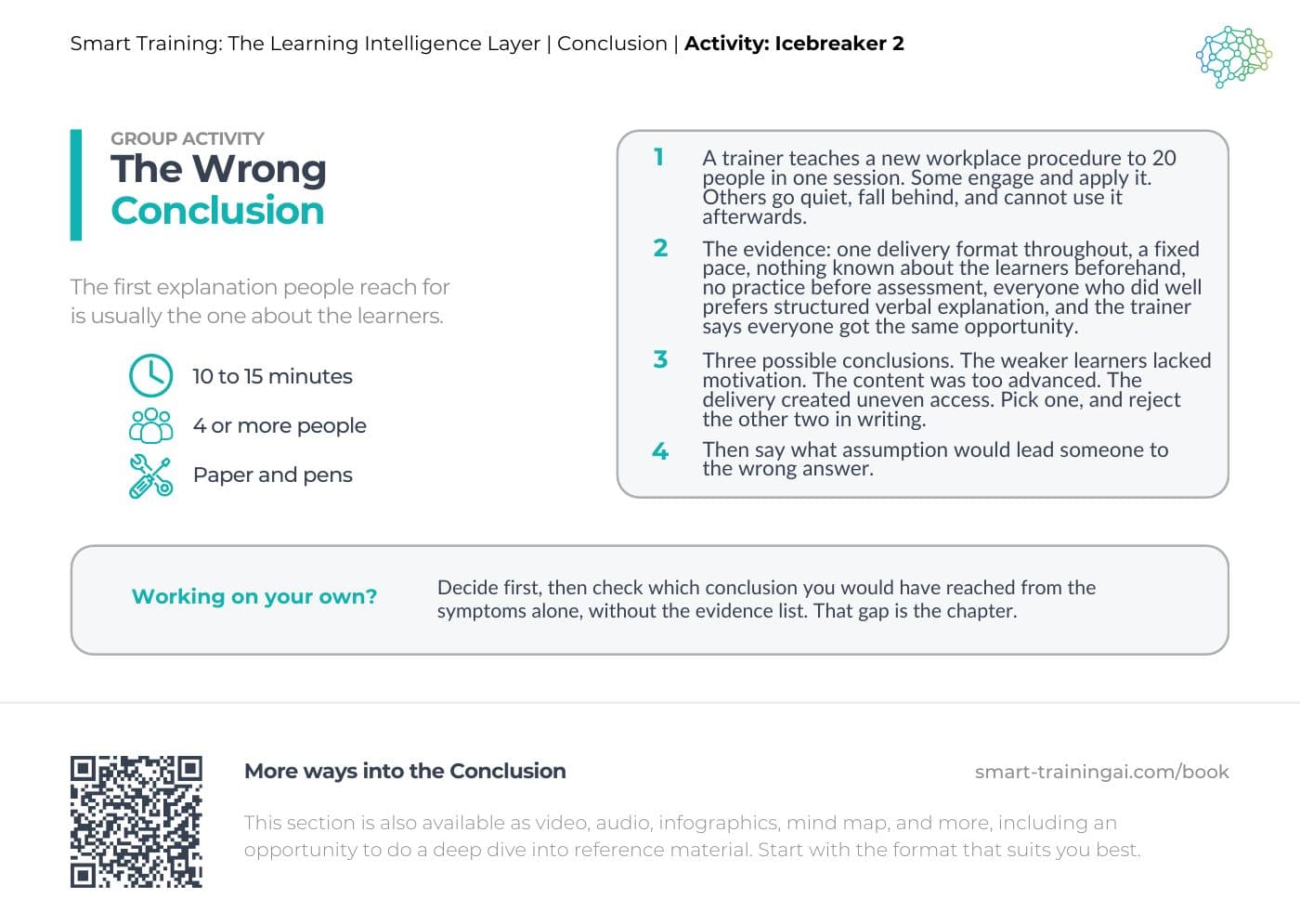
  • Printable card for The Wrong Conclusion
    Time
    10 to 15 minutes
    Who
    4 or more people
    You will need
    Paper and pens

    Icebreaker

    The Wrong Conclusion

    The first explanation people reach for is usually the one about the learners.

    1. A trainer teaches a new workplace procedure to 20 people in one session. Some engage and apply it. Others go quiet, fall behind, and cannot use it afterwards.
    2. The evidence: one delivery format throughout, a fixed pace, nothing known about the learners beforehand, no practice before assessment, everyone who did well prefers structured verbal explanation, and the trainer says everyone got the same opportunity.
    3. Three possible conclusions. The weaker learners lacked motivation. The content was too advanced. The delivery created uneven access. Pick one, and reject the other two in writing.
    4. Then say what assumption would lead someone to the wrong answer.

    Working on your own? Decide first, then check which conclusion you would have reached from the symptoms alone, without the evidence list. That gap is the chapter.

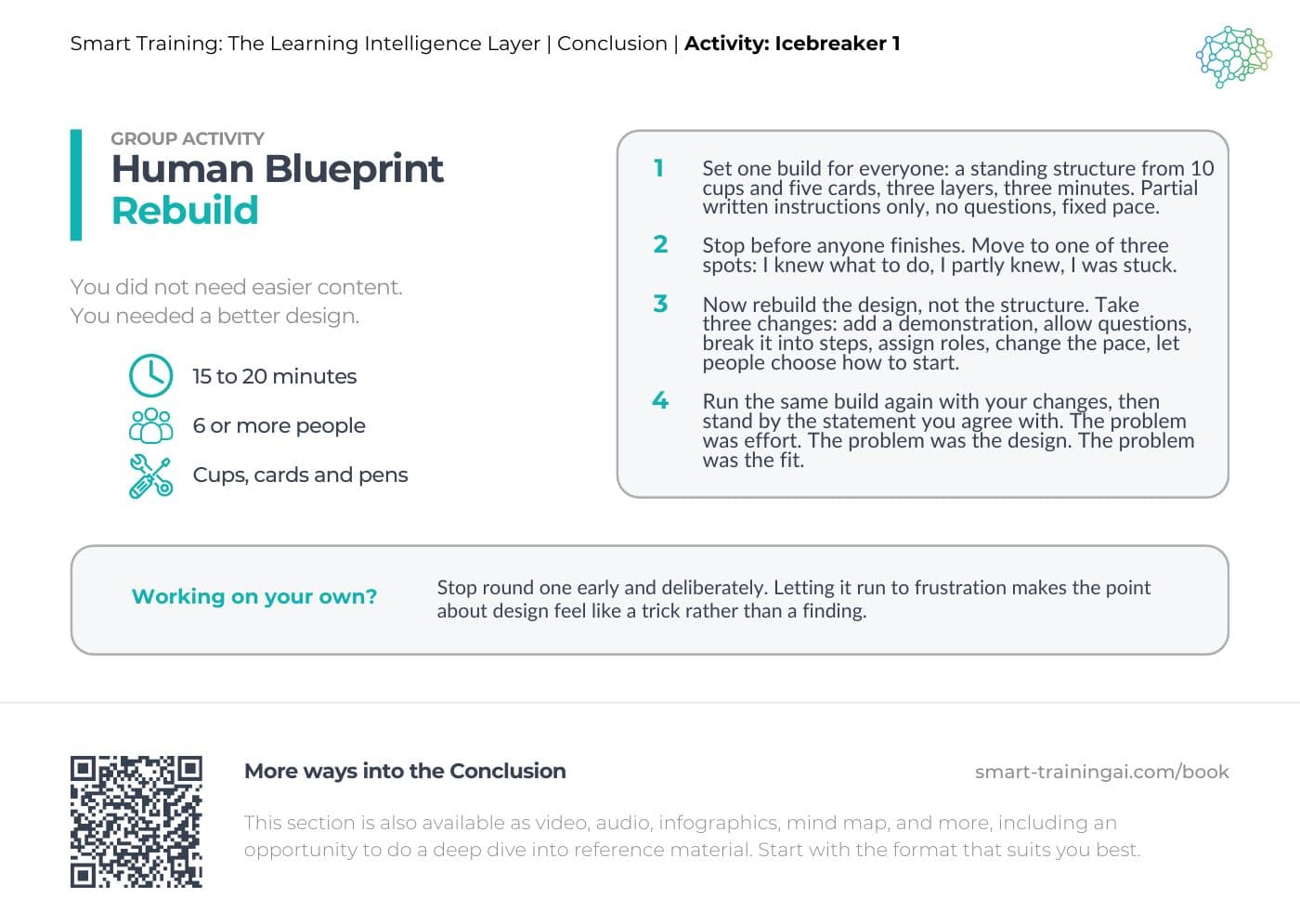
  • Printable card for Misread Me
    Time
    15 to 20 minutes
    Who
    6 or more people
    You will need
    Sticky notes and pens

    Icebreaker

    Misread Me

    We misread the behaviour, then design the wrong response to it.

    1. One prompt for everyone: you are given instructions quickly and told to start straight away, in front of the group.
    2. React however you like. Say it to a partner, write a line on a sticky note, pull a face, or title it like a film scene. Put the written ones up unsigned.
    3. Walk the wall and guess. What was that person feeling, what would have helped them, and what might a trainer wrongly assume?
    4. Reclaim your own and say what you actually meant. Then finish together: if we only saw the behaviour we might assume, but if we understood the learner we would.

    Working on your own? Write your reaction, then write how it would look to someone watching you. Quiet reads as disengaged far more often than it is.

On your own (3)

  • Printable card for From Assumption to Alignment
    Time
    20 to 30 minutes
    Who
    On your own
    You will need
    Notebook or journal and pen

    Journaling

    From Assumption to Alignment

    Most learning failures turn out to be design failures wearing a different name.

    1. Write the difference between a content problem and a design problem, in your own words.
    2. Describe a session that did not work. Who did the delivery leave out, and was motivation really the issue?
    3. Answer as the trainer: before designing a session, what do I need to know about the people in the room?
    4. Finish three times: one change I would make, one assumption I need to challenge, one way to improve alignment.

    Working with a group? Write first, then collect the assumptions people named. The ones that repeat are the ones worth taking to the next planning meeting.

  • Printable card for Diagnose the Design Problem
    Time
    25 to 35 minutes
    Who
    On your own
    You will need
    Paper and pen

    Problem solving

    Diagnose the Design Problem

    90 minutes, five for questions, and the weaker learners get blamed for it.

    1. Say why this is better read as a design problem than a motivation problem.
    2. List five points of misalignment in the session, including the assumption that equal delivery is fair delivery.
    3. Redesign it. Same content, with changes to pacing, participation and how learning gets applied.
    4. Name three things you would want to know about the learners beforehand, and what each would change.

    Working with a group? Compare the three things people wanted to know in advance. That short list is the preparation layer the whole book has been arguing for.

  • Printable card for Blame the Learner or Fix the Design
    Time
    30 to 40 minutes
    Who
    On your own
    You will need
    Paper and pen

    Worksheet

    Blame the Learner or Fix the Design

    Two explanations for the same failure. One of them is actionable.

    1. Read Approach A. Learning fails because some people are unmotivated, less able or unwilling to engage. Everyone received the same content in the same format, so the training was fair, and the explanation for uneven results sits with the individuals.
    2. Read Approach B. Learning fails because training is designed around a false assumption of uniformity. The goal and the content hold, while pacing, examples, participation and engagement are shaped by insight gathered before delivery begins.
    3. Compare them: what each one assumes about the people in the room; where each locates the cause of failure; what each would lead a trainer to change; who benefits, and who is disadvantaged.
    4. Critique both. Why does uniform delivery look fair? What is it confusing equality with? What does alignment achieve without lowering the standard? What does the chapter leave unanswered?
    5. Make a judgement. Is this chapter more persuasive as a critique of traditional training or as a practical guide to improving it? Take a position, name one limitation, and say what a trainer should do next. Finish the sentence: The fairest training is not the one that treats everyone the same, because…
Smart Training AI logo

Empowering trainers to boost engagement and results through targeted, adaptive learning

© 2025 Smart Training AI™ All rights reserved.