Insight, not assumption

A companion to the Introduction of the book. The same ideas in several forms: film, conversation, 2 infographics, a mind map and 6 activities. Start with whichever suits you.

The Introduction in two minutes

Standard courses are designed for an average learner who is never actually in the room. Some people disengage, others struggle, and the investment in training goes further for some than for others.

The Introduction sets out the gap between efficiency and effectiveness. Courses built to scale prioritise consistency and coverage, and success gets measured by completion rather than capability.

The answer it proposes has two steps. The Learning Strength Assessment gives visibility of how people prefer to take in and work with new ideas before training begins. Adapt Your Training turns that into decisions about pace, structure and activity, so the trainer changes how the content is taught, not what is taught.

Adjust how you teach, not what you teach.

Watch or listen

Prefer to take it in by eye or by ear? Both cover the core ideas of the Introduction in a few minutes.

Film, 1 min

How training intelligence adapts to you

The two steps in the book's approach: see how a group prefers to learn, then shape delivery around it. Captions are built in.

Conversation, 6 min

How AI tailors learning to everyone

A conversation about why teaching to the average falls short, and what changes when the trainer knows the group first.

0:000:00

The Introduction at a glance

A quick overview, then the full argument with the evidence. Select either one to see it full size.

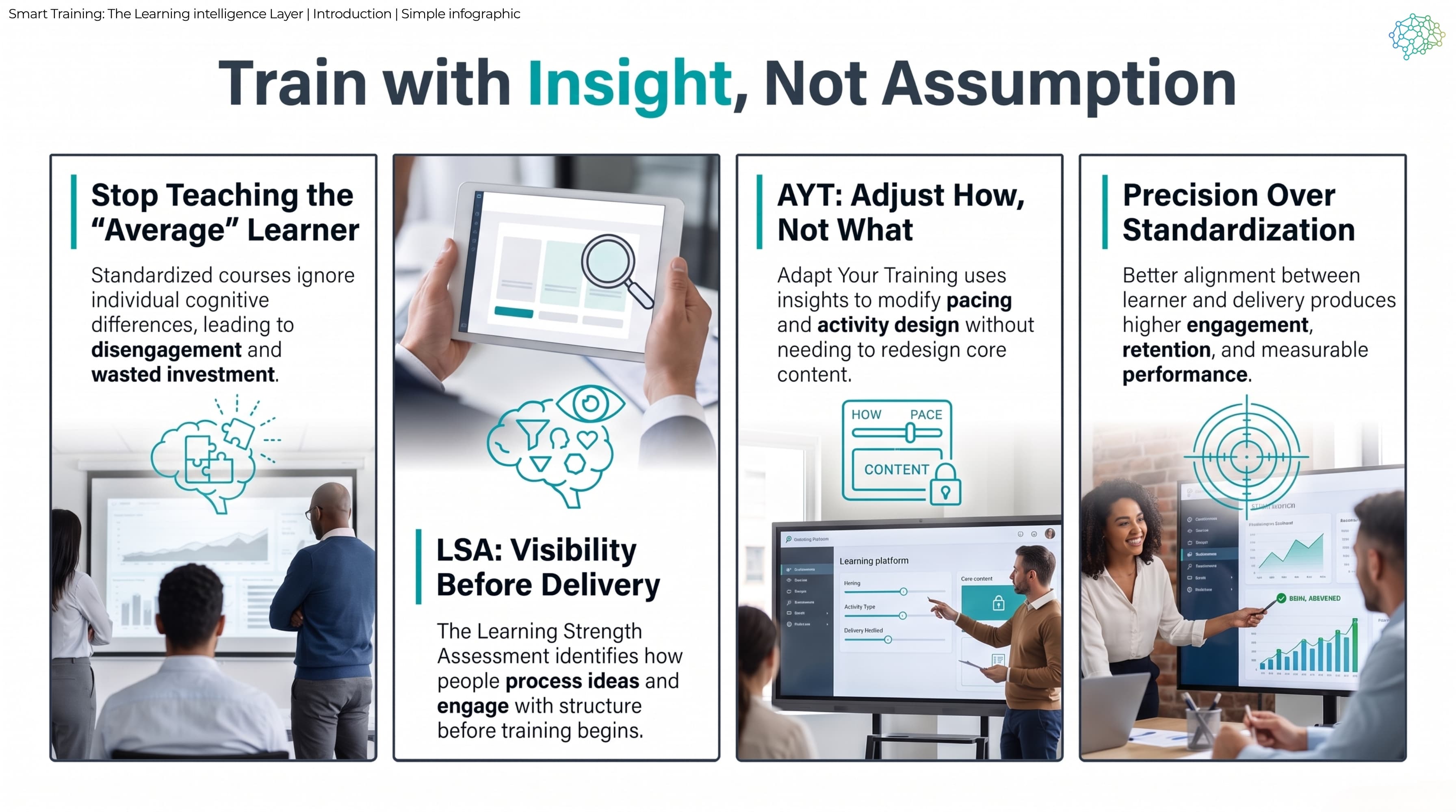
Train with Insight, Not Assumption
Four-panel infographic: stop teaching the average learner; LSA gives visibility before delivery; AYT adjusts how, not what, by changing pace and activity; better alignment produces higher engagement and retention.
The Training Intelligence Journey
Detailed infographic: the learning problem of teaching the average, the intelligence layer of assessing with LSA and adapting with AYT, and a model comparison. The traditional model is based on assumptions, focused on content and measures completion; training intelligence is based on evidence, focused on alignment and measures capability.

How the ideas connect

Every idea in the Introduction on one page. Look at it before you read to see the shape of the argument, or afterwards as a recap.
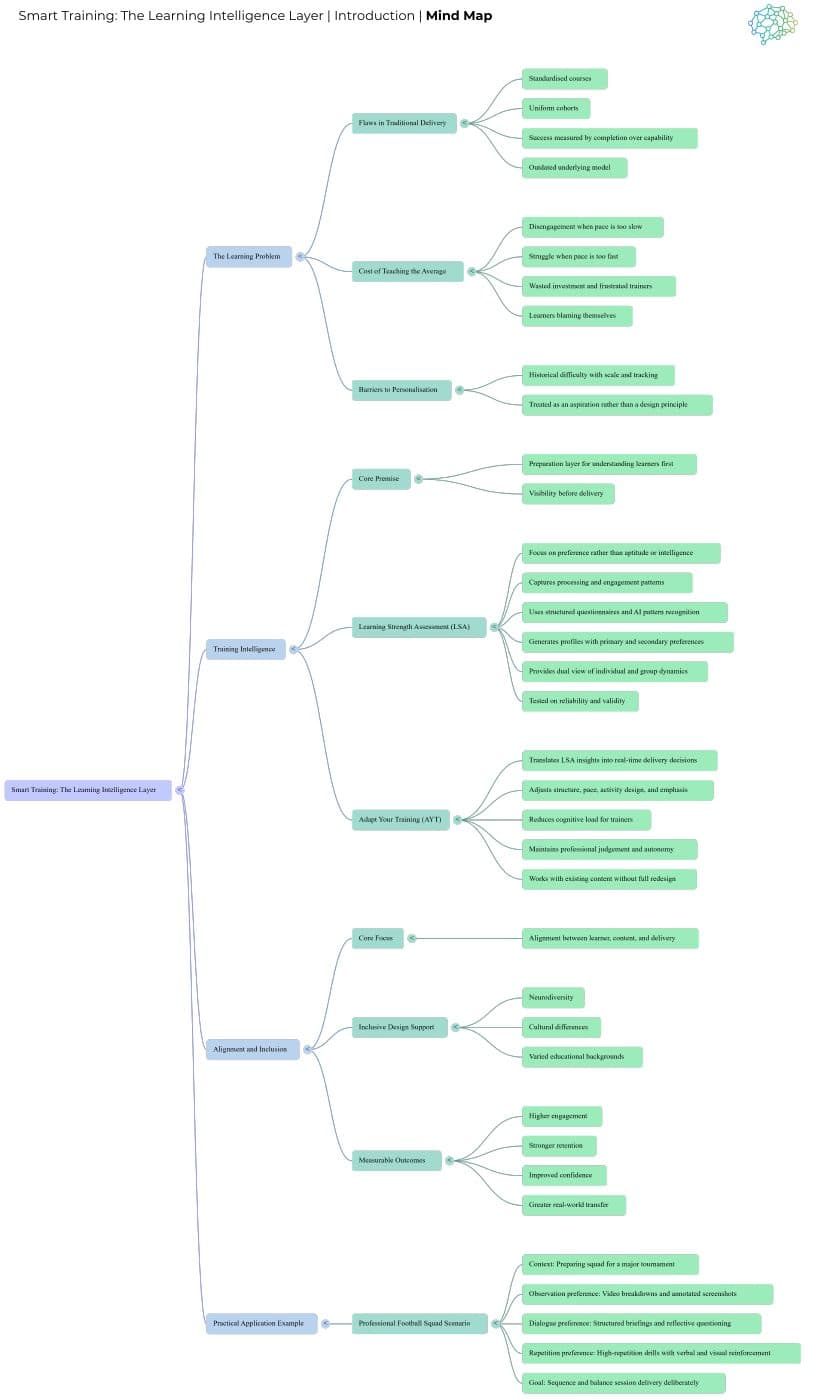
Mind map of the Introduction.

Put it into practice

Short activities to run with a group or work through on your own. Each one has a printable card.

With a group (3)

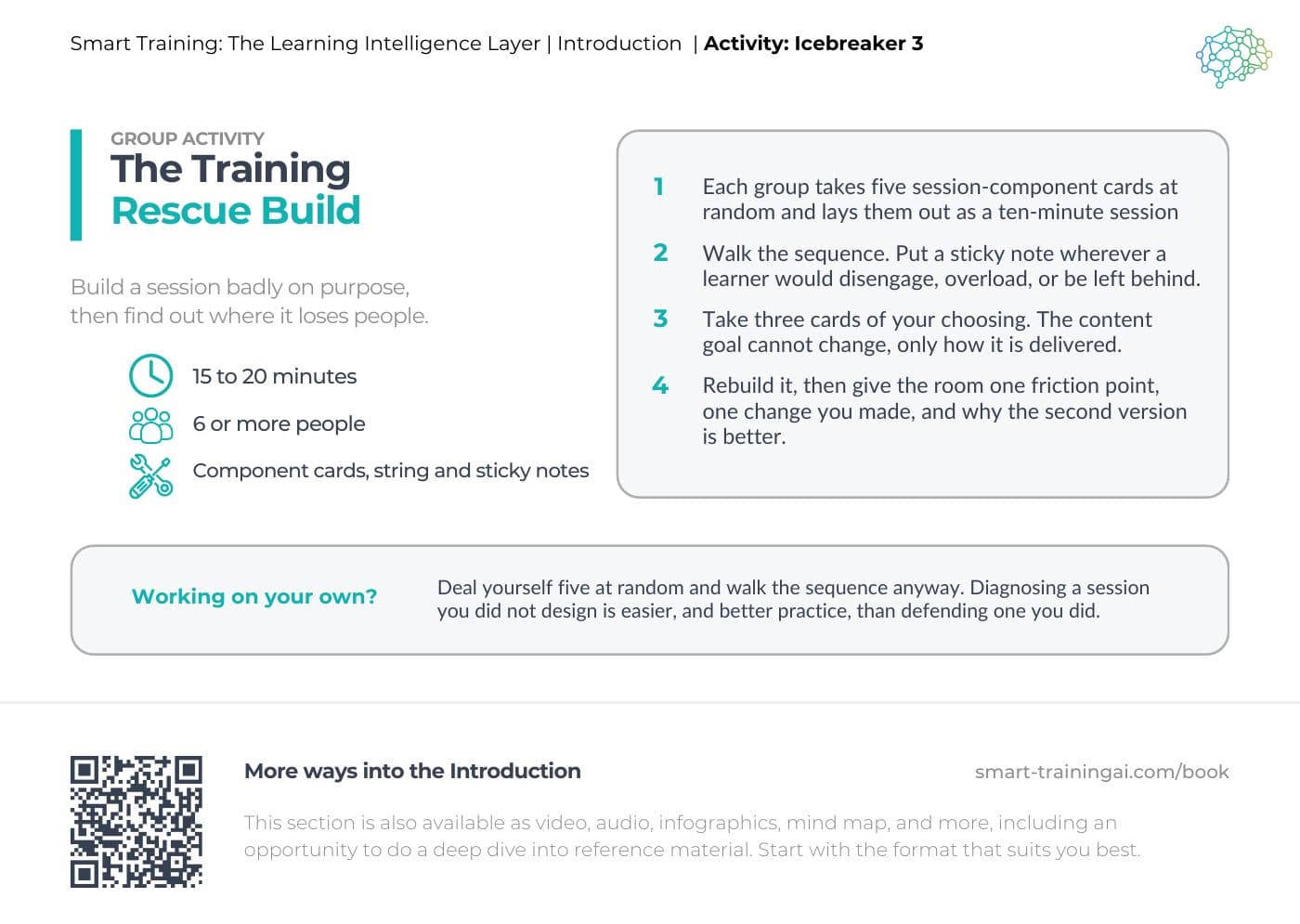
  • Printable card for Same Lesson, Different Routes
    Time
    15 to 25 minutes
    Who
    6 or more people
    You will need
    Sticky notes and pens

    Icebreaker

    Same Lesson, Different Routes

    One task, one room, and no two people will explain it the same way.

    1. Everyone takes the same question: how would you teach a new team member to do one important task?
    2. Choose privately how you will answer. Draw it, talk it through, write the steps, act it out, or start from a real example.
    3. Four minutes to make your version, then show it in pairs or threes and say why you chose that route.
    4. As a room: which versions were easy to follow, which were not, and what does that say about teaching a group one way?

    Working on your own? Answer in your natural way, then answer again using the route that feels most awkward. The second version is how some of your learners receive everything.

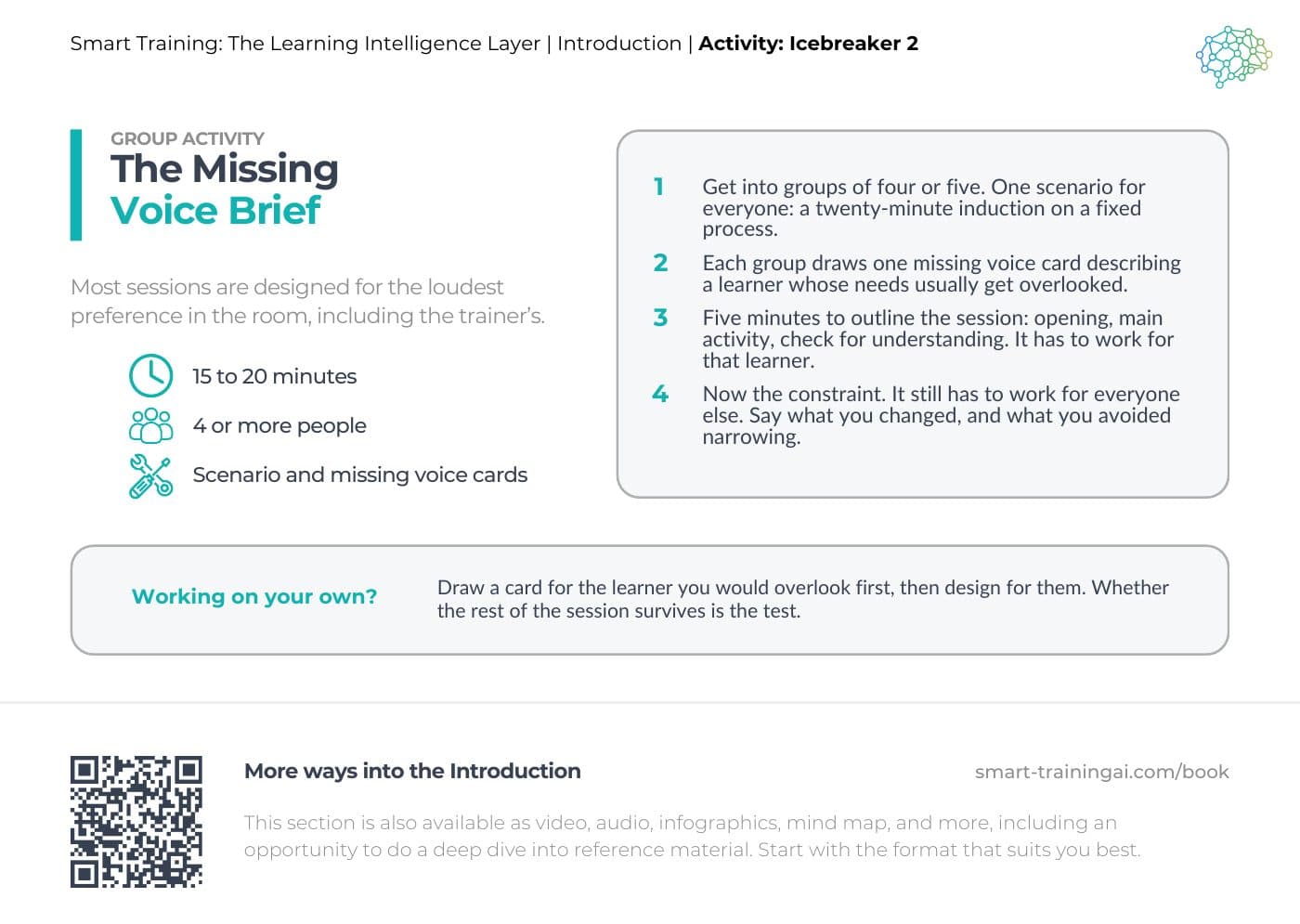
  • Printable card for The Missing Voice Brief
    Time
    15 to 20 minutes
    Who
    4 or more people
    You will need
    Scenario and missing voice cards

    Icebreaker

    The Missing Voice Brief

    Most sessions are designed for the loudest preference in the room, including the trainer’s.

    1. Get into groups of four or five. One scenario for everyone: a twenty-minute induction on a fixed process.
    2. Each group draws one missing voice card describing a learner whose needs usually get overlooked.
    3. Five minutes to outline the session: opening, main activity, check for understanding. It has to work for that learner.
    4. Now the constraint. It still has to work for everyone else. Say what you changed, and what you avoided narrowing.

    Working on your own? Draw a card for the learner you would overlook first, then design for them. Whether the rest of the session survives is the test.

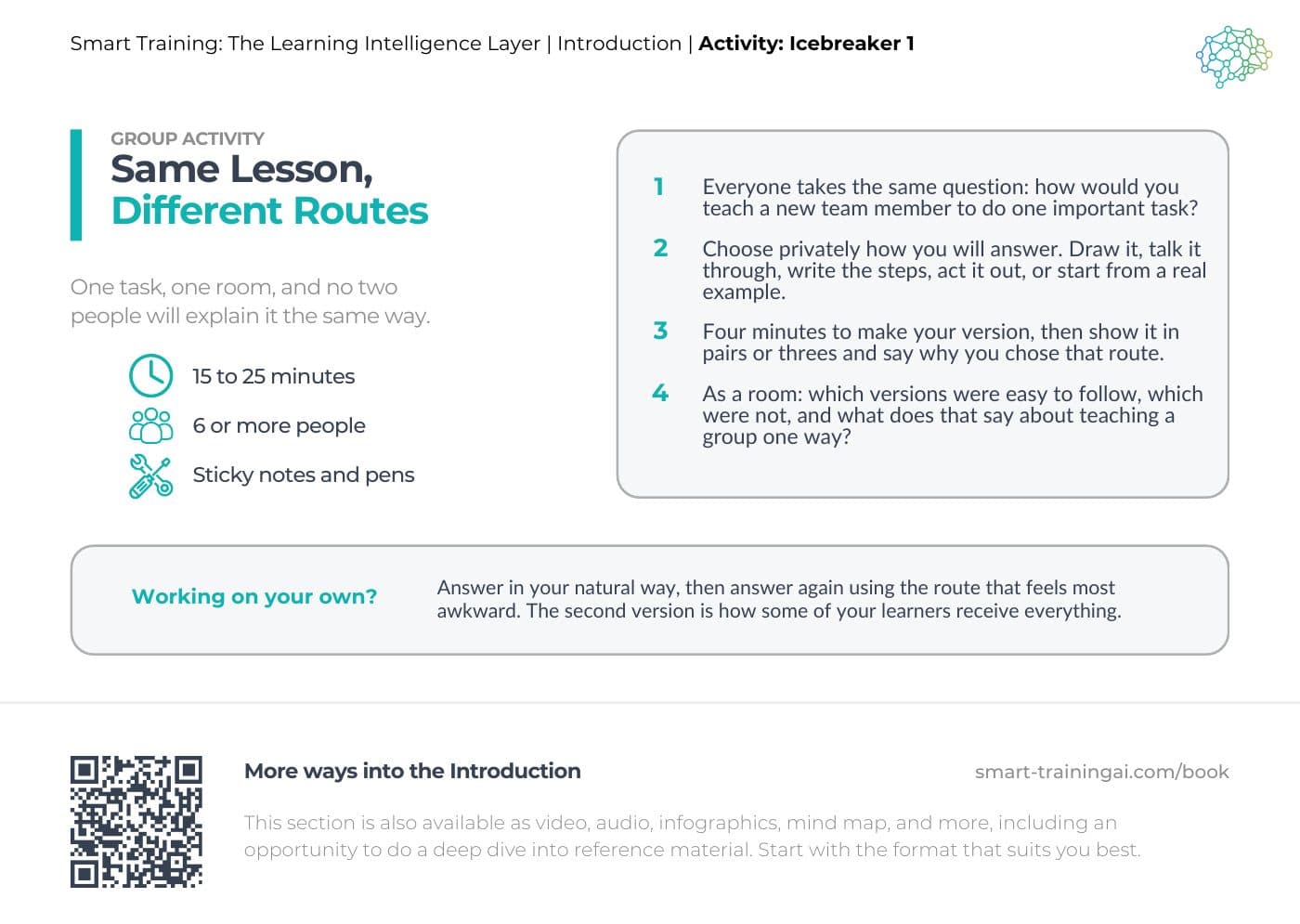
  • Printable card for The Training Rescue Build
    Time
    15 to 20 minutes
    Who
    6 or more people
    You will need
    Component cards, string and sticky notes

    Icebreaker

    The Training Rescue Build

    Build a session badly on purpose, then find out where it loses people.

    1. Each group takes five session-component cards at random and lays them out as a ten-minute session.
    2. Walk the sequence. Put a sticky note wherever a learner would disengage, overload, or be left behind.
    3. Take three cards of your choosing. The content goal cannot change, only how it is delivered.
    4. Rebuild it, then give the room one friction point, one change you made, and why the second version is better.

    Working on your own? Deal yourself five at random and walk the sequence anyway. Diagnosing a session you did not design is easier, and better practice, than defending one you did.

On your own (3)

  • Printable card for Teaching the Average Learner
    Time
    15 to 20 minutes
    Who
    On your own
    You will need
    Notebook or journal and pen

    Journaling

    Teaching the Average Learner

    A course can look successful and still leave most of the room behind.

    1. Write what traditional training assumes about learners, and why designing for the average fails.
    2. Say what poor alignment costs: disengagement, pace, completion standing in for capability.
    3. Explain how the Learning Strength Assessment and Adapt Your Training work together, and what still belongs to trainer judgement.
    4. Describe a session you sat through that was built for an average learner. What was the sign of mismatch, and what would you have changed?

    Working with a group? Write first, then compare only the signs of mismatch people noticed. Trainers and learners tend to spot entirely different ones.

  • Printable card for Fix the Training Design Problem
    Time
    25 to 35 minutes
    Who
    On your own
    You will need
    Paper and pen

    Problem solving

    Fix the Training Design Problem

    One session, one pace, one way in. Half the room lost, half of it bored.

    1. Name the assumption. What did the trainer believe about the group before walking in?
    2. Trace the impact. Why did the pace split the room, and why is completion a weak measure of success?
    3. Recommend three changes to how the session is delivered, with the content left as it is.
    4. In one paragraph, say which idea from the Introduction a trainer most needs to hold on to.

    Working with a group? Have everyone write their three changes alone, then pool them. The ones nobody else thought of are usually the ones worth testing.

  • Printable card for Standardised Training or Adaptive Training
    Time
    30 to 40 minutes
    Who
    On your own
    You will need
    Paper and pen

    Worksheet

    Standardised Training or Adaptive Training

    Two models, same room. They disagree about what a trainer needs to know.

    1. Read Approach A. Training is built once and delivered the same way to everyone. It is designed around the average participant, optimised for consistency and coverage, and judged by attendance and completion. Learner difference is treated as noise rather than information.
    2. Read Approach B. The same core content is prepared, but LSA gives the trainer insight into how the group is likely to process and engage, and AYT turns that into decisions about pace, structure and emphasis. What is taught stays the same. How it is delivered does not.
    3. Compare them: what each model assumes about the learner; where the trainer puts their attention; what changes in the way content is delivered; what gets counted as success.
    4. Critique both. Where does standardisation still earn its place? What does designing for the average cost? What does learner insight let a trainer decide? hat goes wrong if preferences are treated as fixed?
    5. Make a judgement. Which model is more likely to improve real learning outcomes, and why? Use evidence from the Introduction rather than opinion alone. Finish the sentence: The claim I would most want to test further is…
Smart Training AI logo

Empowering trainers to boost engagement and results through targeted, adaptive learning

© 2025 Smart Training AI™ All rights reserved.