Visibility before delivery

A companion to the Preface of the book. The same ideas in several forms: film, conversation, 2 infographics, a mind map and 6 activities. Start with whichever suits you.
The Preface in two minutes

Most training is planned without knowing who will be in the room. Learners are treated as one uniform group, and the gap between what is taught and how it is received goes unseen until the session is already under way.

That habit comes from an industrial, factory model built for conformity rather than growth. It survives in corporate learning because it scales, not because the evidence supports it.

The Preface introduces a different starting point: a preparation layer. A seven-minute Learning Strength Assessment shows each learner's primary and secondary preferences before delivery, and Adapt Your Training turns that picture of the group into practical decisions about how to teach it.

Knowledge gain

40.9%

Adaptive training

21.2%

Conventional training

Comparison of learning outcomes between AI-supported adaptive training and conventional methods.

Watch or listen

Prefer to take it in by eye or by ear? Both cover the core ideas of the Preface in a few minutes.

Film, 1 min

How the preparation layer works

Why the same slide deck lands differently with every group, and what changes when the trainer can see the room before walking into it. Captions are built in.

Conversation, 4 min

How personalised training doubles results

A short conversation about the ideas in the Preface. Good for the commute, or before you start reading.

0:000:00

The Preface at a glance

A quick overview, then the full argument with the evidence. Select either one to see it full size.

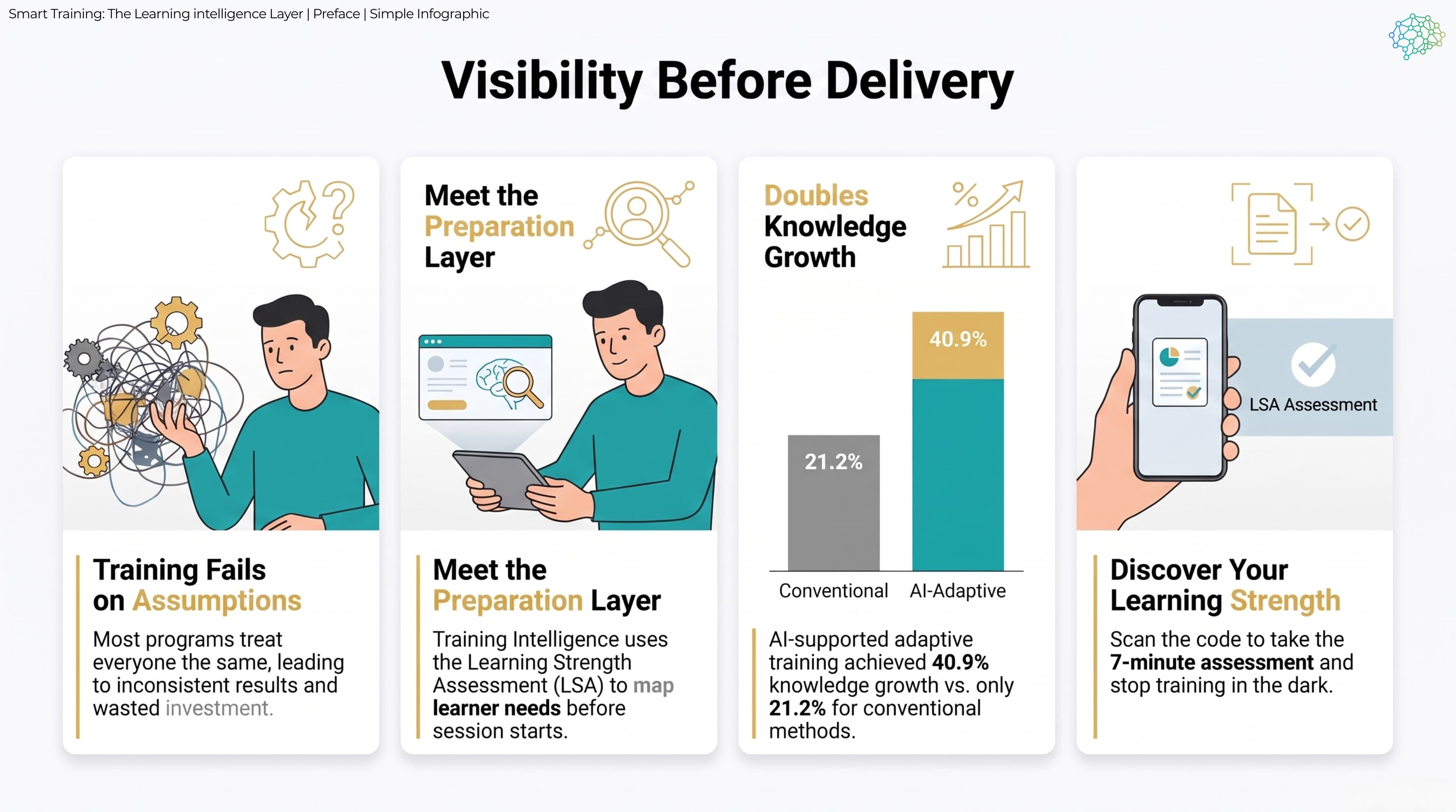
Visibility Before Delivery
Four-panel infographic: training fails on assumptions; meet the preparation layer; adaptive training doubles knowledge growth, 40.9 against 21.2; discover your learning strength.
The Training Intelligence Revolution
Detailed infographic: the industrial model failure and the alignment gap, the preparation layer as the solution, and a comparison of 40.9% knowledge gain with adaptive training against 21.2% with conventional training.

How the ideas connect

Every idea in the Preface on one page. Look at it before you read to see the shape of the argument, or afterwards as a recap.
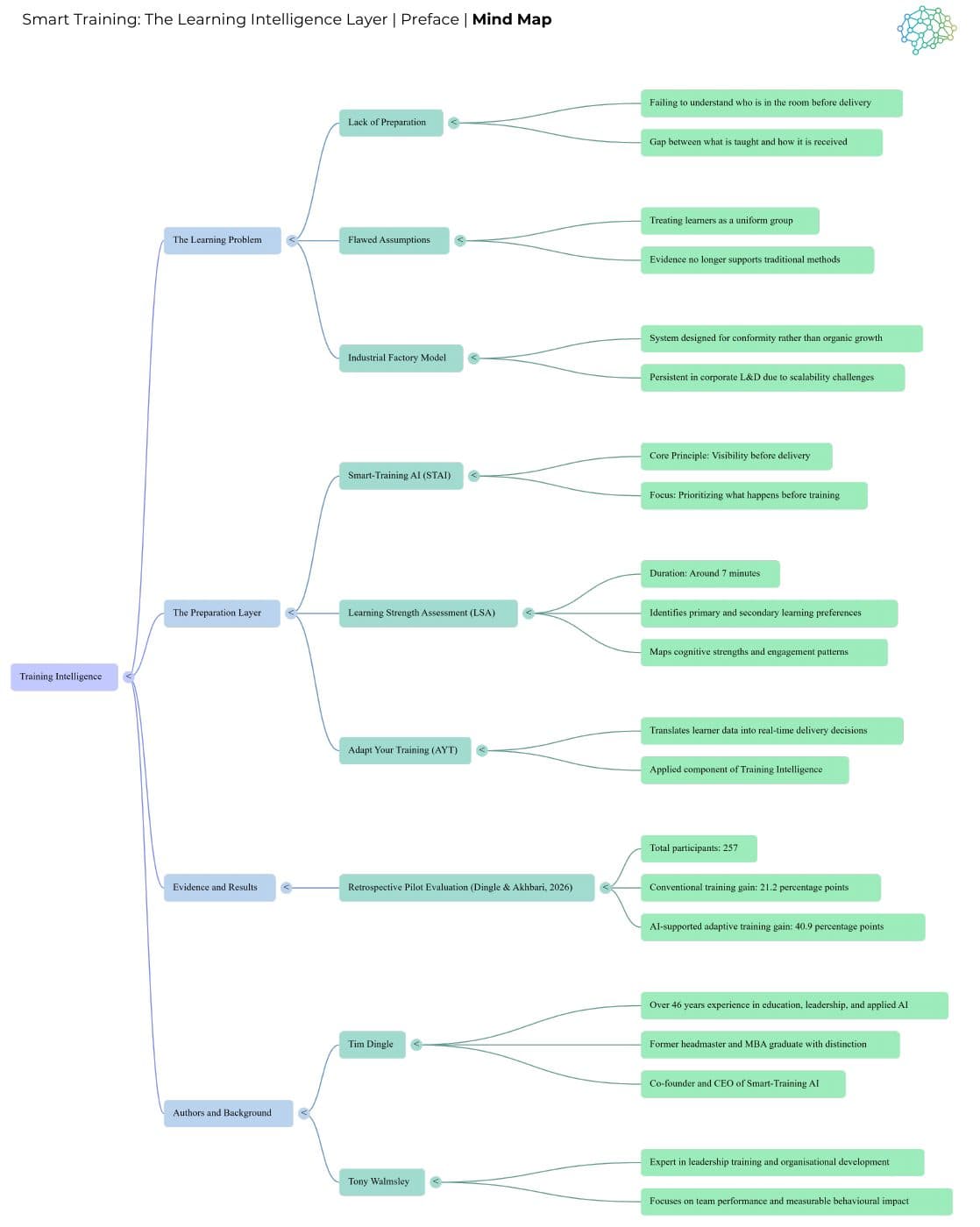
Mind map of the Preface.

Put it into practice

Short activities to run with a group or work through on your own. Each one has a printable card.

With a group (3)

  • Printable card for Learning Strengths Gallery Walk
    Time
    10 to 15 minutes
    Who
    6 or more people
    You will need
    Cards and pens

    Icebreaker

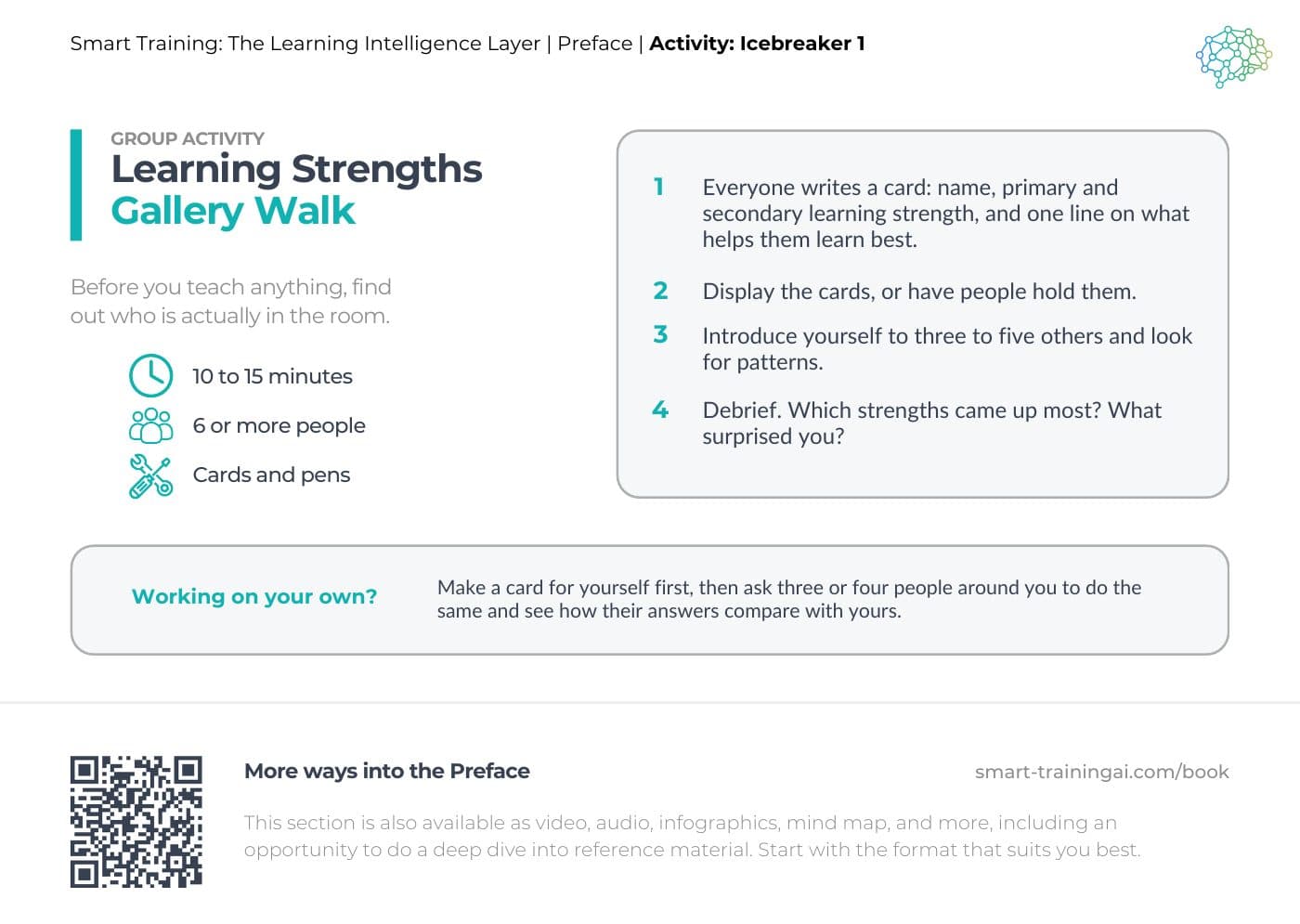
    Learning Strengths Gallery Walk

    Before you teach anything, find out who is actually in the room.

    1. Everyone writes a card: name, primary and secondary learning strength, and one line on what helps them learn best.
    2. Display the cards, or have people hold them.
    3. Introduce yourself to three to five others and look for patterns.
    4. Debrief. Which strengths came up most? What surprised you?

    Working on your own? Make a card for yourself first, then ask three or four people around you to do the same and see how their answers compare with yours.

  • Printable card for One Message, Many Minds
    Time
    15 to 20 minutes
    Who
    6 or more people
    You will need
    Printed message in four formats

    Icebreaker

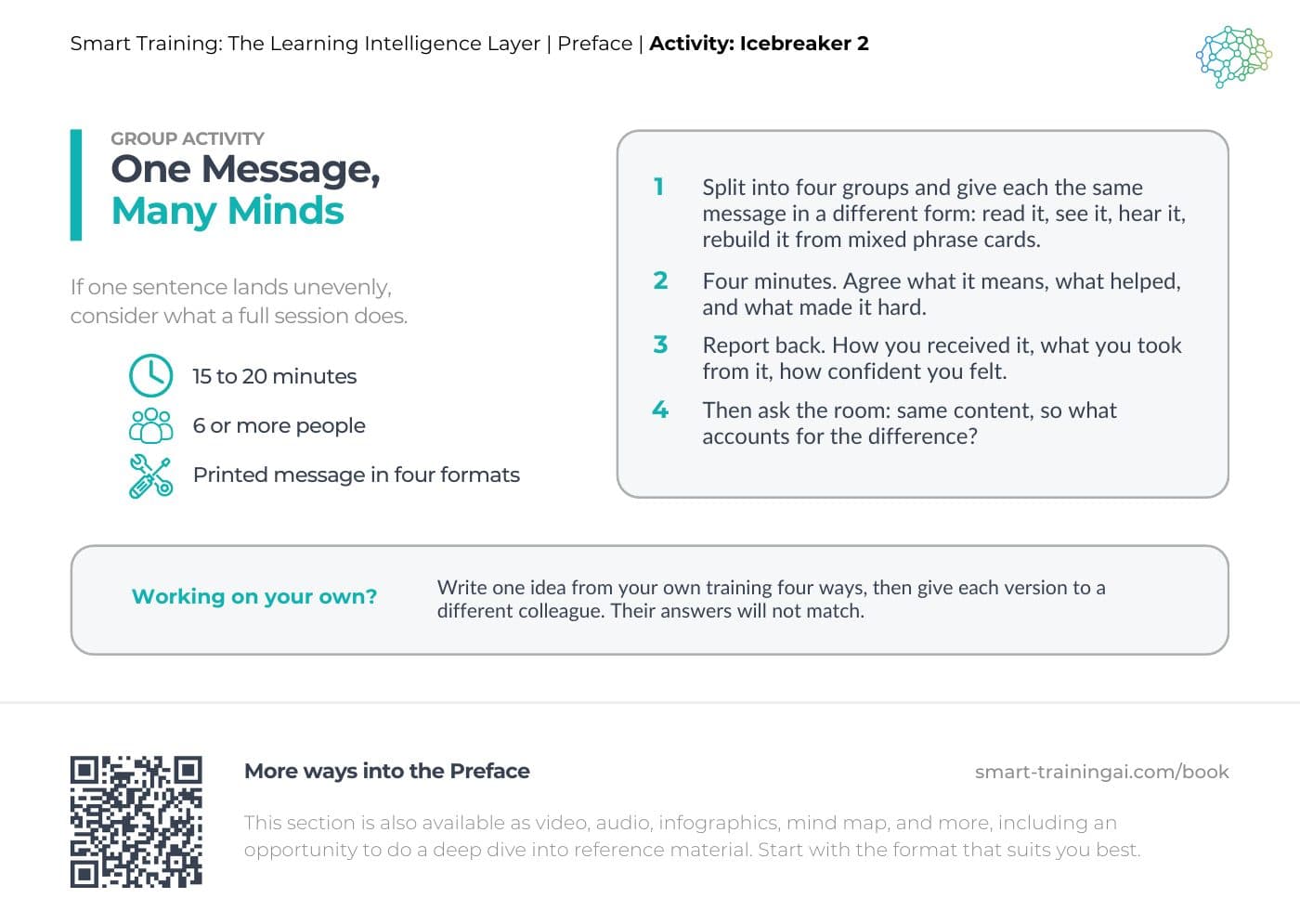
    One Message, Many Minds

    If one sentence lands unevenly, consider what a full session does.

    1. Split into four groups and give each the same message in a different form: read it, see it, hear it, rebuild it from mixed phrase cards.
    2. Four minutes. Agree what it means, what helped, and what made it hard.
    3. Report back. How you received it, what you took from it, how confident you felt.
    4. Then ask the room: same content, so what accounts for the difference?

    Working on your own? Write one idea from your own training four ways, then give each version to a different colleague. Their answers will not match.

  • Printable card for Build the Ideal Learning Room
    Time
    15 to 20 minutes
    Who
    Groups of 3 to 5
    You will need
    Sticky notes and markers

    Icebreaker

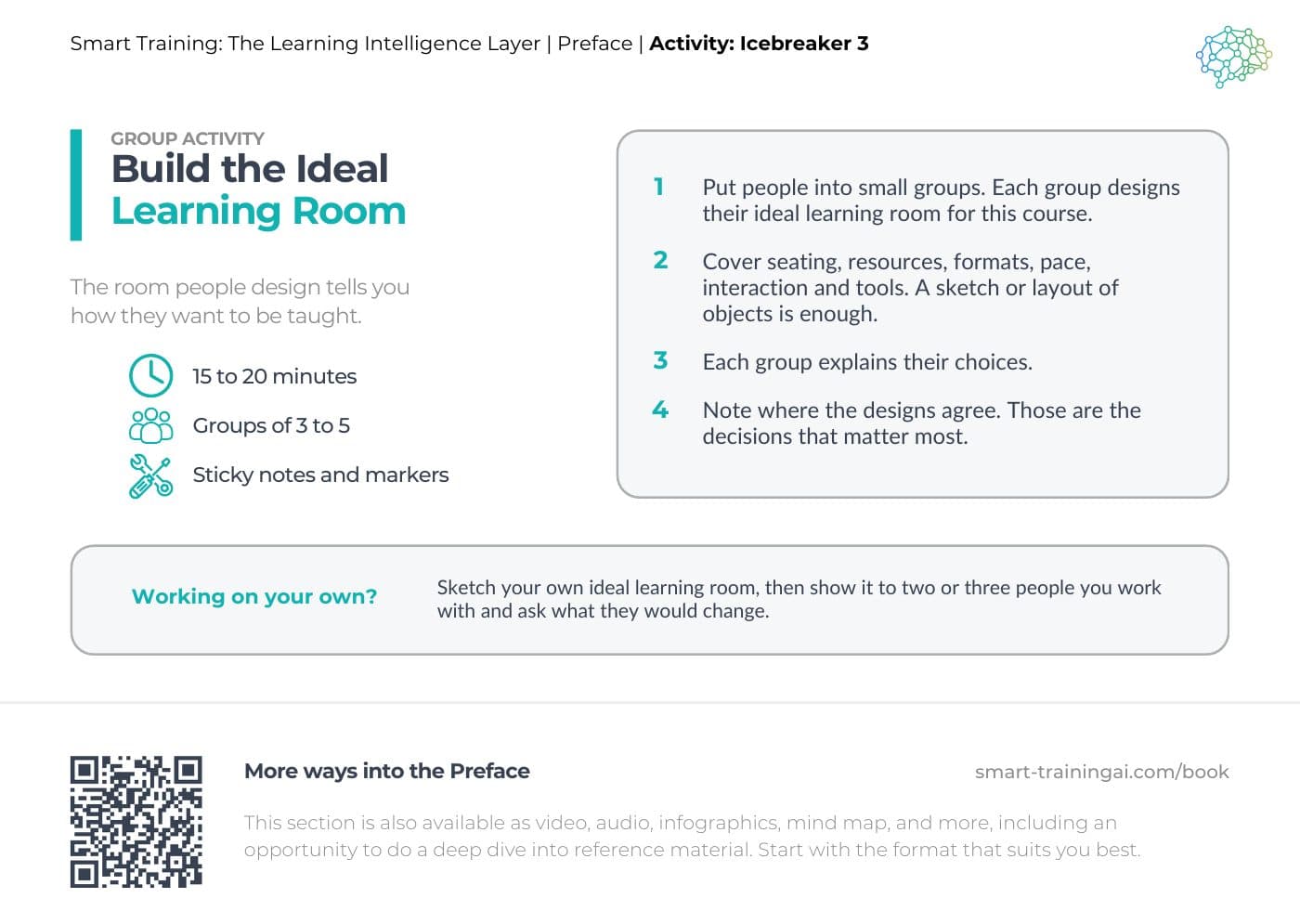
    Build the Ideal Learning Room

    The room people design tells you how they want to be taught.

    1. Put people into small groups. Each group designs their ideal learning room for this course.
    2. Cover seating, resources, formats, pace, interaction and tools. A sketch or layout of objects is enough.
    3. Each group explains their choices.
    4. Note where the designs agree. Those are the decisions that matter most.

    Working on your own? Sketch your own ideal learning room, then show it to two or three people you work with and ask what they would change.

On your own (3)

  • Printable card for From Assumption to Insight
    Time
    20 to 25 minutes
    Who
    On your own
    You will need
    Notebook or journal and pen

    Journaling

    From Assumption to Insight

    Training has never been short of content. The shortage sits earlier than that.

    1. Write why training can fail when the trainer is knowledgeable, well prepared and well intentioned.
    2. Explain what the preparation layer is, and what the Learning Strength Assessment and Adapt Your Training are each for.
    3. Say what visibility before delivery means to you, now you have read it.
    4. Finish: if I were planning a session after this, here is what I would do before it starts, and the questions I would ask about the learners.

    Working with a group? Write first, then collect only the questions people would ask about their learners. That list is the preparation layer, written by the room.

  • Printable card for Why Did the Training Fail
    Time
    25 to 30 minutes
    Who
    On your own
    You will need
    Paper and pen

    Problem solving

    Why Did the Training Fail

    Good trainer, clear slides, full coverage, on time. Eighteen people, mixed results.

    1. Say what the real problem is, and why the content being fine does not settle it.
    2. Give four causes of the uneven outcomes, each tied to an assumption the trainer made.
    3. Say what the Learning Strength Assessment could have shown beforehand, and what Adapt Your Training would have changed in the room.
    4. Plan the next session in three parts: before, during, after. Name the evidence that would show it worked.

    Working with a group? Rank the three failures: poor delivery, poor preparation, poor understanding of the learners. Defend the order. Most groups split on first place.

  • Printable card for Two Ways to Run the Same Session
    Time
    25 to 35 minutes
    Who
    On your own
    You will need
    Paper and pen

    Worksheet

    Two Ways to Run the Same Session

    Same content, same trainer, same hour. The difference is what the trainer knew before walking in.

    1. Read Approach A. The same content is delivered the same way to the whole group. The slides, materials and timing are well prepared. Little is known about the learners beforehand. The assumption is that clear content produces learning.
    2. Read Approach B. The same core content is prepared, but the trainer first gathers insight into how the group is likely to process and engage. Delivery is shaped around that, and adjusted in the room rather than fixed in advance.
    3. Compare them: how each approach views the learner; what preparation happens before delivery; how much the session can flex; who does well, and who gets missed.
    4. Critique both. Where would this still work reasonably well? Why can strong content still fail? What does learner insight change? What would an organisation need to do it well?
    5. Make a judgement. Which approach is more convincing, and why? Give one strength and one weakness of each before you decide. Finish the sentence: The most important idea from this comparison is…
Smart Training AI logo

Empowering trainers to boost engagement and results through targeted, adaptive learning

© 2025 Smart Training AI™ All rights reserved.